第2章生命の化学的基盤
The Periodic Table周期表
The periodic table organizes and displays different elements. Devised by Russian chemist Dmitri Mendeleev (1834–1907) in 1869, the table groups elements that, although unique, share certain chemical properties with other elements. The properties of elements are responsible for their physical state at room temperature: they may be gases, solids, or liquids. Elements also have specific chemical reactivity, the ability to combine and to chemically bond with each other.
英語のヒント
周期表は、さまざまな元素を整理して示したものである。ロシアの化学者ドミトリ・メンデレーエフ(1834〜1907年)が1869年に考案したこの表は、固有の性質をもちながら、いくつかの化学的性質をほかの元素と共有する元素をまとめている。元素の性質は、室温で気体、固体、液体のどの状態をとるかを決める。また、元素には、互いに結びついて化学結合をつくる能力である、特定の化学反応性がある。
In the periodic table in Figure 2.5, the elements are organized and displayed according to their atomic number and are arranged in a series of rows and columns based on shared chemical and physical properties. In addition to providing the atomic number for each element, the periodic table also displays the element’s atomic mass. Looking at carbon, for example, its symbol (C) and name appear, as well as its atomic number of six (in the upper left-hand corner) and its atomic mass of 12.01.
英語のヒント
図2.5の周期表では、元素を原子番号に従って整理して示し、共通の化学的・物理的性質に基づいて、行と列に配置している。周期表には、各元素の原子番号だけでなく、原子の質量も示される。例えば炭素を見ると、記号(C)と名称に加え、原子番号6(左上)と原子の質量12.01が記されている。
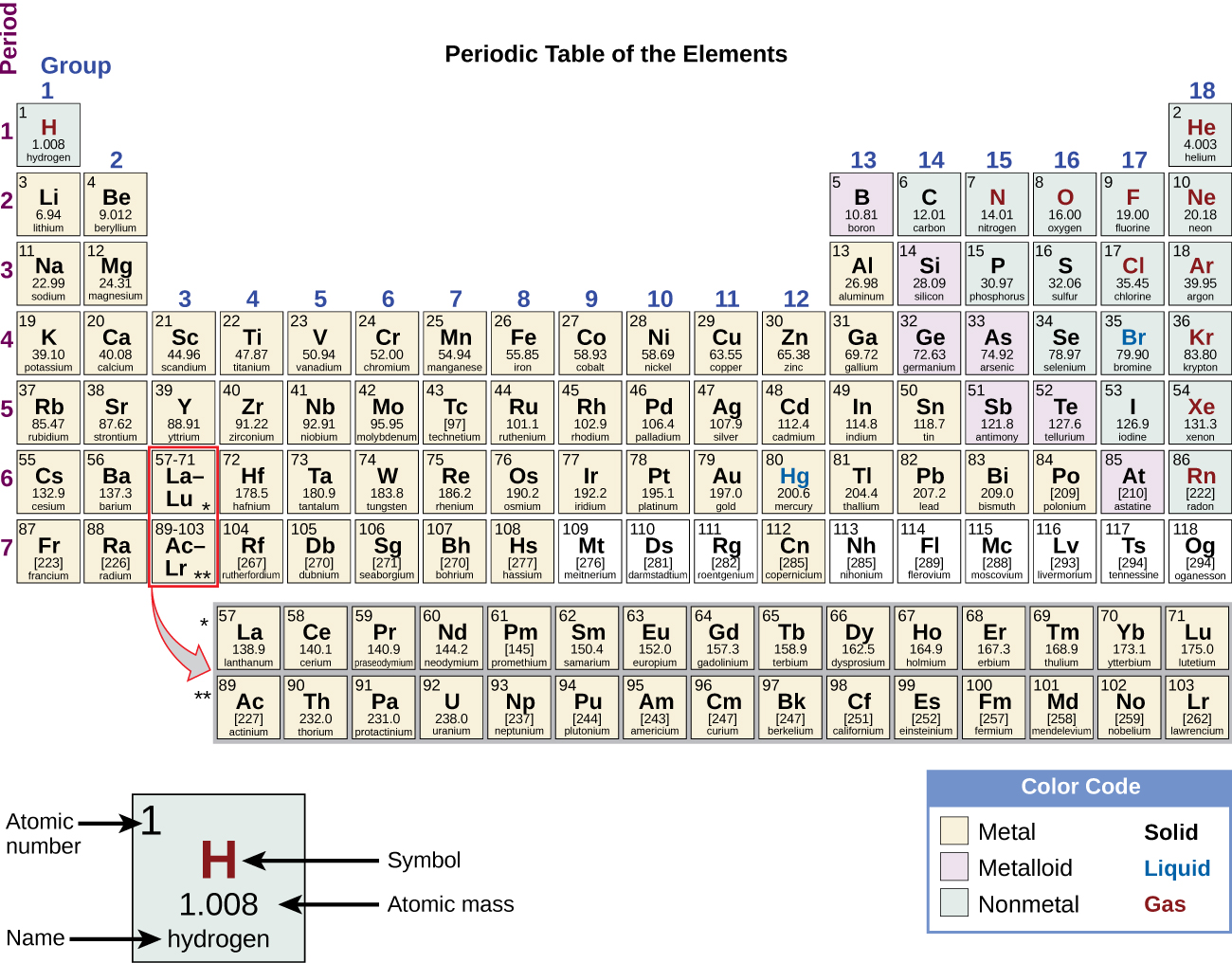
Figure 2.5図 2.5
The periodic table shows each element's atomic mass and atomic number. The atomic number appears above the symbol for the element and the approximate atomic mass appears below it.
周期表は、各元素の原子の質量と原子番号を示す。原子番号は元素記号の上に、原子の質量の概数は下に表示される。
The periodic table groups elements according to chemical properties. Scientists base the differences in chemical reactivity between the elements on the number and spatial distribution of an atom’s electrons. Atoms that chemically react and bond to each other form molecules. Molecules are simply two or more atoms chemically bonded together. Logically, when two atoms chemically bond to form a molecule, their electrons, which form the outermost region of each atom, come together first as the atoms form a chemical bond.
英語のヒント
周期表は、化学的性質に従って元素をまとめている。科学者は、元素間の化学反応性の違いが、原子の電子の数と空間的な分布に基づくと考えている。原子が化学的に反応して互いに結びつくと、分子ができる。分子は、二つ以上の原子が化学結合したものにすぎない。論理的に考えると、二つの原子が化学結合して分子をつくるときには、各原子の最も外側の領域をつくる電子が、まず互いに近づくことになる。
Electron Shells and the Bohr Model電子殻とボーア模型
Note that there is a connection between the number of protons in an element, the atomic number that distinguishes one element from another, and the number of electrons it has. In all electrically neutral atoms, the number of electrons is the same as the number of protons. Thus, each element, at least when electrically neutral, has a characteristic number of electrons equal to its atomic number.
英語のヒント
元素の陽子の数、元素同士を区別する原子番号、電子の数は、互いに関連していることに注意しよう。電気的に中性なすべての原子では、電子の数と陽子の数が等しい。したがって、少なくとも電気的に中性であるとき、各元素は原子番号に等しい、その元素に固有の数の電子をもつ。
In 1913, Danish scientist Niels Bohr (1885–1962) developed an early model of the atom. The Bohr model shows the atom as a central nucleus containing protons and neutrons, with the electrons in electron shells or energy levels at specific distances from the nucleus, as Figure 2.6 illustrates. These energy levels are designated by a number and the symbol “n.” For example, 1n represents the first energy level located closest to the nucleus.
英語のヒント
1913年、デンマークの科学者ニールス・ボーア(1885〜1962年)は、初期の原子模型を発展させた。図2.6に示すように、ボーア模型では、中心に陽子と中性子を含む原子核があり、電子は原子核から決まった距離にある電子殻、すなわちエネルギー準位に存在する。これらのエネルギー準位は、数字と記号「n」で示す。例えば、1nは原子核に最も近い第一のエネルギー準位を表す。
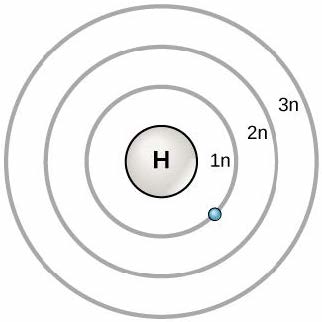


Figure 2.6図 2.6
In 1913, Niels Bohrs developed the Bohr model in which electrons exist within principal shells. An electron normally exists in the lowest energy shell available, which is the one closest to the nucleus. Energy from a photon of light can bump it up to a higher energy shell, but this situation is unstable, and the electron quickly decays back to the ground state. In the process, it releases a photon of light.
英語のヒント
1913年、ニールス・ボーアは、電子が主殻の中に存在するボーア模型を発展させた。電子は通常、入ることができる最も低いエネルギーの殻、すなわち原子核に最も近い殻に存在する。光の光子から得たエネルギーは、電子をより高いエネルギーの殻へ押し上げることがある。しかし、この状態は不安定であり、電子はすぐに基底状態へ戻る。その過程で、光の光子を放出する。
Electrons fill orbitals in a consistent order: they first fill the orbitals closest to the nucleus, then they continue to fill orbitals of increasing energy further from the nucleus. If there are multiple orbitals of equal energy, they fill with one electron in each energy level before adding a second electron. The electrons of the outermost energy level determine the atom's energetic stability and its tendency to form chemical bonds with other atoms to form molecules.
英語のヒント
電子は一定の順序で軌道を満たす。最初に原子核に最も近い軌道を満たし、その後、原子核から遠く、エネルギーの高い軌道を順に満たす。同じエネルギーの軌道が複数あるときは、二個目を入れる前に、各エネルギー準位へ一個ずつ電子を入れる。最外のエネルギー準位の電子が、原子のエネルギー的な安定性と、ほかの原子と化学結合して分子をつくる傾向を決める。
Under standard conditions, atoms fill the inner shells first, often resulting in a variable number of electrons in the outermost shell. The innermost shell has a maximum of two valence electrons but the next two electron shells can each have eight valence electrons. This is known as the octet rule, which states, with the exception of the innermost shell, that atoms are more stable energetically when they have eight electrons in their valence shell, the outermost electron shell. Figure 2.7 shows examples of some neutral atoms and their electron configurations. Notice that in Figure 2.7, helium has a complete outer electron shell, with two electrons filling its first and only shell. Similarly, neon has a complete outer 2n shell containing eight electrons. In contrast, chlorine and sodium have seven and one in their outer shells, respectively, but theoretically they would be more energetically stable if they followed the octet rule and had eight valence electrons.
英語のヒント
標準的な条件では、原子は内側の殻から電子を満たすため、最外殻の電子の数は変わりうる。最内殻には最大二個の価電子が入るが、次の二つの電子殻には、それぞれ八個の価電子が入る。これはオクテット則として知られ、最内殻を除いて、価電子殻、すなわち最も外側の電子殻に八個の電子があると、原子はエネルギー的により安定するという規則である。図2.7は、いくつかの中性原子とその電子配置の例を示す。図2.7では、ヘリウムの最外電子殻は完全に満たされており、最初の、そして唯一の殻に二個の電子がある。同様に、ネオンも外側の2n殻に八個の電子を含み、この殻が完全に満たされている。これに対し、塩素とナトリウムの最外殻の電子は、それぞれ七個と一個である。しかし理論上は、オクテット則に従って価電子を八個もてば、エネルギー的により安定する。
Understanding that the periodic table's organization is based on the total number of protons (and electrons) helps us know how electrons distribute themselves among the shells. The periodic table is arranged in columns and rows based on the number of electrons and their location. Examine more closely some of the elements in the table’s far right column in Figure 2.5. The group 18 atoms helium (He), neon (Ne), and argon (Ar) all have filled outer electron shells, making it unnecessary for them to share electrons with other atoms to attain stability. They are highly stable as single atoms. Because they are non reactive, scientists coin them inert (or noble gases). Compare this to the group 1 elements in the left-hand column. These elements, including hydrogen (H), lithium (Li), and sodium (Na), all have one electron in their outermost shells. That means that they can achieve a stable configuration and a filled outer shell by donating or sharing one electron with another atom or a molecule such as water. Hydrogen will donate or share its electron to achieve this configuration, while lithium and sodium will donate their electron to become stable. As a result of losing a negatively charged electron, they become positively charged ions. Group 17 elements, including fluorine and chlorine, have seven electrons in their outmost shells, so they tend to fill this shell with an electron from other atoms or molecules, making them negatively charged ions. Group 14 elements, of which carbon is the most important to living systems, have four electrons in their outer shell allowing them to make several covalent bonds (discussed below) with other atoms. Thus, the periodic table's columns represent the potential shared state of these elements’ outer electron shells that is responsible for their similar chemical characteristics.
英語のヒント
周期表の配列が陽子(および電子)の総数に基づくことを理解すると、電子が各殻にどう分布するかが分かる。周期表は、電子の数と位置に基づいて行と列を配列している。図2.5の一番右の列にある元素のいくつかを、詳しく見てみよう。18族のヘリウム(He)、ネオン(Ne)、アルゴン(Ar)は、すべて最外電子殻が満たされており、安定性を得るためにほかの原子と電子を共有する必要がない。一個の原子として非常に安定している。反応しないため、科学者はそれらを不活性ガス、または希ガスと呼ぶ。これを、左端の列にある1族元素と比較してみよう。水素(H)、リチウム(Li)、ナトリウム(Na)を含むこれらの元素は、最外殻に一個の電子をもつ。つまり、ほかの原子や水などの分子に電子を一個与えたり、共有したりすれば、最外殻が満たされた安定な配置を得られる。水素はこの配置を得るために電子を与えるか共有し、リチウムとナトリウムは電子を与えて安定になる。負に帯電した電子を失う結果、正に帯電したイオンになる。フッ素と塩素を含む17族元素には、最外殻に七個の電子がある。そのため、ほかの原子や分子から電子を一個受け取ってこの殻を満たし、負に帯電したイオンになる傾向がある。14族元素のうち、生物の仕組みにとって最も重要なのは炭素である。14族元素は最外殻に四個の電子をもち、そのため、ほかの原子と複数の共有結合(後述)をつくれる。このように、周期表の各列は、その元素に共通する化学的特徴の原因となる、最外電子殻に共有される潜在的な状態を表している。