第2章生命の化学的基盤
Isomers異性体
The three-dimensional placement of atoms and chemical bonds within organic molecules is central to understanding their chemistry. We call molecules that share the same chemical formula but differ in the placement (structure) of their atoms and/or chemical bonds isomers. Structural isomers (like butane and isobutane in Figure 2.24a) differ in the placement of their covalent bonds: both molecules have four carbons and ten hydrogens (C4H10), but the different atom arrangement within the molecules leads to differences in their chemical properties. For example, butane is suited for use as a fuel for cigarette lighters and torches; whereas, isobutane is suited for use as a refrigerant and a propellant in spray cans.
英語のヒント
有機分子の化学を理解するうえで中心となるのが、分子内の原子と化学結合の三次元的な配置である。同じ化学式を持ちながら、原子や化学結合の配置(構造)が異なる分子を異性体という。構造異性体は、共有結合の配置が異なる。例えば図2.24aのブタンとイソブタンは、どちらも炭素四つと水素十個(C4H10)を持つが、分子内の原子の並びが異なるため、化学的性質も異なる。ブタンはライターやトーチの燃料に適しているのに対し、イソブタンは冷媒やスプレー缶の噴射剤に適している。
Geometric isomers, alternatively have similar placements of their covalent bonds but differ in how these bonds are made to the surrounding atoms, especially in carbon-to-carbon double bonds. In the simple molecule butene (C4H8), the two methyl groups (CH3) can be on either side of the double covalent bond central to the molecule, as Figure 2.24b illustrates. When the carbons are bound on the same side of the double bond, this is the cis configuration. If they are on opposite sides of the double bond, it is a trans configuration. In the trans configuration, the carbons form a more or less linear structure; whereas, the carbons in the cis configuration make a bend (change in direction) of the carbon backbone.
英語のヒント
一方、幾何異性体は共有結合の配置が似ているが、周囲の原子に対してその結合がどのように作られているかが異なる。特に炭素間二重結合でこの違いが生じる。単純な分子であるブテン(C4H8)では、図2.24bに示すように、二つのメチル基(CH3)は分子の中央の共有二重結合のどちらの側にも位置しうる。二つの炭素が二重結合の同じ側に結び付いている場合は、シス配置である。反対側にある場合は、トランス配置である。トランス配置では炭素はおおむね直線的な構造を作るが、シス配置では炭素骨格が曲がる、つまり向きが変わる。
In triglycerides (fats and oils), long carbon chains known as fatty acids may contain double bonds, which can be in either the cis or trans configuration, as Figure 2.25 illustrates. Fats with at least one double bond between carbon atoms are unsaturated fats. When some of these bonds are in the cis configuration, the resulting bend in the chain's carbon backbone means that triglyceride molecules cannot pack tightly, so they remain liquid (oil) at room temperature. Alternatively, triglycerides with trans double bonds (popularly called trans fats), have relatively linear fatty acids that are able to pack tightly together at room temperature and form solid fats. In the human diet, trans fats are linked to an increased risk of cardiovascular disease, so many food manufacturers have reduced or eliminated their use in recent years. In contrast to unsaturated fats, we call triglycerides without double bonds between carbon atoms saturated fats, meaning that they contain all the hydrogen atoms available. Saturated fats are a solid at room temperature and usually of animal origin.
英語のヒント
トリグリセリド(脂肪や油)では、脂肪酸と呼ばれる長い炭素鎖に二重結合が含まれることがある。図2.25に示すように、この二重結合はシス配置にもトランス配置にもなりうる。炭素間に少なくとも一つの二重結合がある脂肪を、不飽和脂肪という。二重結合の一部がシス配置であると、炭素鎖の骨格が曲がるため、トリグリセリド分子は密に詰まれず、室温で液体(油)のままでいる。一方、トランス型の二重結合を持つトリグリセリド(一般にトランス脂肪と呼ばれる)は、脂肪酸が比較的直線状で、室温でも密に詰まることができ、固体の脂肪になる。ヒトの食事では、トランス脂肪は心血管疾患のリスク増加と関連している。このため近年、多くの食品メーカーがその使用を減らしたり、やめたりしている。不飽和脂肪とは対照的に、炭素間に二重結合のないトリグリセリドを飽和脂肪という。これは、結合可能な水素原子をすべて含むという意味である。飽和脂肪は室温で固体であり、通常は動物由来である。
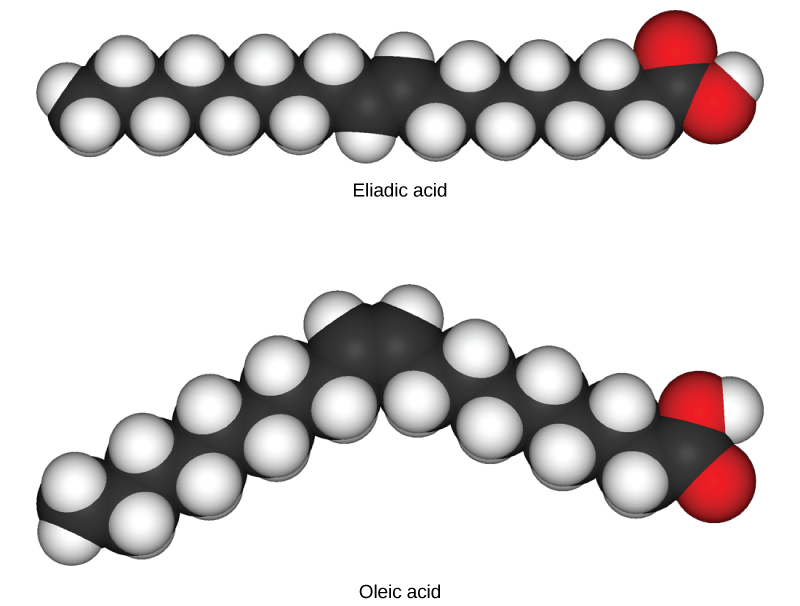

Figure 2.25図 2.25
These space-filling models show a cis (oleic acid) and a trans (eliadic acid) fatty acid. Notice the bend in the molecule caused by the cis configuration.
これらの空間充填模型は、シス型の脂肪酸(オレイン酸)とトランス型の脂肪酸(エライジン酸)を示している。シス配置によって分子に曲がりが生じていることに注目しよう。
Enantiomers鏡像異性体
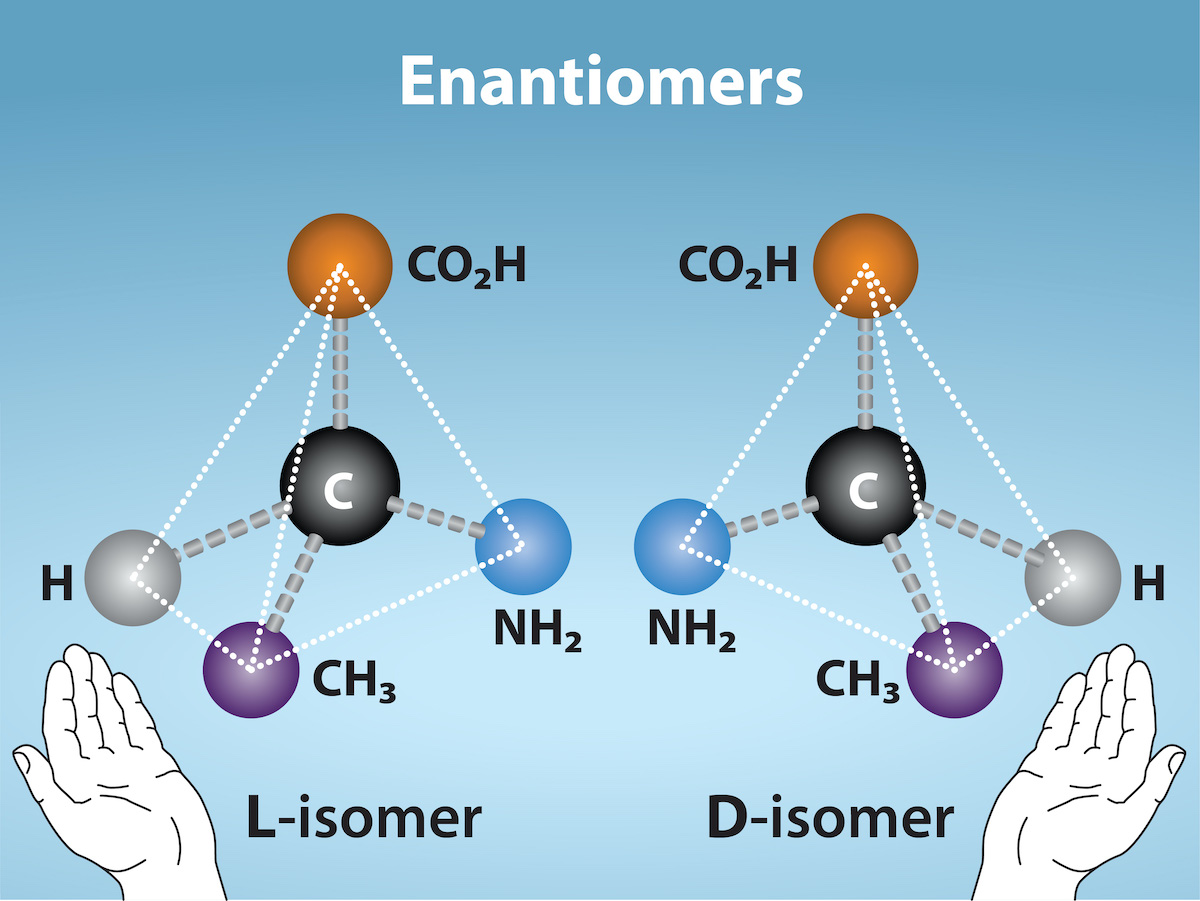
Enantiomers are molecules that share the same chemical structure and chemical bonds but differ in the three-dimensional placement of atoms so that they are non-superimposable mirror images. Figure 2.26 shows an amino acid alanine example, where the two structures are nonsuperimposable. In nature, the L-forms of amino acids are predominant in proteins. Some D forms of amino acids are seen in the cell walls of bacteria and polypeptides in other organisms. Similarly, the D-form of glucose is the main product of photosynthesis and we rarely see the molecule's L-form in nature.
英語のヒント
鏡像異性体とは、化学構造と化学結合は同じだが、原子の三次元的な配置が異なり、互いに重ね合わせられない鏡像となる分子である。図2.26はアミノ酸のアラニンを例にしており、この二つの構造は重ね合わせられない。自然界のタンパク質では、L型のアミノ酸が優勢である。D型のアミノ酸の一部は、細菌の細胞壁や、ほかの生物のポリペプチドに見られる。同様に、光合成の主な生成物はD型のグルコースであり、L型のグルコースは自然界ではめったに見られない。
OpenStax, Rice University; Biology 2e. Credit: Rao, A., Hawkins, A., Fletcher, S. and Ryan K. Department of Biology, Texas A&M University. · CC BY 4.0 · Source出典

Figure 2.26図 2.26
Enantiomers are molecules that are mirror images of each other and are non-superimposable. The L/D naming system is from the Latin words for left and right: laevus and dexter, respectively. This example shows the L and D isomers of the amino acid alanine. Credit: Rao, A., Hawkins, A., Fletcher, S. and Ryan K. Department of Biology, Texas A&M University.
鏡像異性体は互いに鏡像であり、重ね合わせることのできない分子である。L/Dという命名法は、ラテン語でそれぞれ左と右を表すlaevusとdexterに由来する。この例は、アミノ酸アラニンのL型とD型の異性体を示している。出典:Rao, A., Hawkins, A., Fletcher, S. and Ryan K.(テキサスA&M大学生物学部)