第36章感覚系
36.4 Hearing and Vestibular Sensation36.4 聴覚と前庭感覚
Learning Objectives学習目標
By the end of this section, you will be able to do the following:
この節を学び終えると、次のことができるようになる。
- Describe the relationship of amplitude and frequency of a sound wave to attributes of sound音波の振幅と周波数が、音の性質とどう関係するか説明する。
- Trace the path of sound through the auditory system to the site of transduction of sound聴覚系を通り、音が変換される場所に至る経路をたどる。
- Identify the structures of the vestibular system that respond to gravity前庭系のうち、重力に応答する構造を挙げる。
Audition, or hearing, is important to humans and to other animals for many different interactions. It enables an organism to detect and receive information about danger, such as an approaching predator, and to participate in communal exchanges like those concerning territories or mating. On the other hand, although it is physically linked to the auditory system, the vestibular system is not involved in hearing. Instead, an animal’s vestibular system detects its own movement, both linear and angular acceleration and deceleration, and balance.
英語のヒント
聴覚は、ヒトやほかの動物のさまざまな相互作用に重要である。近づく捕食者などの危険を察知して情報を受け取ったり、縄張りや配偶に関する仲間同士のやり取りに参加したりできる。前庭系は聴覚系と物理的につながっているが、聴覚には関わらない。動物自身の直線運動と回転運動の加速・減速、そして平衡を検出する。
Sound音
Auditory stimuli are sound waves, which are mechanical, pressure waves that move through a medium, such as air or water. There are no sound waves in a vacuum since there are no air molecules to move in waves. The speed of sound waves differs, based on altitude, temperature, and medium, but at sea level and a temperature of 20º C (68º F), sound waves travel in the air at about 343 meters per second.
英語のヒント
聴覚刺激は音波であり、空気や水などの媒質を通って進む、機械的な圧力の波である。真空には波として動く空気分子がないので、音波もない。音波の速さは高度、温度、媒質によって異なるが、海面高度、20℃(68°F)の空気中では約343 m/sである。
As is true for all waves, there are four main characteristics of a sound wave: frequency, wavelength, period, and amplitude. Frequency is the number of waves per unit of time, and in sound is heard as pitch. High-frequency (≥15.,ds. For sound frequency, the most commonly used unit is hertz (Hz), or cycles per second. Most humans can perceive sounds with frequencies between 30 and 20,000 Hz. Everyone’s ability to hear high frequencies decreases with age. Dogs detect up to about 40,000 Hz; cats, 60,000 Hz; bats, 100,000 Hz; and dolphins 150,000 Hz, and American shad (Alosa sapidissima), a fish, can hear 180,000 Hz. Those frequencies above the human range are called ultrasound.
ほかのすべての波と同じく、音波の主要な特徴は周波数、波長、周期、振幅の四つである。周波数は単位時間あたりの波の数で、音では高さとして聞こえる。高周波(≥15.,ds.音の周波数によく使われる単位はヘルツ(Hz)、すなわち1秒あたりの周期の数である。大部分のヒトは30~20,000 Hzの音を知覚できる。高い周波数を聞き取る力は、誰でも年齢とともに低下する。イヌは約40,000 Hz、ネコは60,000 Hz、コウモリは100,000 Hz、イルカは150,000 Hzまで検出する。魚のアメリカシャッド(Alosa sapidissima)は180,000 Hzを聞き取れる。ヒトの範囲を超える周波数を超音波という。
Amplitude, or the dimension of a wave from the resting position (the equilibrium) to the peak, in sound is heard as volume and is illustrated in Figure 36.12. The sound waves of louder sounds have greater amplitude than those of softer sounds. For sound, volume is measured in decibels (dB). The softest sound that a human can hear is the zero point. Humans speak normally at 60 decibels.
振幅は、静止位置、すなわち平衡位置から波の頂点までの大きさで、音では音量として聞こえる(図36.12)。大きい音の音波は、小さい音より振幅が大きい。音量はデシベル(dB)で測り、ヒトに聞こえる最も小さい音をゼロとする。通常の会話は60デシベル程度である。
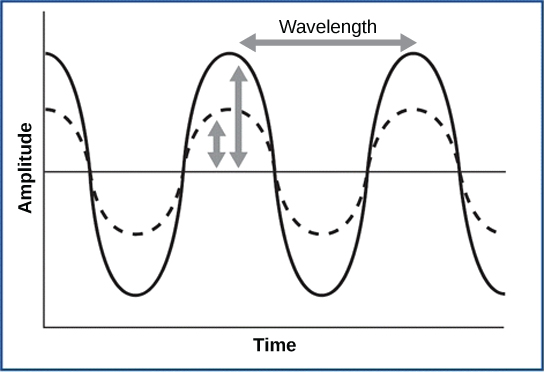
Figure 36.12図 36.12
For sound waves, wavelength corresponds to pitch. Amplitude of the wave corresponds to volume. The sound wave shown with a dashed line is softer in volume than the sound wave shown with a solid line. (credit: NIH)
音波では、波長が音の高さに、振幅が音量に対応する。破線で示す音波は、実線で示すものより音量が小さい。(出典:米国国立衛生研究所〔NIH〕)
Reception of Sound音の受容
In mammals, sound waves are collected by the external, cartilaginous part of the ear called the auricle, then travel through the auditory canal and cause vibration of the thin diaphragm called the tympanum or ear drum, the innermost part of the outer ear (illustrated in Figure 36.13). Interior to the tympanum is the middle ear. The middle ear holds three small bones called the ossicles, which transfer energy from the moving tympanum to the inner ear. The three ossicles are the malleus (also known as the hammer), the incus (the anvil), and stapes (the stirrup). The aptly named stapes looks very much like a stirrup. The three ossicles are unique to mammals, and each plays a role in hearing. The malleus attaches at three points to the interior surface of the tympanic membrane. The incus attaches the malleus to the stapes. In humans, the stapes is not long enough to reach the tympanum. If we did not have the malleus and the incus, then the vibrations of the tympanum would never reach the inner ear. These bones also function to collect force and amplify sounds. The ear ossicles are homologous to bones in a fish mouth: the bones that support gills in fish are thought to be adapted for use in the vertebrate ear over evolutionary time. Many animals (frogs, reptiles, and birds, for example) use the stapes of the middle ear to transmit vibrations to the inner ear.
英語のヒント
哺乳類では、耳介と呼ばれる外側の軟骨性の部分が音波を集める。音波は外耳道を進み、外耳の最も奥にある、鼓膜という薄い膜を振動させる(図36.13)。鼓膜の内側が中耳である。中耳には耳小骨と呼ばれる三つの小骨があり、鼓膜の運動エネルギーを内耳へ伝える。耳小骨はツチ骨、キヌタ骨、アブミ骨である。英語の別名は、それぞれhammer(金づち)、anvil(金床)、stirrup(あぶみ)で、アブミ骨はまさにあぶみのような形をしている。三つの耳小骨は哺乳類に固有で、それぞれ聴覚に役立つ。ツチ骨は鼓膜の内面に三点で付着し、キヌタ骨はツチ骨とアブミ骨をつなぐ。ヒトのアブミ骨は鼓膜に届くほど長くないため、ツチ骨とキヌタ骨がなければ、鼓膜の振動は内耳へ届かない。これらの骨は力を集め、音を増幅する働きもある。耳小骨は魚の口の骨と相同である。魚のえらを支える骨が、進化の過程で脊椎動物の耳に使われるようになったと考えられる。カエル、爬虫類、鳥類など多くの動物は、中耳のアブミ骨で内耳へ振動を伝える。
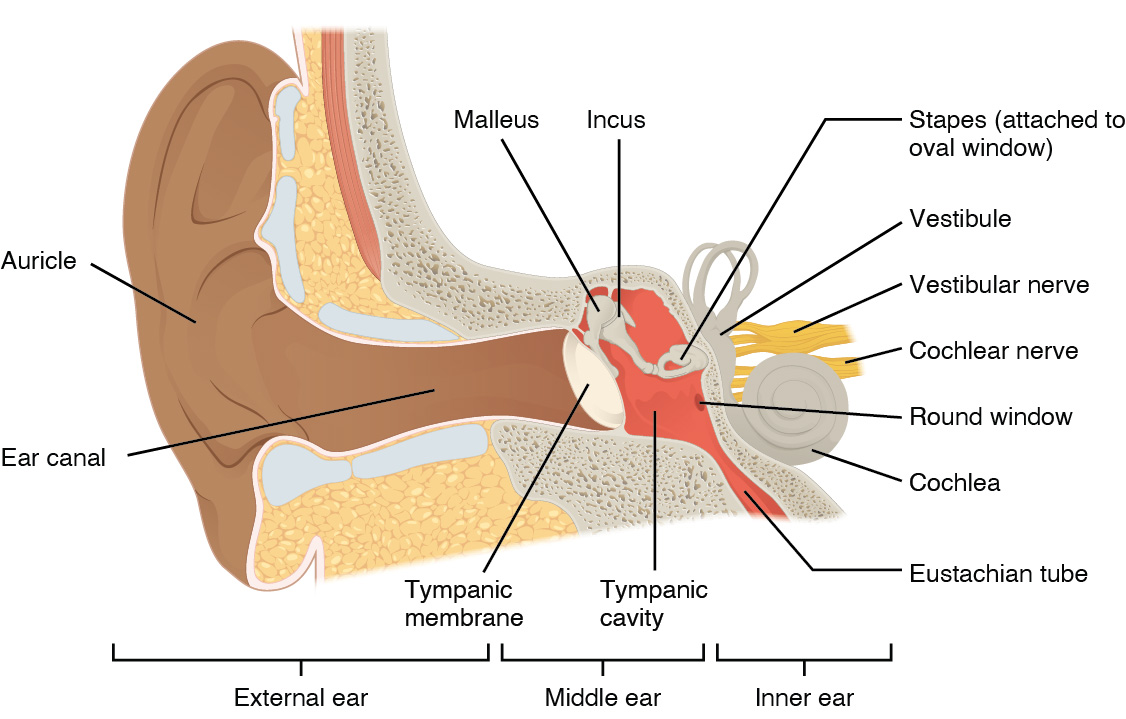


Figure 36.13図 36.13
Sound travels through the outer ear to the middle ear, which is bounded on its exterior by the tympanic membrane. The middle ear contains three bones called ossicles that transfer the sound wave to the oval window, the exterior boundary of the inner ear. The organ of Corti, which is the organ of sound transduction, lies inside the cochlea.
音は外耳から中耳へ進む。中耳は外側で鼓膜に接し、耳小骨という三つの骨を含む。耳小骨は、内耳の外側の境界にある卵円窓へ音波を伝える。音の変換を担うコルチ器は、蝸牛内にある。