第36章感覚系
36.3 Taste and Smell36.3 味覚と嗅覚
Learning Objectives学習目標
By the end of this section, you will be able to do the following:
この節を学び終えると、次のことができるようになる。
- Explain in what way smell and taste stimuli differ from other sensory stimuli嗅覚と味覚の刺激が、ほかの感覚刺激とどう異なるか説明する。
- Identify the five primary tastes that can be distinguished by humansヒトが区別できる五つの基本味を挙げる。
- Explain in anatomical terms why a dog’s sense of smell is more acute than a human’sイヌの嗅覚がヒトより鋭い理由を、解剖学的に説明する。
Taste, also called gustation, and smell, also called olfaction, are the most interconnected senses in that both involve molecules of the stimulus entering the body and bonding to receptors. Smell lets an animal sense the presence of food or other animals—whether potential mates, predators, or prey—or other chemicals in the environment that can impact their survival. Similarly, the sense of taste allows animals to discriminate between types of foods. While the value of a sense of smell is obvious, what is the value of a sense of taste? Different tasting foods have different attributes, both helpful and harmful. For example, sweet-tasting substances tend to be highly caloric, which could be necessary for survival in lean times. Bitterness is associated with toxicity, and sourness is associated with spoiled food. Salty foods are valuable in maintaining homeostasis by helping the body retain water and by providing ions necessary for cells to function.
英語のヒント
味覚(gustation)と嗅覚(olfaction)は、最も密接につながった感覚である。どちらも、刺激となる分子が体内に入り、受容体に結合することに関わる。嗅覚は、食べ物、配偶相手の候補、捕食者、獲物といった他の動物や、生存に影響する環境中の化学物質の存在を知らせる。同じように、味覚は食べ物の種類を区別させる。嗅覚の価値は明らかだが、味覚にはどんな価値があるだろうか。異なる味の食べ物には、有益なものも有害なものも含め、それぞれ異なる性質がある。たとえば甘い物質は高カロリーであることが多く、食べ物の乏しい時期に生き延びるために必要になりうる。苦味は毒性と、酸味は食べ物の腐敗と関連する。塩味のある食べ物は、体内の水分保持を助け、細胞が働くのに必要なイオンを供給することで、恒常性の維持に役立つ。
Tastes and Odors味とにおい
Both taste and odor stimuli are molecules taken in from the environment. The primary tastes detected by humans are sweet, sour, bitter, salty, and umami. The first four tastes need little explanation. The identification of umami as a fundamental taste occurred fairly recently—it was identified in 1908 by Japanese scientist Kikunae Ikeda while he worked with seaweed broth, but it was not widely accepted as a taste that could be physiologically distinguished until many years later. The taste of umami, also known as savoriness, is attributable to the taste of the amino acid L-glutamate. In fact, monosodium glutamate, or MSG, is often used in cooking to enhance the savory taste of certain foods. What is the adaptive value of being able to distinguish umami? Savory substances tend to be high in protein.
英語のヒント
味とにおいの刺激は、どちらも環境から取り込まれる分子である。ヒトが検出する基本の味は、甘味、酸味、苦味、塩味、うま味である。最初の四つは、あまり説明を要しないだろう。うま味が基本味として見いだされたのは比較的最近である。日本の科学者、池田菊苗が1908年に昆布だしを研究するなかで発見したが、生理学的に区別できる味として広く受け入れられたのは、ずっと後のことだった。うま味は、アミノ酸のL-グルタミン酸の味による。実際、グルタミン酸ナトリウム(MSG)は、食品のうま味を強めるため料理によく使われる。うま味を区別できることに、適応上どのような価値があるのだろうか。うま味のある物質は、タンパク質に富む傾向がある。
All odors that we perceive are molecules in the air we breathe. If a substance does not release molecules into the air from its surface, it has no smell. And if a human or other animal does not have a receptor that recognizes a specific molecule, then that molecule has no smell. Humans have about 350 olfactory receptor subtypes that work in various combinations to allow us to sense about 10,000 different odors. Compare that to mice, for example, which have about 1,300 olfactory receptor types, and therefore probably sense more odors. Both odors and tastes involve molecules that stimulate specific chemoreceptors. Although humans commonly distinguish taste as one sense and smell as another, they work together to create the perception of flavor. A person’s perception of flavor is reduced if they have congested nasal passages.
英語のヒント
私たちが知覚するにおいはすべて、吸う空気の中の分子による。表面から空気中へ分子を放出しない物質には、においがない。また、ヒトや他の動物が特定の分子を認識する受容体をもたなければ、その分子にもにおいはない。ヒトには約350種類の嗅覚受容体があり、さまざまな組合せで働くことで、およそ1万種類のにおいを感じ取れる。たとえばマウスには約1,300種類あり、もっと多くのにおいを感じると考えられる。においと味は、どちらも特定の化学受容体を刺激する分子に関わる。ヒトはふつう味覚と嗅覚を別の感覚として区別するが、両者が一緒に働いて風味の知覚をつくる。鼻が詰まると、風味を感じる力が低下する。
Reception and Transduction受容と変換
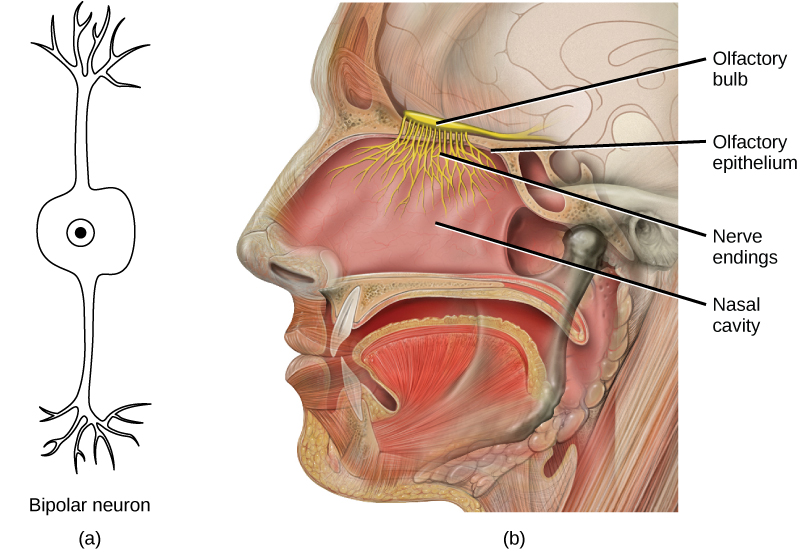
Odorants (odor molecules) enter the nose and dissolve in the olfactory epithelium, the mucosa at the back of the nasal cavity (as illustrated in Figure 36.8). The olfactory epithelium is a collection of specialized olfactory receptors in the back of the nasal cavity that spans an area about 5 cm2 in humans. Recall that sensory cells are neurons. An olfactory receptor, which is a dendrite of a specialized neuron, responds when it binds certain molecules inhaled from the environment by sending impulses directly to the olfactory bulb of the brain. Humans have about 12 million olfactory receptors, distributed among hundreds of different receptor types that respond to different odors. Twelve million seems like a large number of receptors, but compare that to other animals: rabbits have about 100 million, most dogs have about 1 billion, and bloodhounds—dogs selectively bred for their sense of smell—have about 4 billion. The overall size of the olfactory epithelium also differs between species, with that of bloodhounds, for example, being many times larger than that of humans.
英語のヒント
におい分子は鼻に入り、鼻腔の奥の粘膜である嗅上皮に溶け込む(図36.8)。嗅上皮は、鼻腔の奥に集まった特殊な嗅覚受容器からなり、ヒトでは約5 cm2の面積を占める。感覚細胞はニューロンであることを思い出そう。特殊化したニューロンの樹状突起である嗅覚受容器は、外界から吸い込んだ特定の分子と結合すると、脳の嗅球へ直接インパルスを送って応答する。ヒトには約1,200万個の嗅覚受容器がある。異なるにおいに応答する数百種類に分かれる。1,200万個は多く感じるが、ウサギは約1億個、大部分のイヌは約10億個ある。嗅覚を目的に選択交配されたブラッドハウンドでは約40億個である。嗅上皮全体の大きさも種によって異なり、たとえばブラッドハウンドはヒトの何倍も大きい。
Olfactory neurons are bipolar neurons (neurons with two processes extending from the cell body). Each neuron has a single dendrite buried in the olfactory epithelium, and extending from this dendrite are 5 to 20 receptor-laden, hair-like cilia that trap odorant molecules. The sensory receptors on the cilia are proteins, and it is the variations in their amino acid chains that make the receptors sensitive to different odorants. Each olfactory sensory neuron has only one type of receptor on its cilia, and the receptors are specialized to detect specific odorants, so the bipolar neurons themselves are specialized. When an odorant binds with a receptor that recognizes it, the sensory neuron associated with the receptor is stimulated. Olfactory stimulation is the only sensory information that directly reaches the cerebral cortex, whereas other sensations are relayed through the thalamus.
英語のヒント
嗅覚ニューロンは、細胞体から二つの突起が伸びる双極性ニューロンである。各ニューロンは嗅上皮に埋まった樹状突起を一本もち、そこから受容体を備えた5~20本の毛状の繊毛が伸び、におい分子をとらえる。繊毛上の感覚受容体はタンパク質であり、そのアミノ酸鎖の違いによって、異なるにおい分子に反応する。各嗅覚感覚ニューロンの繊毛には一種類の受容体しかない。受容体は特定のにおい分子の検出に特化しているため、双極性ニューロン自体も特殊化している。におい分子が、それを認識する受容体に結合すると、その受容体に結びついた感覚ニューロンが刺激される。嗅覚刺激は、大脳皮質に直接達する唯一の感覚情報である。ほかの感覚は視床で中継される。
Many of the details of the sense of smell were discovered relatively recently by Linda B. Buck and Richard Axel. In 1991, they were the first to pinpoint the olfactory receptors in the back of the nasal cavity of mice. Buck later proposed the way that these receptors could detect so many different smells: Some receptors detect more than one odor, and many odors can be detected by more than more receptor. These detection abilities are applied in different combinations of detection to create a pattern that can both be recognized and remembered. The exact nature of this scent identification (sometimes called odor coding) is still being researched and debated. Buck and Axel later shared the Nobel Prize in medicine for solving the next piece of the olfactory puzzle: the way that genes code the olfactory receptors, essentially showing the genetic nature of the sense of smell.
嗅覚の詳細の多くは、比較的最近、リンダ・B・バックとリチャード・アクセルによって明らかにされた。1991年、二人はマウスの鼻腔の奥にある嗅覚受容体を初めて特定した。その後バックは、これらの受容体が多数のにおいを検出できる仕組みを提案した。一つの受容体が複数のにおいを検出し、多くのにおいは複数の受容体で検出される。この検出能力がさまざまに組み合わさり、認識も記憶もできるパターンをつくる。においの符号化とも呼ばれるこの識別の正確な仕組みは、今も研究と議論の対象である。バックとアクセルは後に、嗅覚の謎の次の部分、すなわち遺伝子が嗅覚受容体をコードする仕組みを解き、嗅覚の遺伝的な性質を示した功績により、ノーベル生理学・医学賞を共同受賞した。
OpenStax, Rice University; Biology 2e. (credit: modification of work by Patrick J. Lynch, medical illustrator; C. Carl Jaffe, MD, cardiologist) Original head illustration: Patrick J. Lynch, medical illustrator; C. Carl Jaffe, MD, cardiologist; CC BY 2.5 (https://creativecommons.org/licenses/by/2.5/). · CC BY 4.0 · Source出典

Figure 36.8図 36.8
In the human olfactory system, (a) bipolar olfactory neurons extend from (b) the olfactory epithelium, where olfactory receptors are located, to the olfactory bulb. (credit: modification of work by Patrick J. Lynch, medical illustrator; C. Carl Jaffe, MD, cardiologist)
ヒトの嗅覚系では、(a)双極性の嗅覚ニューロンが、(b)嗅覚受容器のある嗅上皮から嗅球へ伸びる。(出典:医療イラストレーターPatrick J. Lynch、循環器内科医C. Carl Jaffeの作品を改変)