第36章感覚系
Taste味覚
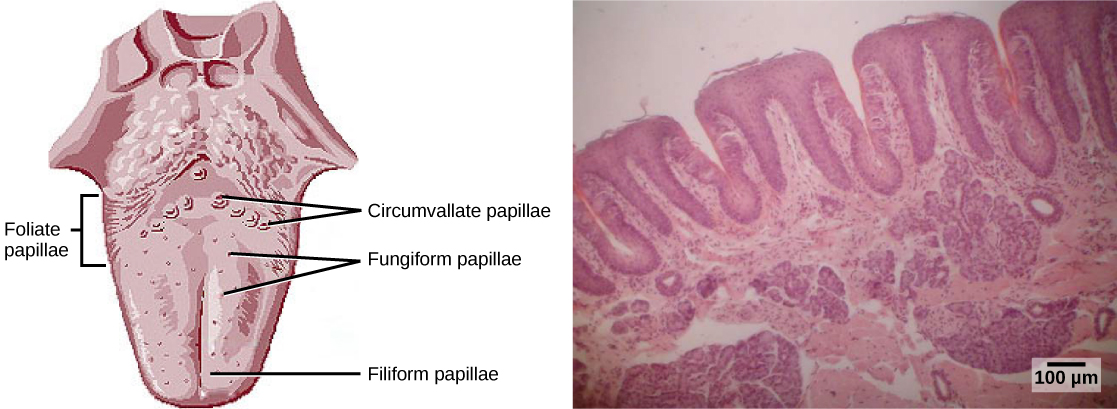
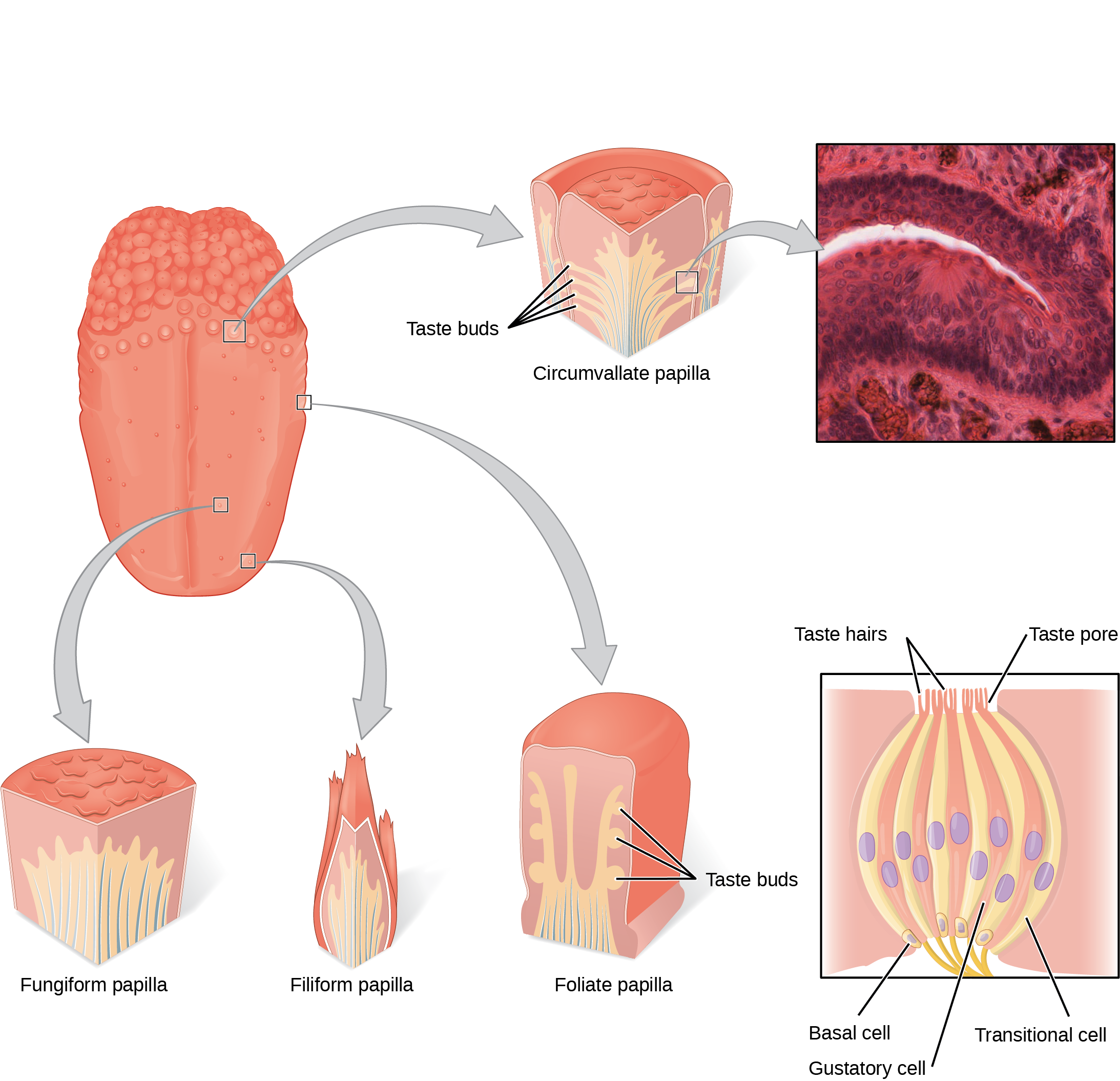
Detecting a taste (gustation) is fairly similar to detecting an odor (olfaction), given that both taste and smell rely on chemical receptors being stimulated by certain molecules. The primary organ of taste is the taste bud. A taste bud is a cluster of gustatory receptors (taste cells) that are located within the bumps on the tongue called papillae (singular: papilla) (illustrated in Figure 36.11). There are several structurally distinct papillae. Filiform papillae, which are located across the tongue, are tactile, providing friction that helps the tongue move substances, and contain no taste cells. In contrast, fungiform papillae, which are located mainly on the anterior two-thirds of the tongue, each contain one to eight taste buds and also have receptors for pressure and temperature.
英語のヒント
味の検出は、においの検出とかなり似ている。どちらも、特定の分子が化学受容体を刺激することに依存するからである。味覚の主な器官は味蕾である。味蕾は味覚受容器、すなわち味細胞の集まりで、舌の乳頭という隆起の中にある(図36.11)。乳頭は英語でpapilla、複数形はpapillaeという。乳頭には、構造の異なる数種類がある。舌全体にある糸状乳頭は触覚性で、舌が物を動かすのに役立つ摩擦を生むが、味細胞は含まない。対して、主に舌の前方3分の2にある茸状乳頭は、それぞれ1~8個の味蕾をもち、圧力と温度の受容器も備える。
OpenStax, Rice University; Biology 2e. (credit a: modification of work by NCI; scale-bar data from Matt Russell) · CC BY 4.0 · Source出典

Figure 36.10図 36.10
(a) Foliate, circumvallate, and fungiform papillae are located on different regions of the tongue. (b) Foliate papillae are prominent protrusions on this light micrograph. (credit a: modification of work by NCI; scale-bar data from Matt Russell)
(a)葉状乳頭、有郭乳頭、茸状乳頭は、舌の異なる領域に位置する。(b)光学顕微鏡像では、葉状乳頭が目立つ突出部としてみえる。(aの出典:米国国立がん研究所〔NCI〕の作品を改変。スケールバーのデータ:Matt Russell)
In addition to those two types of chemically and mechanically sensitive papillae are foliate papillae—leaf-like papillae located in parallel folds along the edges and toward the back of the tongue, as seen in the Figure 36.10 micrograph. Foliate papillae contain about 1,300 taste buds within their folds. Finally, there are circumvallate papillae, which are wall-like papillae in the shape of an inverted “V” at the back of the tongue. Each of these papillae is surrounded by a groove and contains about 250 taste buds.
英語のヒント
化学的・機械的刺激に敏感なこれら二種類の乳頭に加え、葉状乳頭がある。図36.10の顕微鏡像に示すように、舌の縁に沿った後方寄りに、葉に似たひだが平行に並ぶ。ひだの中には約1,300個の味蕾がある。最後に有郭乳頭がある。舌の後方で逆V字形に並ぶ、壁のような乳頭である。それぞれが溝に囲まれ、約250個の味蕾を含む。
Each taste bud’s taste cells are replaced every 10 to 14 days. These are elongated cells with hair-like processes called microvilli at the tips that extend into the taste bud pore (illustrated in Figure 36.11). Food molecules (tastants) are dissolved in saliva, and they bind with and stimulate the receptors on the microvilli. The receptors for tastants are located across the outer portion and front of the tongue, outside of the middle area where the filiform papillae are most prominent.
英語のヒント
味蕾の味細胞は、10~14日ごとに置き換わる。細長い細胞で、先端には微絨毛という毛状の突起があり、味孔の中へ伸びる(図36.11)。食べ物の分子、すなわち呈味物質は唾液に溶け、微絨毛上の受容体に結合して刺激する。呈味物質の受容体は、糸状乳頭の目立つ中央部の外側、舌の周辺部と前方に分布する。
OpenStax, Rice University; Biology 2e. (credit: modification of work by Vincenzo Rizzo) · CC BY 4.0 · Source出典

Figure 36.11図 36.11
Pores in the tongue allow tastants to enter taste buds in the tongue. (credit: modification of work by Vincenzo Rizzo)
舌の孔を通して、呈味物質が舌の味蕾に入る。(出典:Vincenzo Rizzoの作品を改変)
In humans, there are five primary tastes, and each taste has only one corresponding type of receptor. Thus, like olfaction, each receptor is specific to its stimulus (tastant). Transduction of the five tastes happens through different mechanisms that reflect the molecular composition of the tastant. A salty tastant (containing NaCl) provides the sodium ions (Na+) that enter the taste neurons and excite them directly. Sour tastants are acids and belong to the thermoreceptor protein family. Binding of an acid or other sour-tasting molecule triggers a change in the ion channel and these increase hydrogen ion (H+) concentrations in the taste neurons, thus depolarizing them. Sweet, bitter, and umami tastants require a G-protein coupled receptor. These tastants bind to their respective receptors, thereby exciting the specialized neurons associated with them.
ヒトには五つの基本味があり、それぞれに対応する受容体は一種類である。嗅覚と同じく、各受容体はその刺激、すなわち呈味物質に特異的である。五つの味の変換は、呈味物質の分子組成を反映した異なる仕組みで起こる。NaClを含む塩味の呈味物質は、ナトリウムイオン(Na+)を供給する。このイオンは味覚ニューロンに入り、直接興奮させる。酸味の呈味物質は酸であり、温度受容体タンパク質ファミリーに属する。酸などの酸味分子の結合がイオンチャネルの変化を引き起こし、味覚ニューロン内の水素イオン(H+)濃度を高め、脱分極させる。甘味、苦味、うま味の呈味物質は、Gタンパク質共役受容体を必要とする。それぞれの受容体に結合することで、その受容体につながる特殊なニューロンを興奮させる。
Both tasting abilities and sense of smell change with age. In humans, the senses decline dramatically by age 50 and continue to decline. A child may find a food to be too spicy, whereas an elderly person may find the same food to be bland and unappetizing.
英語のヒント
味覚能力と嗅覚は、どちらも年齢とともに変化する。ヒトでは50歳までに大きく低下し、その後も低下を続ける。子どもには辛すぎる食べ物も、高齢者には味気なく、食欲をそそらないと感じられることがある。
Smell and Taste in the Brain脳での嗅覚と味覚
Olfactory neurons project from the olfactory epithelium to the olfactory bulb as thin, unmyelinated axons. The olfactory bulb is composed of neural clusters called glomeruli, and each glomerulus receives signals from one type of olfactory receptor, so each glomerulus is specific to one odorant. From glomeruli, olfactory signals travel directly to the olfactory cortex and then to the frontal cortex and the thalamus. Recall that this is a different path from most other sensory information, which is sent directly to the thalamus before ending up in the cortex. Olfactory signals also travel directly to the amygdala, thereafter reaching the hypothalamus, thalamus, and frontal cortex. The last structure that olfactory signals directly travel to is a cortical center in the temporal lobe structure important in spatial, autobiographical, declarative, and episodic memories. Olfaction is finally processed by areas of the brain that deal with memory, emotions, reproduction, and thought.
英語のヒント
嗅覚ニューロンは、細い無髄軸索として嗅上皮から嗅球へ投射する。嗅球は糸球体と呼ばれる神経の集まりからなる。各糸球体は一種類の嗅覚受容体から信号を受け取るので、一種類のにおい分子に特異的である。嗅覚信号は糸球体から嗅皮質へ直接向かい、その後、前頭皮質と視床へ伝わる。ほかの感覚情報の大部分が、先に視床へ直接送られ、その後に皮質へ至るのとは異なる経路である。嗅覚信号は扁桃体にも直接向かい、続いて視床下部、視床、前頭皮質へ達する。直接向かう最後の構造は、空間記憶、自伝的記憶、宣言的記憶、エピソード記憶に重要な、側頭葉内の皮質中枢である。最終的に嗅覚は、記憶、感情、生殖、思考を扱う脳領域で処理される。
Taste neurons project from taste cells in the tongue, esophagus, and palate to the medulla, in the brainstem. From the medulla, taste signals travel to the thalamus and then to the primary gustatory cortex. Information from different regions of the tongue is segregated in the medulla, thalamus, and cortex.
味覚ニューロンは、舌、食道、口蓋の味細胞から、脳幹の延髄へ投射する。味覚信号は延髄から視床へ、さらに一次味覚野へ伝わる。舌の異なる領域から来る情報は、延髄、視床、皮質で区別して保たれる。