第36章感覚系
36.1 Sensory Processes36.1 感覚の過程
Learning Objectives学習目標
By the end of this section, you will be able to do the following:
この節を学び終えると、次のことができるようになる。
- Identify the general and special senses in humansヒトの一般感覚と特殊感覚を挙げる。
- Describe three important steps in sensory perception感覚知覚の三つの重要な段階を説明する。
- Explain the concept of just-noticeable difference in sensory perception感覚知覚における丁度可知差異の概念を説明する。
Senses provide information about the body and its environment. Humans have five special senses: olfaction (smell), gustation (taste), equilibrium (balance and body position), vision, and hearing. Additionally, we possess general senses, also called somatosensation, which respond to stimuli like temperature, pain, pressure, and vibration. Vestibular sensation, which is an organism’s sense of spatial orientation and balance, proprioception (position of bones, joints, and muscles), and the sense of limb position that is used to track kinesthesia (limb movement) are part of somatosensation. Although the sensory systems associated with these senses are very different, they all share a common function: to convert a stimulus (such as light, or sound, or the position of the body) into an electrical signal in the nervous system. This process is called sensory transduction.
英語のヒント
感覚は、体と環境についての情報をもたらす。ヒトには、嗅覚、味覚、平衡感覚(釣り合いと体の位置)、視覚、聴覚という五つの特殊感覚がある。また一般感覚、すなわち体性感覚もあり、温度、痛み、圧力、振動などの刺激に応答する。空間内での体の向きと釣り合いを感じる前庭感覚、骨・関節・筋肉の位置を感じる固有感覚、手足の動きである運動感覚を把握するための肢の位置の感覚は、体性感覚の一部である。これらの感覚に関わる感覚系は大きく異なるが、光、音、体の位置などの刺激を神経系の電気信号へ変えるという機能は共通する。この過程を感覚変換という。
There are two broad types of cellular systems that perform sensory transduction. In one, a neuron works with a sensory receptor, a cell, or cell process that is specialized to engage with and detect a specific stimulus. Stimulation of the sensory receptor activates the associated afferent neuron, which carries information about the stimulus to the central nervous system. In the second type of sensory transduction, a sensory nerve ending responds to a stimulus in the internal or external environment: this neuron constitutes the sensory receptor. Free nerve endings can be stimulated by several different stimuli, thus showing little receptor specificity. For example, pain receptors in your gums and teeth may be stimulated by temperature changes, chemical stimulation, or pressure.
英語のヒント
感覚変換を行う細胞の仕組みは、大きく二つに分かれる。一つでは、ニューロンが感覚受容器と協働する。感覚受容器とは、特定の刺激と接して検出するように特殊化した細胞、または細胞の突起である。受容器への刺激が結びついた求心性ニューロンを活性化し、このニューロンが中枢神経系へ刺激の情報を運ぶ。もう一つでは、感覚神経の終末が体内や外界の刺激に応答する。このニューロン自体が感覚受容器をなす。自由神経終末は複数の異なる刺激を受けられるため、受容器特異性が低い。たとえば歯肉や歯の痛覚受容器は、温度変化、化学的刺激、圧力によって刺激される。
Reception受容
The first step in sensation is reception, which is the activation of sensory receptors by stimuli such as mechanical stimuli (being bent or squished, for example), chemicals, or temperature. The receptor can then respond to the stimuli. The region in space in which a given sensory receptor can respond to a stimulus, be it far away or in contact with the body, is that receptor’s receptive field. Think for a moment about the differences in receptive fields for the different senses. For the sense of touch, a stimulus must come into contact with the body. For the sense of hearing, a stimulus can be a moderate distance away (some baleen whale sounds can propagate for many kilometers). For vision, a stimulus can be very far away; for example, the visual system perceives light from stars at enormous distances.
英語のヒント
感覚の最初の段階は受容である。これは、曲げられる、押しつぶされるといった機械的刺激や、化学物質、温度などによって感覚受容器が活性化されることである。活性化した受容器は刺激に応答できる。刺激が遠くにあっても、体に接していても、一つの感覚受容器が刺激に応答できる空間的な範囲を、その受容器の受容野という。感覚による受容野の違いを考えてみよう。触覚では、刺激が体に接触する必要がある。聴覚では、刺激がある程度離れていてもよい。ヒゲクジラの一部の音は、何キロメートルも伝わる。視覚では刺激が非常に遠くてもよく、たとえば視覚系は、途方もなく遠い星からの光を知覚する。
Transduction変換
The most fundamental function of a sensory system is the translation of a sensory signal to an electrical signal in the nervous system. This takes place at the sensory receptor, and the change in electrical potential that is produced is called the receptor potential. How is sensory input, such as pressure on the skin, changed to a receptor potential? In this example, a type of receptor called a mechanoreceptor (as shown in Figure 36.2) possesses specialized membranes that respond to pressure. Disturbance of these dendrites by compressing them or bending them opens gated ion channels in the plasma membrane of the sensory neuron, changing its electrical potential. Recall that in the nervous system, a positive change of a neuron’s electrical potential (also called the membrane potential), depolarizes the neuron. Receptor potentials are graded potentials: the magnitude of these graded (receptor) potentials varies with the strength of the stimulus. If the magnitude of depolarization is sufficient (that is, if membrane potential reaches a threshold), the neuron will fire an action potential. In most cases, the correct stimulus impinging on a sensory receptor will drive membrane potential in a positive direction, although for some receptors, such as those in the visual system, this is not always the case.
英語のヒント
感覚系の最も基本的な機能は、感覚信号を神経系の電気信号へ変えることである。これは感覚受容器で起こり、生じた電位の変化を受容器電位という。皮膚への圧力などの感覚入力は、どのように受容器電位へ変わるのだろうか。この例では、図36.2に示す機械受容器という種類の受容器が、圧力に応答する特殊な膜をもつ。樹状突起が圧縮されたり曲げられたりして変形すると、感覚ニューロンの細胞膜にある開閉型のイオンチャネルが開き、電位が変わる。ニューロンの電位、すなわち膜電位が正の方向へ変わると脱分極することを思い出そう。受容器電位は段階的電位であり、その大きさは刺激の強さによって変わる。脱分極が十分に大きい、つまり膜電位が閾値に達すると、ニューロンは活動電位を発生させる。大部分の場合、適切な刺激が感覚受容器に加わると膜電位は正の方向へ変化する。ただし視覚系の受容器など、一部では必ずしもそうではない。
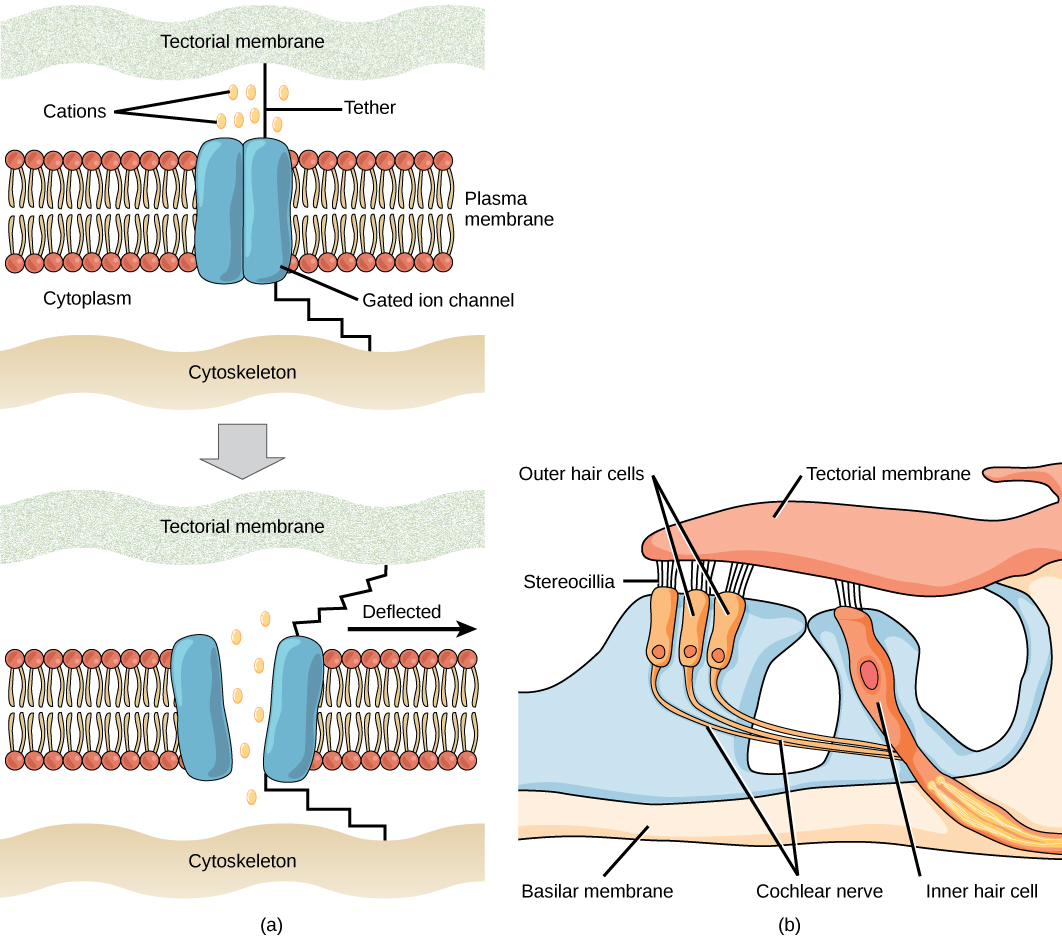

Figure 36.2図 36.2
(a) Mechanosensitive ion channels are gated ion channels that respond to mechanical deformation of the plasma membrane. A mechanosensitive channel is connected to the plasma membrane and the cytoskeleton by hair-like tethers. When pressure causes the extracellular matrix to move, the channel opens, allowing ions to enter or exit the cell. (b) Stereocilia in the human ear are connected to mechanosensitive ion channels. When a sound causes the stereocilia to move, mechanosensitive ion channels transduce the signal to the cochlear nerve.
(a)機械感受性イオンチャネルは、細胞膜の機械的な変形に応答する開閉型イオンチャネルである。毛のような連結線維によって細胞膜と細胞骨格につながる。圧力で細胞外マトリックスが動くとチャネルが開き、イオンが細胞を出入りできる。(b)ヒトの耳の不動毛は、機械感受性イオンチャネルにつながる。音が不動毛を動かすと、チャネルが信号を変換して蝸牛神経に伝える。
Sensory receptors for different senses are very different from each other, and they are specialized according to the type of stimulus they sense: they have receptor specificity. For example, touch receptors, light receptors, and sound receptors are each activated by different stimuli. Touch receptors are not sensitive to light or sound; they are sensitive only to touch or pressure. However, stimuli may be combined at higher levels in the brain, as happens with olfaction, contributing to our sense of taste.
異なる感覚の受容器は互いに大きく異なり、検出する刺激の種類に合わせて特殊化している。つまり受容器特異性をもつ。たとえば触覚、光、音の受容器は、それぞれ異なる刺激で活性化する。触覚受容器は光や音には反応せず、接触や圧力だけに反応する。ただし脳のより高次の段階では、刺激が組み合わされる場合がある。嗅覚が味の感覚に寄与するのが、その例である。