第26章種子植物
Monocots単子葉類
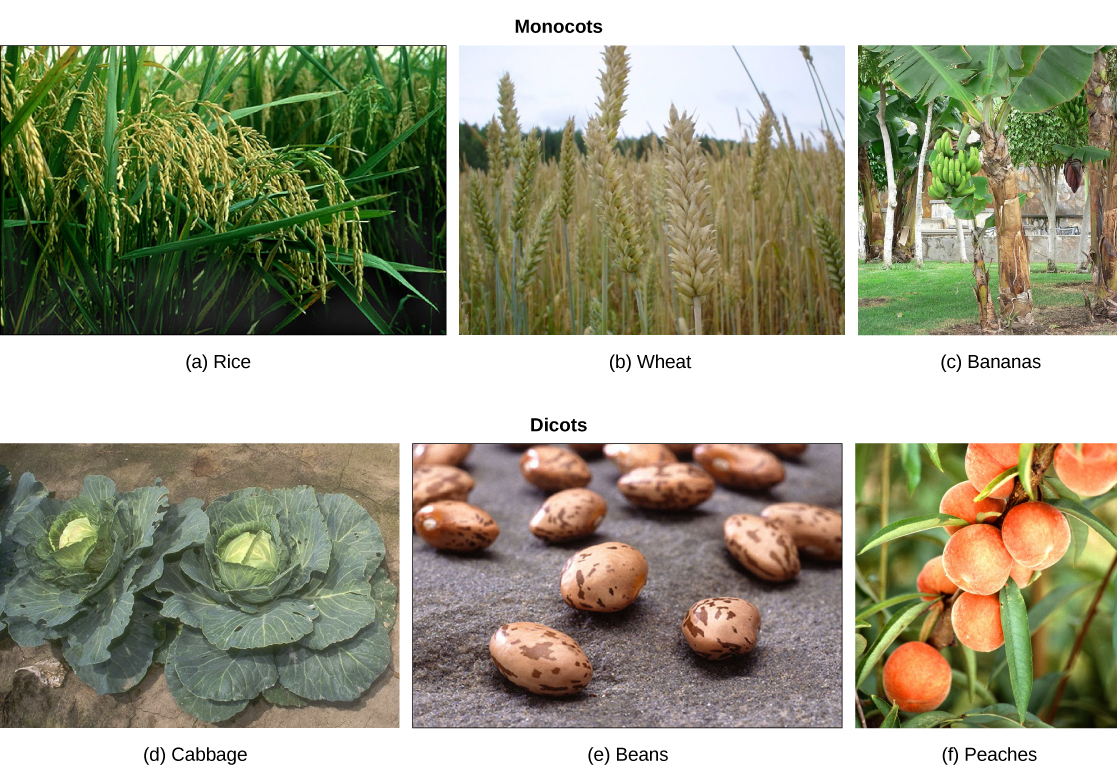
Plants in the monocot group are primarily identified by the presence of a single cotyledon in the seedling. Other anatomical features shared by monocots include veins that run parallel to and along the length of the leaves, and flower parts that are arranged in a three- or six-fold symmetry. True woody tissue is rarely found in monocots. In palm trees, vascular and parenchyma tissues produced by the primary and secondary thickening meristems form the trunk. The pollen from the first angiosperms was likely monosulcate, containing a single furrow or pore through the outer layer. This feature is still seen in the modern monocots. Vascular tissue of the stem is scattered, not arranged in any particular pattern, but is organized in a ring in the roots. The root system consists of multiple fibrous roots, with no major tap root. Adventitious roots often emerge from the stem or leaves. The monocots include familiar plants such as the true lilies (Liliopsida), orchids, yucca, asparagus, grasses, and palms. Many important crops are monocots, such as rice and other cereals, corn, sugar cane, and tropical fruits like bananas and pineapples (Figure 26.19a,b,c).
英語のヒント
単子葉類は、主に実生の子葉が一枚であることによって識別される。共通するその他の解剖学的特徴には、葉の長さに沿って平行に走る葉脈と、三回または六回対称に配列する花の各部分がある。単子葉類には、真の木質組織はめったに見られない。ヤシでは、一次および二次の肥厚分裂組織が生み出す維管束組織と柔組織が、幹を形成する。最初の被子植物の花粉は、おそらく単溝型で、外層を貫く溝または孔が一つあった。この特徴は、現在の単子葉類にも見られる。茎の維管束組織は散在し、特定の規則的な配列をとらないが、根では環状に配列する。根系は、多数のひげ根からなり、主要な直根をもたない。不定根が茎や葉から出ることも多い。単子葉類には、ユリ類(ユリ綱)、ラン、ユッカ、アスパラガス、イネ科植物、ヤシなど、身近な植物が含まれる。イネをはじめとする穀類、トウモロコシ、サトウキビ、バナナやパイナップルなどの熱帯果実を含め、重要な作物の多くは単子葉類である(図26.19a、b、c)。
OpenStax, Rice University; Biology 2e. (credit a: modification of work by David Nance, USDA ARS; credit b, c: modification of work by Rosendahl; credit d: modification of work by Bill Tarpenning, USDA; credit e: modification of work by Scott Bauer, USDA ARS; credit f: modification of work by Keith Weller, USDA) · CC BY 4.0 · Source出典

Figure 26.19図 26.19
Monocot and dicot crop plants. The world’s major crops are flowering plants. (a) Rice, (b) wheat, and (c) bananas are monocots, while (d) cabbage, (e) beans, and (f) peaches are dicots. (credit a: modification of work by David Nance, USDA ARS; credit b, c: modification of work by Rosendahl; credit d: modification of work by Bill Tarpenning, USDA; credit e: modification of work by Scott Bauer, USDA ARS; credit f: modification of work by Keith Weller, USDA)
単子葉類と双子葉類の作物。世界の主要作物は、花を咲かせる植物である。(a)イネ、(b)コムギ、(c)バナナは単子葉類であり、(d)キャベツ、(e)マメ類、(f)モモは双子葉類である。(a:David Nance、USDA ARS の作品を改変、b・c:Rosendahl の作品を改変、d:Bill Tarpenning、USDA の作品を改変、e:Scott Bauer、USDA ARS の作品を改変、f:Keith Weller、USDA の作品を改変)
Eudicots真正双子葉類
Eudicots, or true dicots, are characterized by the presence of two cotyledons in the developing shoot. Veins form a network in leaves, and flower parts come in four, five, or many whorls. Vascular tissue forms a ring in the stem; in monocots, vascular tissue is scattered in the stem. Eudicots can be herbaceous (not woody), or produce woody tissues. Most eudicots produce pollen that is trisulcate or triporate, with three furrows or pores. The root system is usually anchored by one main root developed from the embryonic radicle. Eudicots comprise two-thirds of all flowering plants. The major differences between monocots and eudicots are summarized in Table 26.1. However, some species may exhibit characteristics usually associated with the other group, so identification of a plant as a monocot or a eudicot is not always straightforward.
英語のヒント
真正双子葉類は、発達中のシュートに二枚の子葉をもつことが特徴である。葉脈は葉の中で網目を形成し、花の各部分は四つ、五つ、または多数の輪生として現れる。維管束組織は茎の中で環を形成する。単子葉類では、維管束組織は茎の中に散在する。真正双子葉類には、木質化しない草本性のものと、木質組織をつくるものがある。真正双子葉類の大半は、三つの溝または孔をもつ三溝型または三孔型の花粉をつくる。根系は通常、胚の幼根から発達した一本の主根によって支えられる。真正双子葉類は、すべての被子植物の約三分の二を占める。単子葉類と真正双子葉類の主な違いを、表26.1にまとめる。ただし、一部の種には、通常はもう一方の群に結びつけられる特徴が見られることもあるため、単子葉類か真正双子葉類かの識別は、必ずしも単純ではない。
Comparison of Structural Characteristics of Monocots and Eudicots 単子葉類と真正双子葉類の構造上の特徴の比較 |
||
|---|---|---|
Characteristic 特徴 |
Monocot 単子葉類 |
Eudicot 真正双子葉類 |
Cotyledon 子葉 |
One 一枚 |
Two 二枚 |
Veins in Leaves 葉脈 |
Parallel 平行 |
Network (branched) 網状(分岐する) |
Stem Vascular Tissue 茎の維管束組織 |
Scattered 散在 |
Arranged in ring pattern 環状に配列 |
Roots 根 |
Network of fibrous roots ひげ根の網 |
Tap root with many lateral roots 多数の側根をもつ直根 |
Pollen 花粉 |
Monosulcate 単溝型 |
Trisulcate 三溝型 |
Flower Parts 花の各部分 |
Three or multiple of three 三つ、または三の倍数 |
Four, five, multiple of four or five and whorls 四つ、五つ、四または五の倍数、および輪生 |
Section Summaryこの節のまとめ
Angiosperms are the dominant form of plant life in most terrestrial ecosystems, comprising about 90 percent of all plant species. Most crops and ornamental plants are angiosperms. Their success comes from two innovative structures that protect reproduction from variability in the environment: the flower and the fruit. Flowers were derived from modified leaves; their color and fragrance encourages species-specific pollination. The main parts of a flower are the sepals and petals, which protect the reproductive parts: the stamens and the carpels. The stamens produce the male gametes in pollen grains. The carpels contain the female gametes (the eggs inside the ovules), which are within the ovary of a carpel. The walls of the ovary thicken after fertilization, ripening into fruit that ensures dispersal by wind, water, or animals.
被子植物は、陸上生態系の大半で優占する植物であり、全植物種の約90パーセントを占める。作物や観賞植物の大半も被子植物である。その成功は、環境の変動から繁殖を守る、花と果実という二つの新しい構造に由来する。花は変形した葉に由来し、その色と香りは、種に特有の受粉を促す。花の主要な部分は萼片と花弁であり、生殖部分である雄しべと心皮を保護する。雄しべは、花粉粒の中に雄性配偶子をつくる。心皮には、子房の中の胚珠内にある卵、すなわち雌性配偶子が含まれる。子房の壁は受精後に厚くなり、風、水、動物による散布を確実にする果実へと成熟する。
The angiosperm life cycle is dominated by the sporophyte stage. Double fertilization is an event unique to angiosperms. One sperm in the pollen fertilizes the egg, forming a diploid zygote, while the other combines with the two polar nuclei, forming a triploid cell that develops into a food storage tissue called the endosperm. Flowering plants are divided into two main groups, the monocots and eudicots, according to the number of cotyledons in the seedlings. Basal angiosperms belong to an older lineage than monocots and eudicots.
被子植物の生活環では胞子体の段階が優勢である。重複受精は被子植物に特有で、花粉内の一つの精細胞が卵を受精させ、二倍体の接合子を形成する。もう一つは二つの極核と結合し、三倍体の細胞を形成する。この細胞は、胚乳と呼ばれる養分貯蔵組織に発達する。被子植物は、実生の子葉の数に基づき、単子葉類と真正双子葉類という二つの主要群に分けられる。基部被子植物は、それらより古い系統に属する。