第26章種子植物
26.1 Evolution of Seed Plants26.1 種子植物の進化
Learning Objectives学習目標
By the end of this section, you will be able to do the following:
この節を終えると、次のことができるようになる。
- Describe the two major innovations that allowed seed plants to reproduce in the absence of water種子植物が水なしで繁殖することを可能にした、二つの主要な新しい特徴を説明する。
- Explain when seed plants first appeared and when gymnosperms became the dominant plant group種子植物が初めて現れた時期と、裸子植物が優占する植物群になった時期を説明する。
- Discuss the purpose of pollen grains and seeds花粉粒と種子の役割を論じる。
- Describe the significance of angiosperms bearing both flowers and fruit被子植物が花と果実の両方をもつ意義を説明する。
The first plants to colonize land were most likely related to the ancestors of modern day mosses (bryophytes), which are thought to have appeared about 500 million years ago. They were followed by liverworts (also bryophytes) and primitive vascular plants—the pterophytes—from which modern ferns are descended. The life cycle of bryophytes and pterophytes is characterized by the alternation of generations, which is also exhibited in the gymnosperms and angiosperms. However, what sets bryophytes and pterophytes apart from gymnosperms and angiosperms is their reproductive requirement for water. The completion of the bryophyte and pterophyte life cycle requires water because the male gametophyte releases flagellated sperm, which must swim to reach and fertilize the female gamete or egg. After fertilization, the zygote undergoes cellular division and grows into a diploid sporophyte, which in turn will form sporangia or "spore vessels." In the sporangia, mother cells undergo meiosis and produce the haploid spores. Release of spores in a suitable environment will lead to germination and a new generation of gametophytes.
英語のヒント
最初に陸上へ進出した植物は、約5億年前に出現したと考えられる、現生の蘚類(コケ植物)の祖先に近縁だった可能性が高い。その後、苔類(これもコケ植物)と原始的な維管束植物であるシダ類が続き、後者から現生のシダが生じた。コケ植物とシダ類の生活環は世代交代を特徴とし、裸子植物と被子植物にもこれが見られる。しかし前二者を種子植物から区別するのは、繁殖に水を必要とする点である。雄性配偶体が放出する鞭毛のある精子が、雌性配偶子である卵に泳いで到達し受精しなければならないため、コケ植物とシダ類が生活環を完結するには水が必要である。受精後、接合子は細胞分裂して二倍体の胞子体となり、胞子嚢、つまり「胞子の器」を形成する。その中で母細胞が減数分裂し、半数体胞子を作る。適切な環境へ放出された胞子は発芽し、新しい世代の配偶体となる。
In seed plants, the evolutionary trend led to a dominant sporophyte generation accompanied by a corresponding reduction in the size of the gametophyte from a conspicuous structure to a microscopic cluster of cells enclosed in the tissues of the sporophyte. Whereas lower vascular plants, such as club mosses and ferns, are mostly homosporous (producing only one type of spore), all seed plants, or spermatophytes, are heterosporous, producing two types of spores: megaspores (female) and microspores (male). Megaspores develop into female gametophytes that produce eggs, and microspores mature into male gametophytes that generate sperm. Because gametophyte maturation depends on water and nutrient supply from the dominant sporophyte tissue, they are not free-living, as are the gametophytes of seedless vascular plants.
英語のヒント
種子植物の進化では胞子体世代が優勢になり、それに対応して配偶体は、目立つ構造から胞子体の組織内に包まれた微小な細胞集団へと縮小した。ヒカゲノカズラ類やシダなどの下等な維管束植物は大部分が同形胞子性、つまり一種類の胞子だけを作るのに対し、種子植物はすべて異形胞子性で、大胞子(雌性)と小胞子(雄性)の二種類を作る。大胞子は卵を作る雌性配偶体へ、小胞子は精子を作る雄性配偶体へ発達する。配偶体の成熟は優勢な胞子体組織からの水と栄養の供給に依存するため、種子を持たない維管束植物の配偶体のように独立して生活しない。
Ancestral heterosporous seedless plants, represented by modern-day plants such as the spike moss Selaginella, are seen as the evolutionary forerunners of seed plants. In the life cycle of Selaginella, both male and female sporangia develop within the same stem-like strobilus. In each male sporangium, multiple microspores are produced by meiosis. Each microspore produces a small antheridium contained within a spore case. As it develops it is released from the strobilus, and a number of flagellated sperm are produced that then leave the spore case. In the female sporangium, a single megaspore mother cell undergoes meiosis to produce four megaspores. Gametophytes develop within each megaspore, consisting of a mass of tissue that will later nourish the embryo and a few archegonia. The female gametophyte may remain within remnants of the spore wall in the megasporangium until after fertilization has occurred and the embryo begins to develop. This combination of an embryo and nutritional cells is a little different from the organization of a seed, since the nutritive endosperm in a seed is formed from a single cell rather than multiple cells.
英語のヒント
現生のイワヒバ属Selaginellaなどに代表される、祖先的な異形胞子性の無種子植物は、種子植物に先立つ進化上の段階と考えられる。イワヒバの生活環では、同じ茎状の胞子嚢穂の中に雄性・雌性両方の胞子嚢が発達する。雄性胞子嚢では減数分裂で多数の小胞子ができ、各小胞子が胞子の殻の中に小さな造精器を作る。発達すると胞子嚢穂から放出され、多数の鞭毛精子ができて殻を出る。雌性胞子嚢では一つの大胞子母細胞が減数分裂して四つの大胞子を作る。各大胞子内に配偶体が発達し、後に胚を養う組織塊と少数の造卵器からなる。雌性配偶体は、大胞子嚢内の胞子壁の残骸に、受精が済んで胚が発生し始めるまでとどまることがある。この胚と栄養細胞の組み合わせは種子の構成とは少し異なる。種子の栄養組織である胚乳は、複数の細胞ではなく単一の細胞から形成されるからである。
Both seeds and pollen distinguish seed plants from seedless vascular plants. These innovative structures allowed seed plants to reduce or eliminate their dependence on water for gamete fertilization and development of the embryo, and to conquer dry land. Pollen grains are male gametophytes, which contain the sperm (gametes) of the plant. The small haploid (1n) cells are encased in a protective coat that prevents desiccation (drying out) and mechanical damage. Pollen grains can travel far from their original sporophyte, spreading the plant’s genes. Seeds offer the embryo protection, nourishment, and a mechanism to maintain dormancy for tens or even thousands of years, ensuring that germination can occur when growth conditions are optimal. Seeds therefore allow plants to disperse the next generation through both space and time. With such evolutionary advantages, seed plants have become the most successful and familiar group of plants.
英語のヒント
種子と花粉の両方が、種子植物を無種子の維管束植物から区別する。これらの新しい構造によって、配偶子の受精と胚の発生に対する水への依存を減らし、またはなくし、乾燥した陸地へ広がれた。花粉粒は植物の精子、つまり配偶子を含む雄性配偶体である。小さい半数体(1n)の細胞は乾燥や機械的損傷を防ぐ保護殻に包まれる。花粉は元の胞子体から遠くへ移動し、遺伝子を広められる。種子は胚を保護し、栄養を供給し、何十年、ときには何千年も休眠を維持するしくみを与える。これにより成長条件が最適なときに発芽でき、次世代を空間だけでなく時間にも広げられる。この進化上の利点により、種子植物は最も成功し、身近な植物群となった。
Both adaptations expanded the colonization of land begun by the bryophytes and their ancestors. Fossils place the earliest distinct seed plants at about 350 million years ago. The first reliable record of gymnosperms dates their appearance to the transition of Devonian to Carboniferous period, about 319 million years ago (Figure 26.2). Gymnosperms were preceded by progymnosperms, the first naked seed plants, which arose about 380–390 million years ago. Progymnosperms were a transitional group of plants that superficially resembled conifers (cone bearers) because they produced wood from the secondary growth of the vascular tissues; however, they still reproduced like ferns, releasing spores into the environment. At least some species were heterosporous. Progymnosperms, like the extinct Archaeopteris (not to be confused with the ancient bird Archaeopteryx), dominated the forests of the late Devonian period. However, by the early (Triassic, c. 240 MYA) and middle (Jurassic, c. 205 MYA) Mesozoic era, the landscape was dominated by the true gymnosperms. Angiosperms surpassed gymnosperms by the middle of the Cretaceous (c. 100 MYA) in the late Mesozoic era, and today are the most abundant and biologically diverse plant group in most terrestrial biomes.
英語のヒント
二つの適応は、コケ植物とその祖先が始めた陸上への進出を拡大した。化石によると、はっきりした種子植物の最古のものは約3億5,000万年前にあった。裸子植物の最初の確かな記録は、約3億1,900万年前、デボン紀から石炭紀への移行期にさかのぼる(図26.2)。その前に、約3億8,000万〜3億9,000万年前に現れた、最初の裸の種子植物である前裸子植物があった。前裸子植物は移行的な群で、維管束組織の二次成長で木部を作るため、見かけは球果を持つ針葉樹に似ていたが、シダのように環境中へ胞子を放出して繁殖した。少なくとも一部は異形胞子性だった。絶滅したアーケオプテリスなどは後期デボン紀の森林を支配した。古代鳥アーケオプテリクスとは別物である。しかし中生代前半(三畳紀、約2億4,000万年前)と中盤(ジュラ紀、約2億500万年前)には、真の裸子植物が景観を支配した。後半の白亜紀中頃(約1億年前)には被子植物が上回り、現在では大部分の陸上バイオームで最も豊富で多様な植物群となっている。
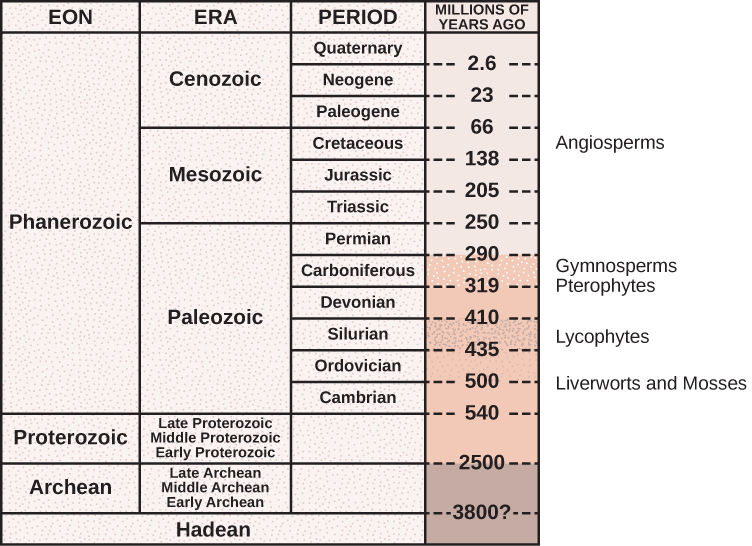
OpenStax, Rice University; Biology 2e. (credit: modification of work by United States Geological Survey) · CC BY 4.0 · Source出典

Figure 26.2図 26.2
Plant timeline. Various plant species evolved in different eras. (credit: modification of work by United States Geological Survey)
植物の年表。さまざまな植物種が異なる時代に進化した。(出典:米国地質調査所の作品を改変)