第26章種子植物
Fruit果実
As the seed develops, the walls of the ovary thicken and form the fruit. The seed forms in an ovary, which also enlarges as the seeds grow. Many foods commonly called vegetables are actually fruits. Eggplants, zucchini, string beans, tomatoes, and bell peppers are all technically fruits because they contain seeds and are derived from the thick ovary tissue. Acorns are true nuts, and winged maple “helicopter seeds” or whirligigs (whose botanical name is samara) are also fruits. Botanists classify fruit into more than two dozen different categories, only a few of which are actually fleshy and sweet.
英語のヒント
種子が発達すると、子房の壁が厚くなり、果実を形成する。種子は子房の中で形成され、種子が育つにつれて子房も大きくなる。一般に野菜と呼ばれる食品の多くは、実は果実である。ナス、ズッキーニ、サヤインゲン、トマト、ピーマンは、種子を含み、厚くなった子房組織に由来するため、厳密にはすべて果実である。ドングリは真正の堅果であり、翼のあるカエデの「ヘリコプターの種」、すなわちくるくる回る実(植物学では翼果という)も果実である。植物学者は果実を二十数種類以上に分類しており、実際に肉質で甘いものは、そのうちわずかである。
Mature fruit can be fleshy or dry. Fleshy fruit include the familiar berries, peaches, apples, grapes, and tomatoes. Rice, wheat, and nuts are examples of dry fruit. Another subtle distinction is that not all fruits are derived from just the ovary. For instance, strawberries are derived from the ovary as well as the receptacle, and apples are formed from the ovary and the pericarp, or hypanthium. Some fruits are derived from separate ovaries in a single flower, such as the raspberry. Other fruits, such as the pineapple, form from clusters of flowers. Additionally, some fruits, like watermelon and orange, have rinds. Regardless of how they are formed, fruits are an agent of seed dispersal. The variety of shapes and characteristics reflect the mode of dispersal. Wind carries the light dry fruits of trees and dandelions. Water transports floating coconuts. Some fruits attract herbivores with their color or scent, or as food. Once eaten, tough, undigested seeds are dispersed through the herbivore’s feces (endozoochory). Other fruits have burrs and hooks to cling to fur and hitch rides on animals (epizoochory).
英語のヒント
成熟した果実には、肉質のものと乾燥したものがある。肉質の果実には、よく知られたベリー類、モモ、リンゴ、ブドウ、トマトがある。コメ、コムギ、堅果類は乾燥した果実の例である。もう一つの微妙な違いは、すべての果実が子房だけに由来するわけではないことである。例えば、イチゴは子房と花床に由来し、リンゴは子房と果皮、すなわち花托筒から形成される。ラズベリーのように、一つの花にある別々の子房から生じる果実もある。パイナップルのように、花の集まりからできる果実もある。さらに、スイカやオレンジのように、厚い外皮をもつものもある。どのように形成されるかにかかわらず、果実は種子散布を担う。形や特徴の多様さは、散布の方法を反映している。風は、樹木やタンポポの軽く乾いた果実を運ぶ。水は、浮かぶココヤシの実を運ぶ。一部の果実は、色や香り、あるいは食物として草食動物を引き寄せる。食べられると、丈夫で消化されなかった種子は、草食動物の糞を通じて散布される(動物被食散布)。他の果実には、とげや鉤があり、毛にしがみついて動物に運んでもらう(動物付着散布)。
Diversity of Angiosperms被子植物の多様性
Angiosperms are classified in a single phylum: the Anthophyta. Modern angiosperms appear to be a monophyletic group, which as you may recall means that they originated from a single ancestor. Within the angiosperms are three major groups: basal angiosperms, monocots, and dicots. Basal angiosperms are a group of plants that are believed to have branched off before the separation of the monocots and dicots, because they exhibit traits from both groups. They are categorized separately in most classification schemes. The basal angiosperms include Amborella, water lilies, the Magnoliids (magnolia trees, laurels, and spice peppers), and a group called the Austrobaileyales, which includes the star anise. The monocots and dicots are differentiated on the basis of the structure of the cotyledons, pollen grains, and other structures. Monocots include grasses and lilies, and the dicots form a multi-branched group that includes (among many others) roses, cabbages, sunflowers, and mints.
英語のヒント
被子植物は、被子植物門(Anthophyta)という一つの門に分類される。現生被子植物は単系統群と考えられる。思い出してほしいが、これは一つの祖先から生じたという意味である。被子植物には、基部被子植物、単子葉類、双子葉類という三つの主要な群がある。基部被子植物は、単子葉類と双子葉類の両方の特徴を示すため、両者が分かれる前に分岐したと考えられる群である。多くの分類体系では独立して扱われる。基部被子植物には、アンボレラ、スイレン類、モクレン類(モクレン、クスノキ類、香辛料になるコショウ類)、そしてトウシキミを含むアウストロバイレヤ目がある。単子葉類と双子葉類は、子葉、花粉粒、その他の構造に基づいて区別される。単子葉類にはイネ科植物やユリ類が含まれる。双子葉類は多くの枝に分かれた群をなし、バラ、キャベツ、ヒマワリ、ハッカなど、さまざまな植物を含む。
Basal Angiosperms基部被子植物
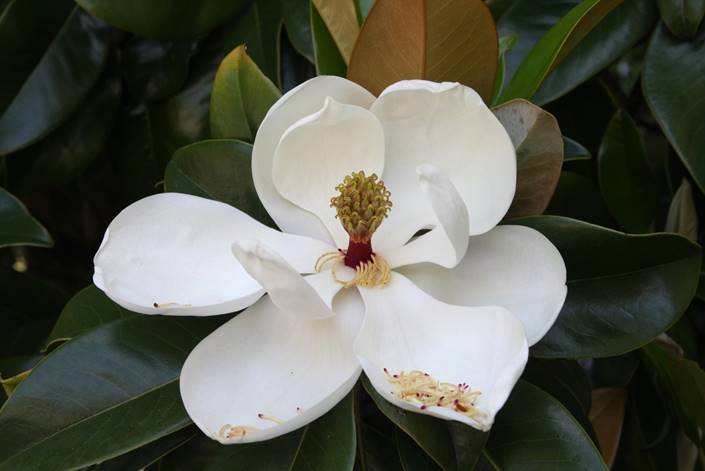
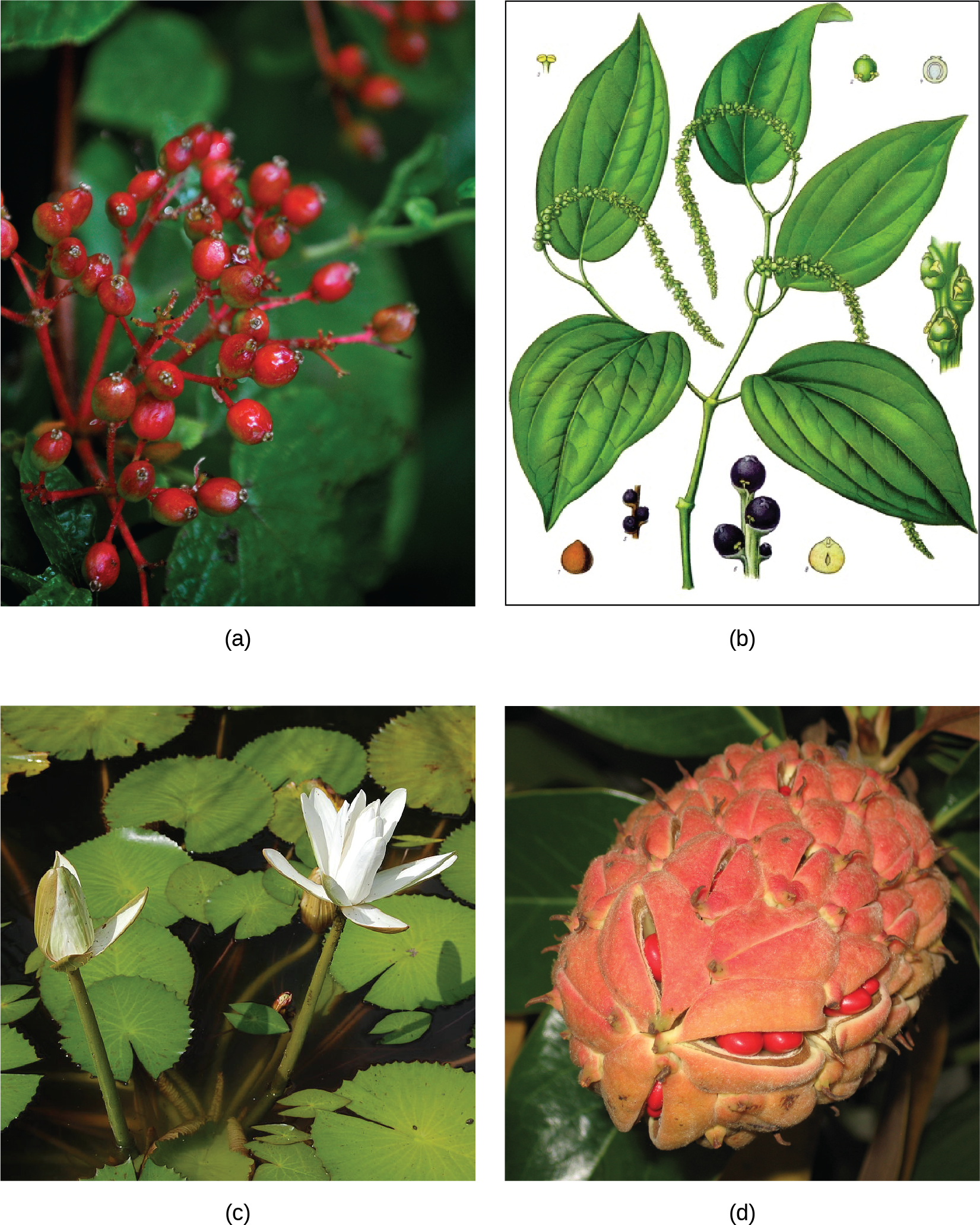
The Magnoliidae are represented by the magnolias, laurels, and peppers. Magnolias are tall trees bearing dark, shiny leaves, and large, fragrant flowers with many parts, and are considered archaic (Figure 26.17). In the outer whorl of the magnolia flower the sepals and petals are undifferentiated and are collectively called tepals. The reproductive parts are arranged in a spiral around a cone-shaped receptacle, with the carpels located above the stamens (Figure 26.17). The aggregate fruit, with one seed formed from each carpel, is seen in Figure 26.18d. Laurel trees produce fragrant leaves and small, inconspicuous flowers. The Laurales grow mostly in warmer climates and are small trees and shrubs. Familiar plants in this group include the bay laurel, cinnamon, spice bush (Figure 26.18a), and avocado tree.
英語のヒント
モクレン類は、モクレン、クスノキ類、コショウ類などに代表される。モクレンは、濃い色で光沢のある葉と、多数の部分からなる大きく香りのよい花をつける高木で、古い特徴をもつと考えられている(図26.17)。モクレンの花の最も外側の輪生では、萼片と花弁が区別されず、まとめて花被片と呼ばれる。生殖部分は、円錐形の花床の周囲にらせん状に配列し、心皮が雄しべの上に位置する(図26.17)。各心皮から一つずつ種子ができた集合果を、図26.18dに示す。クスノキ類は、香りのよい葉と、小さく目立たない花をつくる。クスノキ目は主に温暖な気候で育つ小高木や低木である。この群の身近な植物には、ゲッケイジュ、シナモン、スパイスブッシュ(図26.18a)、アボカドがある。
Ianaré Sévi; Magnolia grandiflora - flower 2. The image retains its original share-alike license. OpenStax, Biology 2e adaptation. · CC BY-SA 3.0 · Source出典

Figure 26.17図 26.17
Magnolia grandiflora. A cluster of carpels can be seen above the stamens, which have shed their pollen and begun to drop from the inflorescence. In the flower, the sepals and petals are undifferentiated and are collectively called tepals. (credit: Ianaré Sévi. http://bioimages.vanderbilt.edu/baskauf/10949)
タイサンボク Magnolia grandiflora。花粉を放出し、花序から落ち始めた雄しべの上に、心皮の集まりが見える。この花では萼片と花弁が区別されず、まとめて花被片と呼ばれる。(出典:Ianaré Sévi。http://bioimages.vanderbilt.edu/baskauf/10949)
OpenStax, Rice University; Biology 2e. (credit a: modification of work by Cory Zanker; credit b: modification of work by Franz Eugen Köhler; credit c: modification of work by Rl/Wikimedia Commons. d: modification of work by "Coastside2"/Wikimedia Commons). · CC BY 4.0 · Source出典

Figure 26.18図 26.18
Basal angiosperms. The (a) common spicebush belongs to the Laurales, the same family as cinnamon and bay laurel. The fruit of (b) the Piper nigrum plant is black pepper, the main product that was traded along spice routes. Notice the small, unobtrusive, clustered flowers. The leaf venation resembles that of both the monocots (parallel) and the dicots (branched). (c) Water lilies, Nymphaea lotus. Although the leaves of the plant float on the surface of the water, their roots are in the underlying soil at the bottom of the lake. The aggregate fruit of a magnolia (d). The fruit is in its final stage, with its red seeds just starting to appear. (credit a: modification of work by Cory Zanker; credit b: modification of work by Franz Eugen Köhler; credit c: modification of work by Rl/Wikimedia Commons. d: modification of work by "Coastside2"/Wikimedia Commons).
基部被子植物。(a)スパイスブッシュは、シナモンやゲッケイジュと同じ仲間のクスノキ目に属する。(b)Piper nigrum の果実は黒コショウであり、香辛料交易路で取引された主要な産物だった。小さく目立たず、密集した花に注目しよう。葉脈は、単子葉類の平行脈と双子葉類の分岐脈の両方に似ている。(c)スイレンの一種 Nymphaea lotus。葉は水面に浮かぶが、根は湖底の土壌にある。(d)モクレンの集合果。果実は最終段階にあり、赤い種子が姿を現し始めている。(a:Cory Zanker の作品を改変、b:Franz Eugen Köhler の作品を改変、c:Rl/Wikimedia Commons の作品を改変、d:「Coastside2」/Wikimedia Commons の作品を改変)