第26章種子植物
The Life Cycle of an Angiosperm被子植物の生活環
The adult or sporophyte phase is the main phase of an angiosperm’s life cycle (Figure 26.15). Like gymnosperms, angiosperms are heterosporous. Therefore, they produce microspores, which will generate pollen grains as the male gametophytes, and megaspores, which will form an ovule that contains female gametophytes. Inside the anther’s microsporangia, male sporocytes divide by meiosis to generate haploid microspores, which, in turn, undergo mitosis and give rise to pollen grains. Each pollen grain contains two cells: one generative cell that will divide into two sperm and a second cell that will become the pollen tube cell.
英語のヒント
被子植物の生活環では、成熟個体、すなわち胞子体の段階が主要な段階である(図26.15)。裸子植物と同様に、被子植物は異形胞子性である。そのため、雄性配偶体である花粉粒を生じる小胞子と、雌性配偶体を含む胚珠を形成する大胞子をつくる。葯の小胞子嚢の内部では、雄性の胞子母細胞が減数分裂し、半数体の小胞子を生じる。小胞子は次に有糸分裂し、花粉粒を生じる。各花粉粒には二つの細胞がある。一つは分裂して二つの精細胞となる生殖細胞であり、もう一つは花粉管細胞となる細胞である。
The ovule, sheltered within the ovary of the carpel, contains the megasporangium protected by two layers of integuments and the ovary wall. Within each megasporangium, a diploid megasporocyte undergoes meiosis, generating four haploid megaspores—three small and one large. Only the large megaspore survives; it divides mitotically three times to produce eight nuclei distributed among the seven cells of the female gametophyte or embryo sac. Three of these cells are located at each pole of the embryo sac. The three cells at one pole become the egg and two synergids. The three cells at the opposite pole become antipodal cells. The center cell contains the remaining two nuclei (polar nuclei). This cell will eventually produce the endosperm of the seed. The mature embryo sac then contains one egg cell, two synergids or “helper” cells, three antipodal cells (which eventually degenerate), and a central cell with two polar nuclei. When a pollen grain reaches the stigma, a pollen tube extends from the grain, grows down the style, and enters through the micropyle: an opening in the integuments of the ovule. The two sperm are deposited in the embryo sac.
英語のヒント
心皮の子房内で保護されている胚珠には、大胞子嚢が含まれる。大胞子嚢は、二層の珠皮と子房壁によって守られている。それぞれの大胞子嚢内では、二倍体の大胞子母細胞が減数分裂し、小さいもの三つと大きいもの一つ、計四つの半数体の大胞子を生じる。大きい大胞子だけが生き残り、有糸分裂を三回行って八つの核を生じる。これらの核は、雌性配偶体、すなわち胚嚢の七つの細胞に分かれて入る。胚嚢の両端には、それぞれ三つの細胞がある。一方の端の三つの細胞は、卵と二つの助細胞になる。反対側の端の三つは、反足細胞になる。中央の細胞には、残る二つの核、すなわち極核が含まれる。この細胞は、最終的に種子の胚乳を生じる。したがって成熟した胚嚢には、一つの卵細胞、二つの助細胞、やがて退化する三つの反足細胞、そして二つの極核をもつ中央細胞が含まれる。花粉粒が柱頭に到達すると、花粉管が花粉粒から伸び、花柱を下って、胚珠の珠皮の開口部である珠孔から入る。二つの精細胞が胚嚢に送り込まれる。
A double fertilization event then occurs. One sperm and the egg combine, forming a diploid zygote—the future embryo. The other sperm fuses with the polar nuclei, forming a triploid cell that will develop into the endosperm—the tissue that serves as a food reserve for the developing embryo. The zygote develops into an embryo with a radicle, or small root, and one (monocot) or two (dicot) leaf-like organs called cotyledons. This difference in the number of embryonic leaves is the basis for the two major groups of angiosperms: the monocots and the eudicots. Seed food reserves are stored outside the embryo, in the form of complex carbohydrates, lipids, or proteins. The cotyledons serve as conduits to transmit the broken-down food reserves from their storage site inside the seed to the developing embryo. The seed consists of a toughened layer of integuments forming the coat, the endosperm with food reserves, and at the center, the well-protected embryo.
英語のヒント
続いて、重複受精が起こる。一つの精細胞は卵と融合し、将来の胚となる二倍体の接合子を形成する。もう一つの精細胞は極核と融合し、三倍体の細胞を形成する。この細胞は胚乳へ発達する。胚乳は、発達中の胚のために養分を蓄える組織である。接合子は、幼根、すなわち小さな根と、子葉と呼ばれる葉状の器官をもつ胚へと発達する。子葉は、単子葉植物では一枚、双子葉植物では二枚である。この胚の葉の数の違いが、被子植物の二大群である単子葉類と真正双子葉類を分ける基準となる。種子の貯蔵養分は、複雑な炭水化物、脂質、タンパク質という形で、胚の外側に蓄えられる。子葉は、種子内の貯蔵部位で分解された養分を、発達中の胚へ運ぶ通路として働く。種子は、丈夫になった珠皮の層からなる種皮、養分を蓄えた胚乳、そして中心で十分に保護された胚からなる。
Most angiosperms have perfect flowers, which means that each flower carries both stamens and carpels (Figure 26.15). In monoecious plants, male (staminate) and female (pistillate) flowers are separate, but carried on the same plant. Sweetgums (Liquidambar spp.) and birches (Betula spp.) are monoecious (Figure 26.16). In dioecious plants, male and female flowers are found on separate plants. Willows (Salix spp.) and poplars (Populus spp.) are dioecious. In spite of the predominance of perfect flowers, only a few species of angiosperms self-pollinate. Both anatomical and environmental barriers promote cross-pollination mediated by a physical agent (wind or water), or an animal, such as an insect or bird. Cross-pollination increases genetic diversity in a species.
英語のヒント
被子植物の大半は両性花をもち、一つの花に雄しべと心皮の両方がある(図26.15)。雌雄同株の植物では、雄花と雌花は別々だが、同じ個体につく。フウ属(Liquidambar spp.)やカバノキ属(Betula spp.)は雌雄同株である(図26.16)。雌雄異株の植物では、雄花と雌花は別々の個体につく。ヤナギ属(Salix spp.)やヤマナラシ属(Populus spp.)は雌雄異株である。両性花が多いにもかかわらず、自家受粉する被子植物の種は少ない。構造上の障壁と環境による障壁の両方が、風や水などの物理的な媒介、あるいは昆虫や鳥などの動物による他家受粉を促す。他家受粉は、種内の遺伝的多様性を高める。
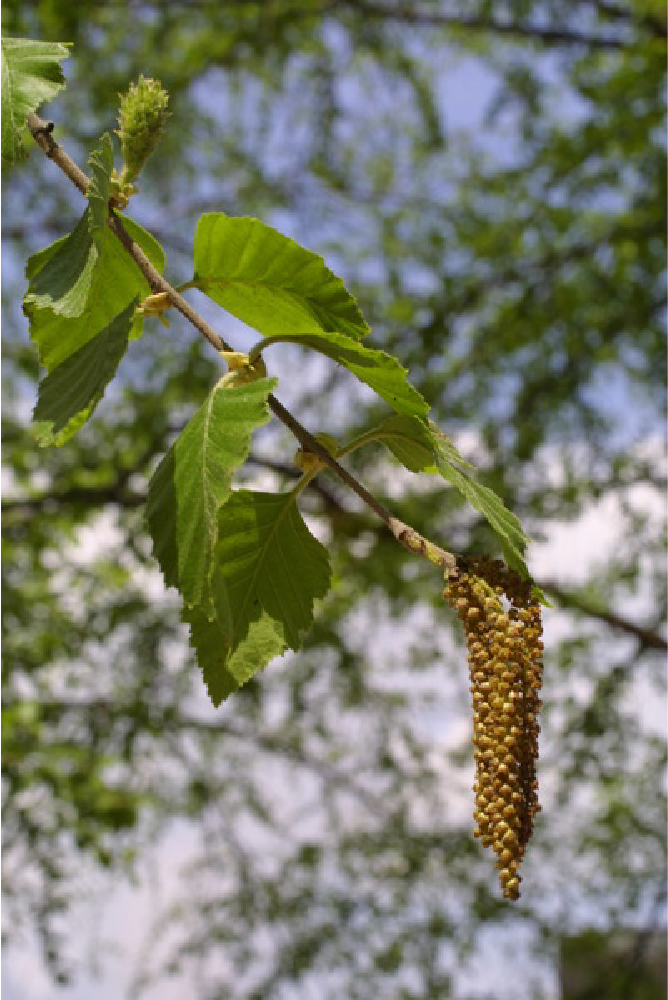
© 2002 Steven J. Baskauf, Bioimages; Betula nigra inflorescences. OpenStax, Biology 2e adaptation. · CC BY 4.0 · Source出典
Figure 26.16図 26.16
Birch inflorescences. The female inflorescence is at the upper left. The male inflorescence is at the lower right. (credit: Stephen J. Baskauf, 2002. http://bioimages.vanderbilt.edu/baskauf/10593. Morphbank :: Biological Imaging (http://www.morphbank.net/, 29 June 2017). Florida State University, Department of Scientific Computing, Tallahassee, FL 32306-4026 USA)
カバノキの花序。雌花序は左上、雄花序は右下にある。(出典:Stephen J. Baskauf、2002年。http://bioimages.vanderbilt.edu/baskauf/10593。Morphbank :: Biological Imaging(http://www.morphbank.net/、2017年6月29日)。フロリダ州立大学科学計算学科、米国フロリダ州タラハシー、32306-4026)