第26章種子植物
Evolution of Gymnosperms裸子植物の進化
The fossil plant Elkinsia polymorpha, a "seed fern" from the Devonian period—about 400 million years ago—is considered the earliest seed plant known to date. Seed ferns (Figure 26.3) produced their seeds along their branches, in structures called cupules that enclosed and protected the ovule—the female gametophyte and associated tissues—which develops into a seed upon fertilization. Seed plants resembling modern tree ferns became more numerous and diverse in the coal swamps of the Carboniferous period.
英語のヒント
約4億年前のデボン紀の「種子シダ」、化石植物Elkinsia polymorphaは、現在知られる最古の種子植物とされる。種子シダ(図26.3)は枝に沿って種子を作り、殻斗という構造が胚珠を包み保護した。胚珠は雌性配偶体と関連組織からなり、受精すると種子になる。現生の木生シダに似た種子植物は、石炭紀の石炭湿地で数と多様性を増した。
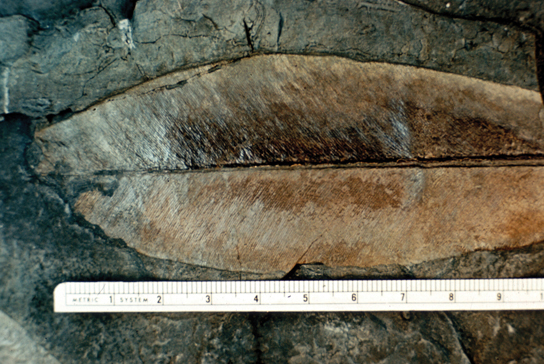
Figure 26.3図 26.3
Seed fern leaf. This fossilized leaf is from Glossopteris, a seed fern that thrived during the Permian age (290–240 million years ago). (credit: D.L. Schmidt, USGS)
種子シダの葉。この化石葉は、ペルム紀(2億9,000万〜2億4,000万年前)に繁栄したグロッソプテリスのもの。(出典:D. L. Schmidt、USGS)
Fossil records indicate the first gymnosperms (progymnosperms) most likely originated in the Paleozoic era, during the middle Devonian period: about 390 million years ago. The following Carboniferous period was wet and dominated by giant fern trees. But the following Permian period was dry, which gave a reproductive edge to seed plants, which are better adapted to survive dry spells. The Ginkgoales, a group of gymnosperms with only one surviving species—the Ginkgo biloba—were the first gymnosperms to appear during the early Permian. Gymnosperms expanded in the Mesozoic era (about 240 million years ago), supplanting ferns in the landscape, and reaching their greatest diversity during this time. The Jurassic period was as much the age of the cycads (palm-tree-like gymnosperms) as the age of the dinosaurs. Ginkgoales and the more familiar conifers also dotted the landscape. Today, although angiosperms (flowering plants) are the major form of plant life in most biomes, gymnosperms still dominate some ecosystems, such as the taiga (boreal forests) and the alpine forests at higher mountain elevations (Figure 26.4) because of their adaptation to cold and dry growth conditions.
英語のヒント
化石記録は、最初の裸子植物(前裸子植物)が古生代のデボン紀中期、約3億9,000万年前に起源を持つ可能性が高いと示す。続く石炭紀は湿潤で巨大な木生シダが優勢だったが、その後のペルム紀は乾燥し、乾期に生き残るのに適した種子植物が繁殖で有利になった。現生種がイチョウGinkgo biloba一種だけのイチョウ目は、ペルム紀初期に現れた最初の裸子植物だった。裸子植物は中生代、約2億4,000万年前に広がり、シダに代わって景観を占め、この時期に最大の多様性に達した。ジュラ紀は恐竜の時代であると同時に、ヤシに似た裸子植物であるソテツの時代でもあった。イチョウ目や、よりなじみ深い針葉樹も点在した。現在、多くのバイオームでは被子植物が主流だが、裸子植物は寒冷・乾燥への適応によって、タイガ(北方林)や高山の森林などをなお支配している(図26.4)。
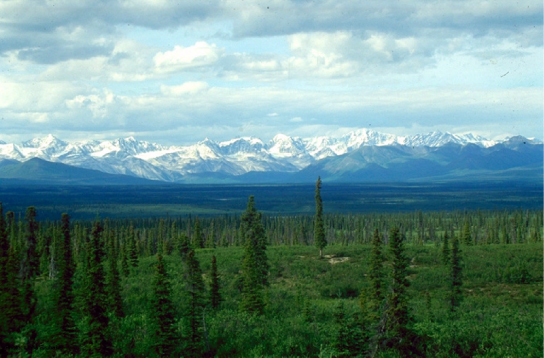
Figure 26.4図 26.4
Conifers. This boreal forest (taiga) has low-lying plants and conifer trees. (credit: L.B. Brubaker, NOAA)
針葉樹。この北方林(タイガ)には低い植物と針葉樹がある。(出典:L. B. Brubaker、NOAA)
Seeds and Pollen as an Evolutionary Adaptation to Dry Land乾燥した陸地への進化的適応としての種子と花粉
Bryophyte and fern spores are haploid cells dependent on moisture for rapid development of multicellular gametophytes. In the seed plants, the female gametophyte consists of just a few cells: the egg and some supportive cells, including the endosperm-producing cell that will support the growth of the embryo. After fertilization of the egg, the diploid zygote produces an embryo that will grow into the sporophyte when the seed germinates. Storage tissue to sustain growth of the embryo and a protective coat give seeds their superior evolutionary advantage. Several layers of hardened tissue prevent desiccation, and free the embryo from the need for a constant supply of water. Furthermore, seeds remain in a state of dormancy—induced by desiccation and the hormone abscisic acid—until conditions for growth become favorable. Whether blown by the wind, floating on water, or carried away by animals, seeds are scattered in an expanding geographic range, thus avoiding competition with the parent plant.
英語のヒント
コケ植物とシダの胞子は半数体細胞で、多細胞配偶体へ速やかに発達するために水分を必要とする。種子植物の雌性配偶体は少数の細胞、つまり卵と、胚の成長を支える胚乳形成細胞などの支持細胞からなる。受精後、二倍体接合子は胚を作り、種子が発芽すると胞子体へ成長する。胚の成長を維持する貯蔵組織と保護殻が、種子に大きな進化的利点を与える。硬い組織の数層が乾燥を防ぎ、胚を絶え間ない水の供給から解放する。さらに種子は、乾燥とアブシシン酸に誘導される休眠状態を、成長条件がよくなるまで保つ。風に吹かれ、水に浮かび、動物に運ばれて、より広い範囲に散布され、親植物との競争を避ける。
Pollen grains (Figure 26.5) are male gametophytes containing just a few cells and are distributed by wind, water, or an animal pollinator. The whole structure is protected from desiccation and can reach the female organs without depending on water. After reaching a female gametophyte, the pollen grain grows a tube that will deliver a male nucleus to the egg cell. The sperm of modern gymnosperms and all angiosperms lack flagella, but in cycads, Ginkgo, and other primitive gymnosperms, the sperm are still motile, and use flagella to swim to the female gamete; however, they are delivered to the female gametophyte enclosed in a pollen grain. The pollen grows or is taken into a fertilization chamber, where the motile sperm are released and swim a short distance to an egg.
英語のヒント
花粉粒(図26.5)は少数の細胞を含む雄性配偶体で、風、水、動物の送粉者によって運ばれる。全体が乾燥から守られ、水に依存せず雌性器官へ到達できる。雌性配偶体へ届くと花粉管を伸ばし、雄性核を卵細胞へ届ける。現生の裸子植物とすべての被子植物の精子には鞭毛がないが、ソテツ、イチョウなどの原始的な裸子植物では精子がなお運動性を持ち、鞭毛で雌性配偶子まで泳ぐ。ただし精子は花粉に包まれて雌性配偶体へ届けられる。花粉が伸びるか受精室へ取り込まれると、運動性精子が放出され、短い距離を泳いで卵へ向かう。
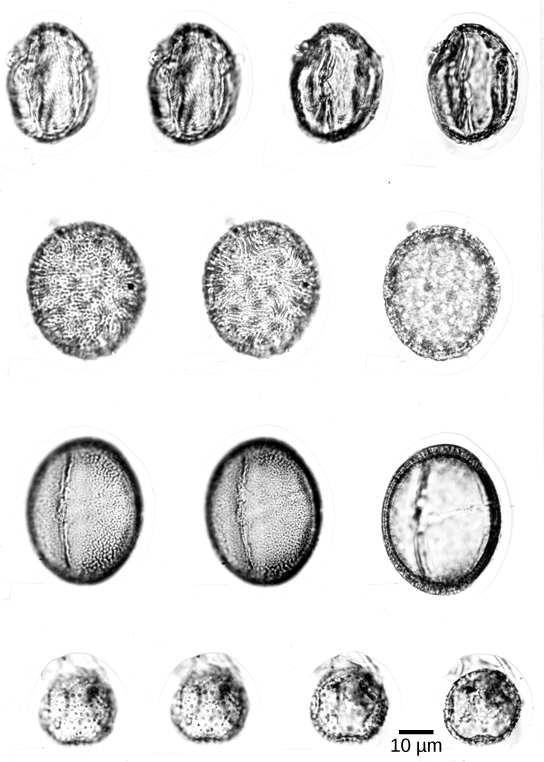
OpenStax, Rice University; Biology 2e. (credit: R.G. Baker, USGS; scale-bar data from Matt Russell) · CC BY 4.0 · Source出典
Figure 26.5図 26.5
Pollen fossils. This fossilized pollen is from a Buckbean fen core found in Yellowstone National Park, Wyoming. The pollen is magnified 1,054 times. (credit: R.G. Baker, USGS; scale-bar data from Matt Russell)
花粉化石。ワイオミング州イエローストーン国立公園のBuckbean湿原のコアから得られた花粉。1,054倍に拡大。(出典:R. G. Baker、USGS。スケールバーのデータ:Matt Russell)
Evolution of Angiosperms被子植物の進化
The roughly 200 million years between the appearance of the gymnosperms and the flowering plants gives us some appreciation for the evolutionary experimentation that ultimately produced flowers and fruit. Angiosperms (“seed in a vessel”) produce a flower containing male and/or female reproductive structures. Fossil evidence (Figure 26.6) indicates that flowering plants first appeared about 125 million years ago in the Lower Cretaceous (late in the Mesozoic era), and were rapidly diversifying by about 100 million years ago in the Middle Cretaceous. Earlier traces of angiosperms are scarce. Fossilized pollen recovered from Jurassic geological material has been attributed to angiosperms. A few early Cretaceous rocks show clear imprints of leaves resembling angiosperm leaves. By the mid-Cretaceous, a staggering number of diverse flowering plants crowd the fossil record. The same geological period is also marked by the appearance of many modern groups of insects, suggesting that pollinating insects played a key role in the evolution of flowering plants.
英語のヒント
裸子植物の出現から花を付ける植物までの約2億年という間隔は、花と果実を生んだ進化の試行の長さを感じさせる。被子植物(「器の中の種子」)は雄性・雌性、またはその両方の生殖構造を含む花を作る。化石証拠(図26.6)によると、約1億2,500万年前の前期白亜紀、中生代後半に初めて現れ、約1億年前の白亜紀中頃には急速に多様化していた。より古い痕跡は少ない。ジュラ紀の地質試料から得た化石花粉が被子植物のものとされ、前期白亜紀の岩石の一部には、被子植物に似た葉の明瞭な印象がある。白亜紀中頃には、驚くほど多くの多様な顕花植物が化石記録を占める。同時期には現生の昆虫群の多くも現れており、送粉昆虫が顕花植物の進化で重要な役割を果たしたことを示唆する。
New data in comparative genomics and paleobotany (the study of ancient plants) have shed some light on the evolution of angiosperms. Although the angiosperms appeared after the gymnosperms, they are probably not derived from gymnosperm ancestors. Instead, the angiosperms form a sister clade (a species and its descendents) that developed in parallel with the gymnosperms. The two innovative structures of flowers and fruit represent an improved reproductive strategy that served to protect the embryo, while increasing genetic variability and range. There is no current consensus on the origin of the angiosperms. Paleobotanists debate whether angiosperms evolved from small woody bushes, or were related to the ancestors of tropical grasses. Both views draw support from cladistics, and the so-called woody magnoliid hypothesis—which proposes that the early ancestors of angiosperms were shrubs like modern magnolia—also offers molecular biological evidence.
英語のヒント
比較ゲノム学と古植物学、つまり古代植物の研究の新しいデータが、被子植物の進化の理解を進めた。被子植物は裸子植物の後に現れたが、裸子植物の祖先から生じたわけではなさそうである。むしろ裸子植物と並行して発達した姉妹クレード、つまり一つの種とその子孫のまとまりを作る。花と果実という二つの新構造は、胚を守りながら遺伝的変異と分布範囲を増す、改良された繁殖戦略となった。被子植物の起源に現在の合意はない。小さな木本の低木から進化したのか、熱帯草本の祖先に近縁だったのかが議論される。両説は分岐分類学に裏付けられ、初期の祖先は現生のモクレンのような低木だったとする木本モクレン類仮説は、分子生物学的な証拠も提示している。
The most primitive living angiosperm is considered to be Amborella trichopoda, a small plant native to the rainforest of New Caledonia, an island in the South Pacific. Analysis of the genome of A. trichopoda has shown that it is related to all existing flowering plants and belongs to the oldest confirmed branch of the angiosperm family tree. The nuclear genome shows evidence of an ancient whole-genome duplication. The mitochondrial genome is large and multichromosomal, containing elements from the mitochondrial genomes of several other species, including algae and a moss. A few other angiosperm groups, called basal angiosperms, are viewed as having ancestral traits because they branched off early from the phylogenetic tree. Most modern angiosperms are classified as either monocots or eudicots, based on the structure of their leaves and embryos. Basal angiosperms, such as water lilies, are considered more ancestral in nature because they share morphological traits with both monocots and eudicots.
英語のヒント
現生で最も原始的な被子植物とされるのは、南太平洋ニューカレドニア島の熱帯雨林に自生する小植物アンボレラ・トリコポダである。ゲノム分析から、すべての現生顕花植物に近縁で、被子植物の系統樹の確認済みの最古の枝に属すると分かった。核ゲノムには古い全ゲノム重複の証拠がある。ミトコンドリアゲノムは大きく複数の染色体からなり、藻類やコケを含む別種のミトコンドリアゲノムの要素を含む。ほかにも少数の基部被子植物群があり、系統樹の早期に分かれたため祖先的形質を持つとされる。現生被子植物の多くは、葉や胚の構造によって単子葉類と真正双子葉類に分けられる。スイレンなどの基部被子植物は両者と形態的特徴を共有するので、性質がより祖先的と考えられる。
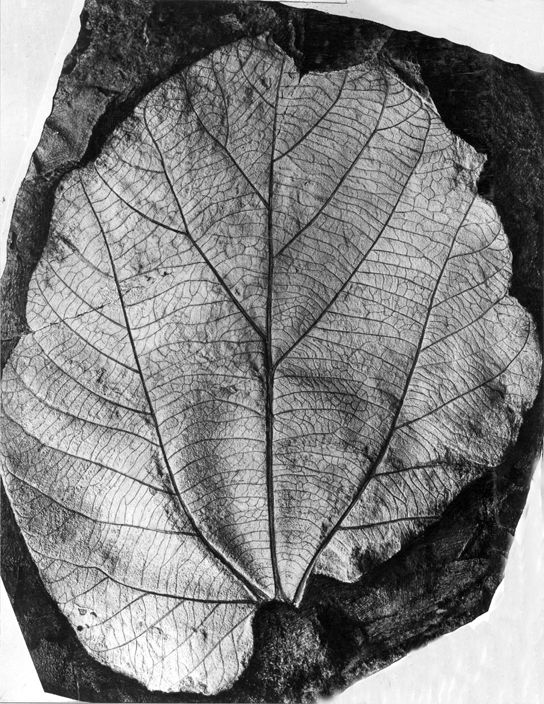


Figure 26.6図 26.6
Ficus imprint. This leaf imprint shows a Ficus speciosissima, an angiosperm that flourished during the Cretaceous period. (credit: W. T. Lee, USGS)
イチジク属の印象化石。白亜紀に繁栄した被子植物Ficus speciosissimaの葉の跡。(出典:W. T. Lee、USGS)