第24章菌類
24.5 Importance of Fungi in Human Life24.5 ヒトの生活における菌類の重要性
Learning Objectives学習目標
By the end of this section, you will be able to do the following:
この節を学ぶと、次のことができるようになる。
- Describe the importance of fungi to the balance of the environment環境のバランスにおける菌類の重要性を説明する。
- Summarize the role of fungi in agriculture and food and beverage preparation農業と食品・飲料の製造における菌類の役割をまとめる。
- Describe the importance of fungi in the chemical and pharmaceutical industries化学産業と製薬産業における菌類の重要性を説明する。
- Discuss the role of fungi as model organismsモデル生物としての菌類の役割を論じる。
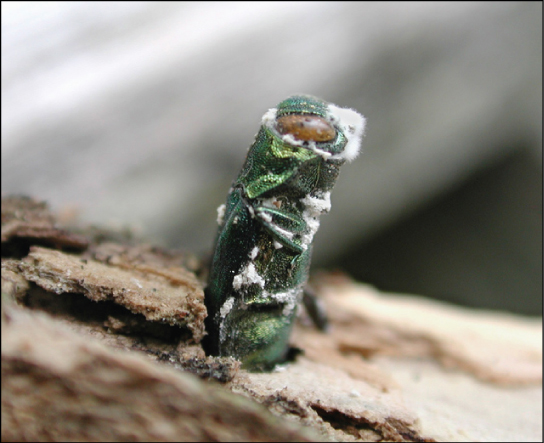
Although we often think of fungi as organisms that cause disease and rot food, they are vitally important to human life on many levels. As we have seen, fungi influence the well-being of human populations on a large scale because they are part of the nutrient cycle in ecosystems. They have other ecosystem roles as well. As animal pathogens, fungi help to control the population of damaging pests. These fungi are very specific to the insects they attack, and do not infect other animals or plants. Fungi are currently under investigation as potential microbial insecticides, with several already on the market. For example, the fungus Beauveria bassiana is being tested as a possible biological control agent for the recent spread of emerald ash borer a beetle that feeds on ash trees. It has been released in Michigan, Illinois, Indiana, Ohio, West Virginia, and Maryland (Figure 24.28).
英語のヒント
私たちは菌類を、病気を起こし食物を腐らせる生物と考えがちだが、菌類は多くの面でヒトの生活に極めて重要である。これまで見たように、生態系の栄養循環の一部であるため、ヒトの集団の暮らしの健全さに大規模な影響を与える。生態系では、ほかの役割もある。動物病原体として、菌類は有害な害虫の個体数制御を助ける。これらの菌類は、攻撃する昆虫に非常に特異的で、他の動物や植物へ感染しない。現在、微生物殺虫剤としての可能性が研究され、すでにいくつかは市販されている。たとえば、Beauveria bassianaは、近年拡大したトネリコ食害甲虫アオナガタマムシの、生物的防除剤候補として試験されている。ミシガン、イリノイ、インディアナ、オハイオ、ウェストバージニア、メリーランドの各州で放出されている(図24.28)。
OpenStax, Rice University; Biology 2e. (credit: Houping Liu, USDA Agricultural Research Service) · CC BY 4.0 · Source出典

Figure 24.28図 24.28
Fungal insect control. The emerald ash borer (Agrilus planipennis) is an insect that attacks ash trees. It is in turn parasitized by a pathogenic fungus (Beauveria bassiana) that holds promise as a biological insecticide. The parasitic fungus appears as white fuzz on the body of the insect. (credit: Houping Liu, USDA Agricultural Research Service)
菌類による昆虫防除。アオナガタマムシ(Agrilus planipennis)は、トネリコを攻撃する昆虫である。その昆虫も、生物殺虫剤として期待される病原菌Beauveria bassianaに寄生される。寄生菌は、昆虫の体の白い綿毛として見える。(クレジット:Houping Liu、USDA Agricultural Research Service)
The mycorrhizal relationship between fungi and plant roots is essential for the productivity of farm land. Without the fungal partner in root systems, 80–90 percent of trees and grasses would not survive. Mycorrhizal fungal inoculants are available as soil amendments from gardening supply stores and are promoted by supporters of organic agriculture, but there is little evidence as to the effectiveness.
英語のヒント
菌類と植物の根の菌根関係は、農地の生産性に不可欠である。根系に菌類の相手がいなければ、樹木や草本の80〜90%は生存できないだろう。菌根菌の接種資材は、園芸用品店で土壌改良材として入手でき、有機農業の支持者によって推奨されているが、その有効性についての証拠は乏しい。
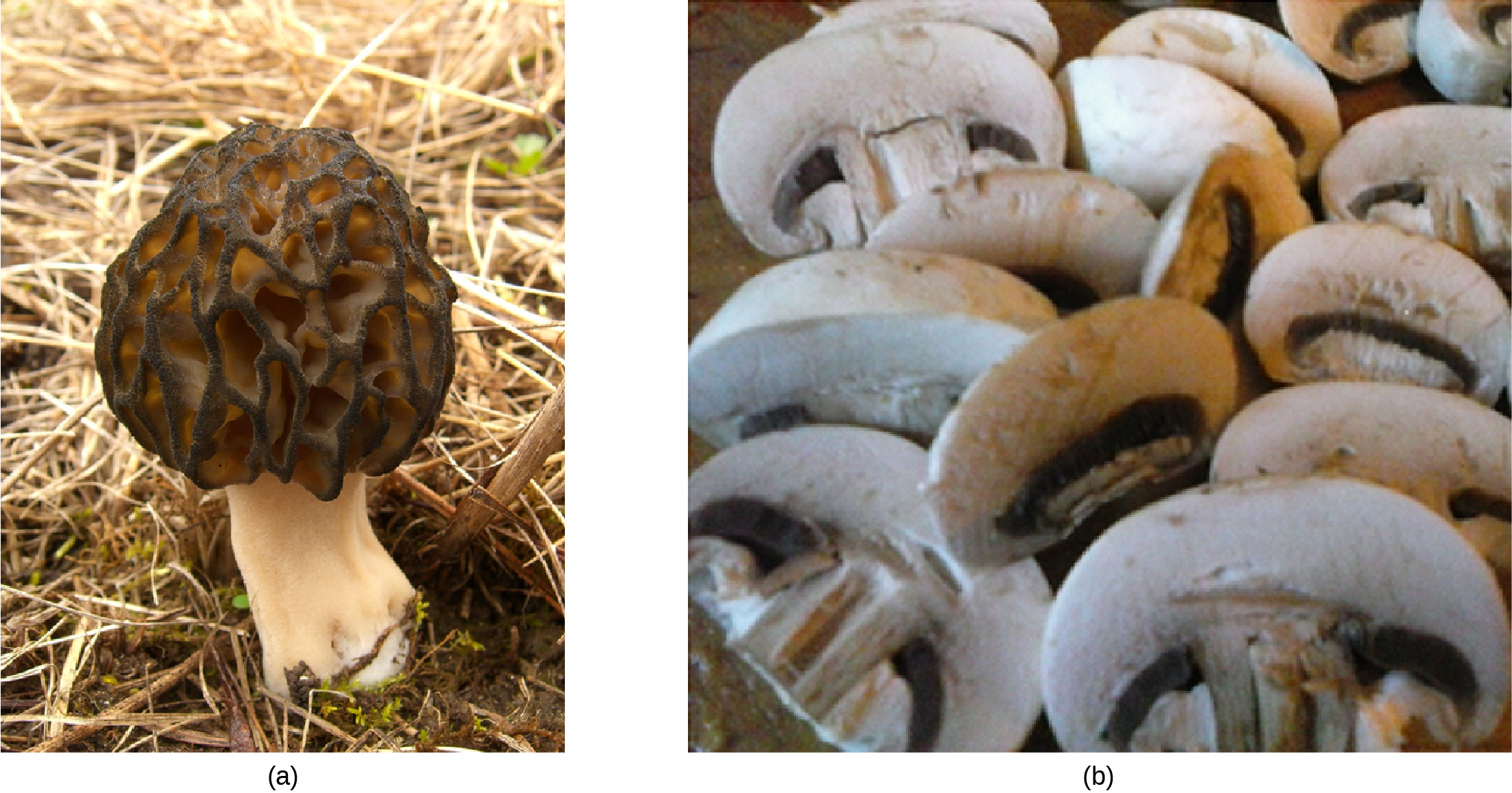
We also eat some types of fungi. Mushrooms figure prominently in the human diet. Morels, shiitake mushrooms, chanterelles, and truffles are considered delicacies (Figure 24.29). The humble meadow mushroom, Agaricus campestris, appears in many dishes. Molds of the genus Penicillium ripen many cheeses. They originate in the natural environment such as the caves of Roquefort, France, where wheels of sheep milk cheese are stacked in order to capture the molds responsible for the blue veins and pungent taste of the cheese.
英語のヒント
私たちは、ある種の菌類を食べもする。キノコはヒトの食事で重要な位置を占める。アミガサタケ、シイタケ、アンズタケ、トリュフは、高級食材とされる(図24.29)。ありふれたハラタケAgaricus campestrisも、多くの料理に使われる。Penicillium属のカビは、多くのチーズを熟成させる。カビは、フランスのロックフォールの洞窟など、自然環境に由来する。そこでは、羊乳で作った円盤状チーズを積み重ね、青い筋と刺激的な味をもたらすカビを取り込む。
OpenStax, Rice University; Biology 2e. (credit: Jason Hollinger). (b) Basidiocarps of Agaricus ready for an omelet (credit: Mary Anne Clark) · CC BY 4.0 · Source出典

Figure 24.29図 24.29
Edible fungi. (a) The morel mushroom is an ascomycete greatly appreciated for its delicate taste. (credit: Jason Hollinger). (b) Basidiocarps of Agaricus ready for an omelet (credit: Mary Anne Clark)
食用菌。(a)アミガサタケは、繊細な味で高く評価される子嚢菌である。(クレジット:Jason Hollinger)(b)オムレツ用に準備されたハラタケ属の担子器果。(クレジット:Mary Anne Clark)
Fermentation—of grains to produce beer, and of fruits to produce wine—is an ancient art that humans in most cultures have practiced for millennia. Wild yeasts are acquired from the environment and used to ferment sugars into CO2 and ethyl alcohol under anaerobic conditions. It is now possible to purchase isolated strains of wild yeasts from different wine-making regions. Louis Pasteur was instrumental in developing a reliable strain of brewer’s yeast, Saccharomyces cerevisiae, for the French brewing industry in the late 1850s. This was one of the first examples of biotechnology patenting.
英語のヒント
穀物からビールを、果物からワインを作る発酵は、大部分の文化で数千年にわたり行われてきた古い技術である。環境から得た野生酵母を用い、嫌気条件下で糖をCO2とエチルアルコールへ発酵させる。現在では、さまざまなワイン産地から分離した野生酵母の株を購入できる。1850年代後半、ルイ・パスツールは、フランスの醸造産業のため、信頼できるビール酵母Saccharomyces cerevisiaeの株を開発するのに、重要な役割を果たした。これは、バイオテクノロジーの特許化の最初期の例の一つだった。
Many secondary metabolites of fungi are of great commercial importance. Antibiotics are naturally produced by fungi to kill or inhibit the growth of bacteria, limiting their competition in the natural environment. Important antibiotics, such as penicillin and the cephalosporins, are isolated from fungi. Valuable drugs isolated from fungi include the immunosuppressant drug cyclosporine (which reduces the risk of rejection after organ transplant), the precursors of steroid hormones, and ergot alkaloids used to stop bleeding. Psilocybin is a compound found in fungi such as Psilocybe semilanceata and Gymnopilus junonius, which have been used for their hallucinogenic properties by various cultures for thousands of years.
英語のヒント
菌類の多くの二次代謝産物は、商業的に非常に重要である。抗生物質は、細菌を殺したり、その成長を抑えたりするために菌類が自然に作り、自然環境での競争を制限する。ペニシリンやセファロスポリン類などの重要な抗生物質は、菌類から分離される。菌類から分離される有用な薬には、臓器移植後の拒絶リスクを減らす免疫抑制薬シクロスポリン、ステロイドホルモンの前駆体、止血に用いる麦角アルカロイドがある。シロシビンは、Psilocybe semilanceataやGymnopilus junoniusなどの菌類に含まれる化合物で、これらの菌類は、さまざまな文化で数千年間、幻覚作用のために用いられてきた。
As simple eukaryotic organisms, fungi are important model research organisms. Many advances in modern genetics were achieved by the use of the red bread mold Neurospora crassa. Additionally, many important genes originally discovered in S. cerevisiae served as a starting point in discovering analogous human genes. As a eukaryotic organism, the yeast cell produces and modifies proteins in a manner similar to human cells, as opposed to the bacterium Escherichia coli, which lacks the internal membrane structures and enzymes to tag proteins for export. This makes yeast a much better organism for use in recombinant DNA technology experiments. Like bacteria, yeasts grow easily in culture, have a short generation time, and are amenable to genetic modification.
英語のヒント
菌類は単純な真核生物として、研究上重要なモデル生物である。現代遺伝学の多くの進歩は、アカパンカビNeurospora crassaを用いて達成された。また、S. cerevisiaeで初めて発見された多くの重要な遺伝子が、対応するヒト遺伝子の発見の出発点となった。真核生物である酵母細胞は、ヒト細胞に似た方法でタンパク質を作り、修飾する。これに対し、細菌Escherichia coliは、輸送用の目印をタンパク質につけるための内膜構造や酵素を欠く。このため、組換えDNA技術の実験には、酵母のほうがはるかに適している。細菌と同じく、酵母は培養で容易に育ち、世代時間が短く、遺伝子改変を行いやすい。