第24章菌類
Ascomycota: The Sac Fungi子嚢菌門:子嚢菌類
The majority of known fungi belong to the Phylum Ascomycota, which is characterized by the formation of an ascus (plural, asci), a sac-like structure that contains haploid ascospores. Filamentous ascomycetes produce hyphae divided by perforated septa, allowing streaming of cytoplasm from one cell to another. Conidia and asci, which are used respectively for asexual and sexual reproduction, are usually separated from the vegetative hyphae by blocked (non-perforated) septa. Many ascomycetes are of commercial importance. Some play a beneficial role for humanity, such as the yeasts used in baking, brewing, and wine fermentation, and directly as food delicacies such as truffles and morels. Aspergillus oryzae is used in the fermentation of rice to produce sake. Other ascomycetes parasitize plants and animals, including humans. For example, fungal pneumonia poses a significant threat to AIDS patients who have a compromised immune system. Ascomycetes not only infest and destroy crops directly; they also produce poisonous secondary metabolites that make crops unfit for consumption.
英語のヒント
既知の菌類の大部分は、子嚢菌門に属する。この門は、半数体の子嚢胞子を含む袋状構造、子嚢(単数形ascus、複数形asci)の形成を特徴とする。糸状の子嚢菌類は、有孔隔壁で区切られた菌糸を作り、細胞質が細胞間を流れることを可能にする。無性生殖に用いる分生子と、有性生殖に用いる子嚢は、通常、穴のない閉じた隔壁によって栄養菌糸から区切られる。多くの子嚢菌類は、商業的に重要である。パン、ビール、ワインの発酵に用いる酵母や、トリュフ、アミガサタケのように直接高級食材となるものなど、ヒトに有益な役割を果たす種がある。Aspergillus oryzaeは、米を発酵させて日本酒を作るのに用いられる。別の子嚢菌類は、ヒトを含む動植物に寄生する。たとえば、真菌性肺炎は、免疫系の働きが低下したエイズ患者に重大な脅威となる。子嚢菌類は、作物に直接感染して破壊するだけでなく、有毒な二次代謝産物を作り、作物を食用に適さなくする。
Asexual reproduction is frequent and involves the production of conidiophores that release haploid conidiospores (Figure 24.14). Sexual reproduction starts with the development of special hyphae from either one of two types of mating strains (Figure 24.14). The “male” strain produces an antheridium and the “female” strain develops an ascogonium. At fertilization, the antheridium and the ascogonium combine in plasmogamy, without nuclear fusion. Special dikaryotic ascogenous (ascus-producing) hyphae arise from this dikaryon, in which each cell has pairs of nuclei: one from the “male” strain and one from the “female” strain. In each ascus, two haploid nuclei fuse in karyogamy. Thousands of asci fill a fruiting body called the ascocarp. The diploid nucleus in each ascus gives rise to haploid nuclei by meiosis, and spore walls form around each nucleus. The spores in each ascus contain the meiotic products of a single diploid nucleus. The ascospores are then released, germinate, and form hyphae that are disseminated in the environment and start new mycelia (Figure 24.15).
英語のヒント
無性生殖は頻繁に起こり、半数体の分生子を放出する分生子柄を作る(図24.14)。有性生殖は、二つの接合型の株それぞれから、特殊な菌糸が発達することから始まる(図24.14)。「雄」株は造精器を作り、「雌」株は造嚢器を発達させる。受精の際、造精器と造嚢器は、核融合なしに細胞質融合で結合する。この二核体から、子嚢を作る特殊な二核性の造嚢菌糸が生じ、各細胞に「雄」株由来と「雌」株由来の核が1個ずつ、対になって入る。各子嚢では、二つの半数体核が核融合する。子嚢果という子実体の中には、数千個の子嚢が詰まる。各子嚢の二倍体核は、減数分裂によって半数体核を生み、各核の周囲に胞子壁ができる。各子嚢の胞子は、単一の二倍体核の減数分裂産物を含む。子嚢胞子は放出されて発芽し、菌糸を形成する。菌糸は環境へ広がり、新しい菌糸体を作り始める(図24.15)。
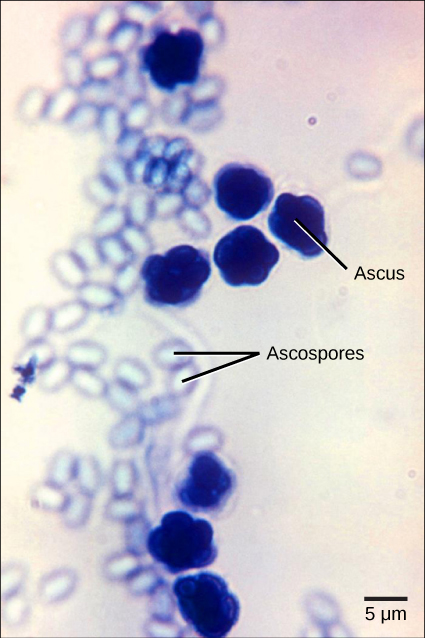
OpenStax, Rice University; Biology 2e. (credit: modification of work by Dr. Lucille Georg, CDC; scale-bar data from Matt Russell) · CC BY 4.0 · Source出典

Figure 24.15図 24.15
Ascospores. The bright field light micrograph shows ascospores being released from asci in the fungus Talaromyces flavus var. flavus. (credit: modification of work by Dr. Lucille Georg, CDC; scale-bar data from Matt Russell)
子嚢胞子。Talaromyces flavus var. flavusの子嚢から、子嚢胞子が放出される明視野光学顕微鏡像。(クレジット:CDCのDr. Lucille Georgによる作品を改変。スケールバーのデータ:Matt Russell)
Basidiomycota: The Club Fungi担子菌門:担子菌類
The fungi in the Phylum Basidiomycota are easily recognizable under a light microscope by their club-shaped fruiting bodies called basidia (singular, basidium), which are the swollen terminal cells of hyphae. The basidia, which are the reproductive organs of these fungi, are often contained within the familiar mushroom, commonly seen in fields after rain, on the supermarket shelves, and growing on your lawn (Figure 24.16). These mushroom-producing basidiomycetes are sometimes referred to as “gill fungi” because of the presence of gill-like structures on the underside of the cap. The gills are actually compacted hyphae on which the basidia are borne. This group also includes shelf fungi, which cling to the bark of trees like small shelves. In addition, the basidiomycota include smuts and rusts, which are important plant pathogens. Most edible fungi belong to the Phylum Basidiomycota; however, some basidiomycota are inedible and produce deadly toxins. For example, Cryptococcus neoformans causes severe respiratory illness. The infamous death cap mushroom (Amanita phalloides) is related to the fly agaric seen at the beginning of the previous section.
英語のヒント
担子菌門の菌類は、担子器(複数形basidia、単数形basidium)と呼ばれる棍棒状の子実構造によって、光学顕微鏡で容易に見分けられる。担子器は、菌糸の膨らんだ末端細胞である。これらの菌類の生殖器官である担子器は、雨上がりの野原、スーパーの棚、芝生でよく見る、おなじみのキノコの中に含まれることが多い(図24.16)。キノコを作る担子菌類は、傘の裏に鰓のような構造があるため、「ひだをもつ菌」と呼ばれることがある。ひだは、実際には密集した菌糸で、その上に担子器がつく。この群には、小さな棚のように樹皮に付着する棚状の菌類も含まれる。また、重要な植物病原体である黒穂菌やさび菌も含まれる。大部分の食用菌は担子菌門に属するが、食べられず、致死性毒素を作るものもある。たとえば、Cryptococcus neoformansは重い呼吸器疾患を起こす。悪名高い毒キノコAmanita phalloides(タマゴテングタケ)は、前節の冒頭で見たベニテングタケに近縁である。
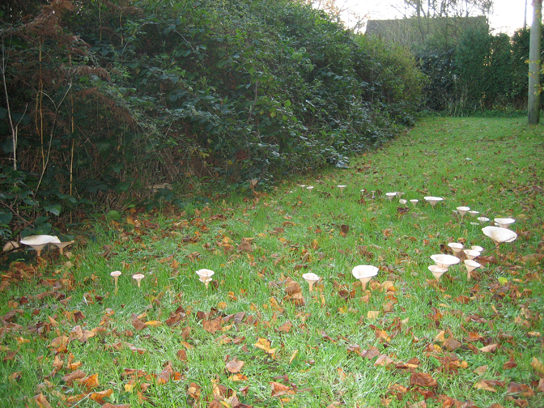
OpenStax, Rice University; Biology 2e. (Credit: "Cropcircles"/Wikipedia Commons)] · CC BY 4.0 · Source出典

Figure 24.16図 24.16
Fairy ring. The fruiting bodies of a basidiomycete form a ring in a meadow, commonly called “fairy ring.” The best-known fairy ring fungus has the scientific name Marasmius oreades. The body of this fungus, its mycelium, is underground and grows outward in a circle. As it grows, the mycelium depletes the soil of nitrogen, causing the mycelia to grow away from the center and leading to the “fairy ring” of fruiting bodies where there is adequate soil nitrogen. (Credit: "Cropcircles"/Wikipedia Commons)]
菌輪。担子菌類の子実体が草地に輪を作り、一般に「妖精の輪」と呼ばれる。最もよく知られた菌輪を作る菌の学名は、Marasmius oreadesである。本体である菌糸体は地下にあり、円形に外へ成長する。成長すると土壌の窒素を使い果たすため、菌糸体は中心から離れる方向へ伸び、十分な土壌窒素のある場所に子実体の「妖精の輪」ができる。(クレジット:“Cropcircles”/Wikipedia Commons)
The lifecycle of basidiomycetes includes sexual and asexual reproduction (Figure 24.17). Most fungi are haploid through most of their life cycles, but the basidiomycetes produce both haploid and dikaryotic mycelia, with the dikaryotic phase being dominant. (Note: The dikaryotic phase is technically not diploid, since the nuclei remain unfused until shortly before spore production.) In the basidiomycetes, sexual spores are more common than asexual spores. The sexual spores form in the club-shaped basidium and are called basidiospores. In the basidium, nuclei of two different mating strains fuse (karyogamy), giving rise to a diploid zygote that then undergoes meiosis. The haploid nuclei migrate into four different chambers appended to the basidium, and then become basidiospores.
英語のヒント
担子菌類の生活環には、有性生殖と無性生殖がある(図24.17)。大部分の菌類は生活環の大部分を半数体で過ごすが、担子菌類は半数体と二核性の両方の菌糸体を作り、二核性段階が優勢である。(注:胞子形成の直前まで核が融合しないため、二核性段階は厳密には二倍体ではない。)担子菌類では、有性胞子のほうが無性胞子より一般的である。有性胞子は、棍棒状の担子器に形成され、担子胞子と呼ばれる。担子器内で、異なる二つの接合型の株の核が融合し(核融合)、二倍体の接合子を作り、その後に減数分裂が起こる。半数体核は、担子器に付随する四つの別々の小室へ移り、担子胞子となる。
Each basidiospore germinates and generates monokaryotic haploid hyphae. The mycelium that results is called a primary mycelium. Mycelia of different mating strains can combine and produce a secondary mycelium that contains haploid nuclei of two different mating strains. This is the dominant dikaryotic stage of the basidiomycete life cycle. Thus, each cell in this mycelium has two haploid nuclei, which will not fuse until formation of the basidium. Eventually, the secondary mycelium generates a basidiocarp, a fruiting body that protrudes from the ground—this is what we think of as a mushroom. The basidiocarp bears the developing basidia on the gills under its cap.
英語のヒント
各担子胞子は発芽し、単核の半数体菌糸を生じる。こうしてできる菌糸体を、一次菌糸体という。異なる接合型の株の菌糸体は結合し、二つの異なる接合型に由来する半数体核を含む、二次菌糸体を作れる。これが、担子菌類の生活環で優勢な二核性段階である。したがって、各細胞には二つの半数体核があり、担子器の形成までは融合しない。やがて二次菌糸体は、担子器果という、地面から突き出る子実体を作る。これが、私たちがキノコと考えるものである。担子器果は、傘の裏のひだに、発達中の担子器をつける。