第24章菌類
24.2 Classifications of Fungi24.2 菌類の分類
Learning Objectives学習目標
By the end of this section, you will be able to do the following:
この節を学ぶと、次のことができるようになる。
- Identify fungi and place them into the five major phyla according to current classification菌類を識別し、現在の分類に従って五つの主要な門へ分類する。
- Describe each phylum in terms of major representative species and patterns of reproduction各門を、主要な代表種と生殖様式の観点から説明する。
The kingdom Fungi contains five major phyla that were established according to their mode of sexual reproduction or using molecular data. Unrelated fungi that reproduce without a sexual cycle, were once placed for convenience in a sixth group, the Deuteromycota, called a “form phylum,” because superficially they appeared to be similar, a polyphyletic group (group of organisms that is of mixed evolutionary origin). However, most mycologists have discontinued this practice. Rapid advances in molecular biology and the sequencing of 18S rRNA (ribosomal RNA) continue to show new and different relationships among the various categories of fungi.
英語のヒント
菌界には、有性生殖の様式または分子データに基づいて定められた、五つの主要な門がある。有性周期を経ずに増殖する、互いに近縁でない菌類は、かつて便宜上、第6の群である不完全菌門にまとめられていた。これは表面的に似て見えることによる「形態門」であり、進化的起源が混在する多系統群だった。しかし、現在では大部分の菌学者は、この扱いをやめている。分子生物学の急速な進歩と、18S rRNA(リボソームRNA)の配列決定によって、菌類のさまざまな分類群の間に、新たな、従来とは異なる関係が明らかになり続けている。
The five true phyla of fungi are the Chytridiomycota (Chytrids), the Zygomycota (conjugated fungi), the Ascomycota (sac fungi), the Basidiomycota (club fungi) and the recently described Phylum Glomeromycota (Figure 24.10).
菌類の五つの真の門は、ツボカビ門、接合菌門、子嚢菌門、担子菌門、そして最近記載されたグロムス菌門である(図24.10)。
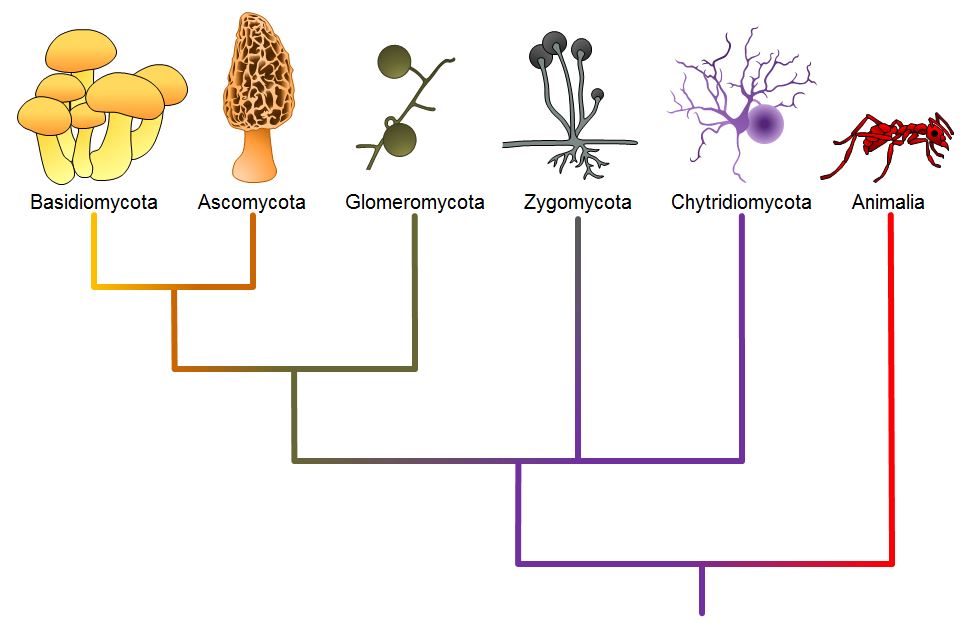
Figure 24.10図 24.10
Fungal phyla. Note: “-mycota” is used to designate a phylum while “-mycetes” formally denotes a class or is used informally to refer to all members of the phylum.
菌類の門。注:「-mycota」は門を表すのに使われ、「-mycetes」は正式には綱を表すか、非公式には門の全成員を指すのに使われる。
Chytridiomycota: The Chytridsツボカビ門:ツボカビ類
The only class in the Phylum Chytridiomycota is the Chytridiomycetes. The chytrids are the simplest and most primitive Eumycota, or true fungi. The evolutionary record shows that the first recognizable chytrids appeared during the late pre-Cambrian period, more than 500 million years ago. Like all fungi, chytrids have chitin in their cell walls, but one group of chytrids has both cellulose and chitin in the cell wall. Most chytrids are unicellular; however, a few form multicellular organisms and hyphae, which have no septa between cells (coenocytic). The Chytrids are the only fungi that have retained flagella. They produce both gametes and diploid zoospores that swim with the help of a single flagellum. An unusual feature of the chytrids is that both male and female gametes are flagellated.
英語のヒント
ツボカビ門にある唯一の綱は、ツボカビ綱である。ツボカビ類は、真正の菌類の中で最も単純で原始的である。進化の記録は、識別可能な最初のツボカビ類が、5億年以上前の先カンブリア時代後期に現れたことを示す。すべての菌類と同様に、ツボカビ類は細胞壁にキチンをもつが、一つの群はセルロースとキチンの両方をもつ。大部分のツボカビ類は単細胞だが、少数は多細胞体や菌糸を作り、細胞間に隔壁をもたない多核体性である。ツボカビ類は、鞭毛を保持した唯一の菌類である。配偶子と二倍体の遊走子の両方を作り、1本の鞭毛を使って泳ぐ。雄性と雌性の両方の配偶子が鞭毛をもつことは、ツボカビ類の珍しい特徴である。
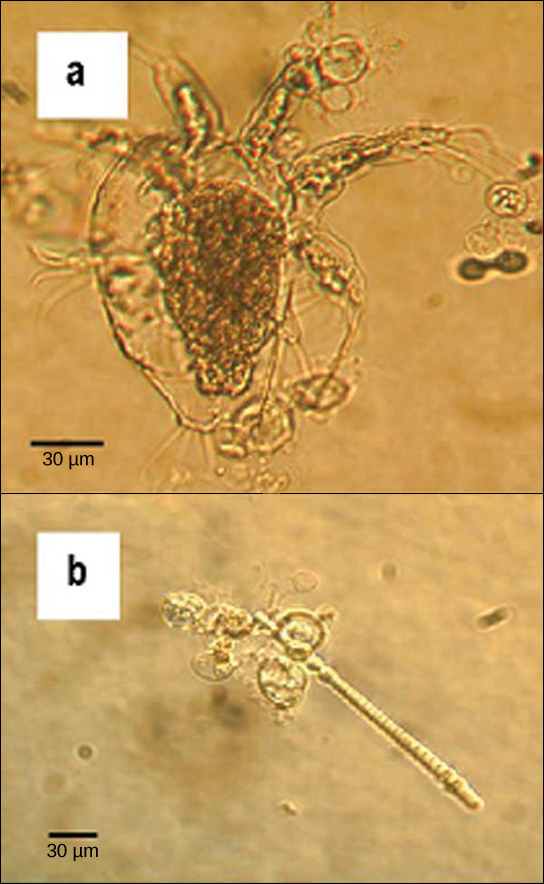
The ecological habitat and cell structure of chytrids have much in common with protists. Chytrids usually live in aquatic environments, although some species live on land. Some species thrive as parasites on plants, insects, or amphibians (Figure 24.11), while others are saprobes. The chytrid species Allomyces is well characterized as an experimental organism. Its reproductive cycle includes both asexual and sexual phases. Allomyces produces diploid or haploid flagellated zoospores in a sporangium.
英語のヒント
ツボカビ類の生息環境と細胞構造は、原生生物と多くの共通点をもつ。通常は水中にすむが、陸上にすむ種もある。植物、昆虫、両生類の寄生者として繁殖する種(図24.11)もいれば、腐生生物もいる。ツボカビ類のAllomycesは、実験生物としてよく調べられている。その生殖周期には、無性段階と有性段階の両方がある。Allomycesは胞子嚢で、鞭毛のある二倍体または半数体の遊走子を作る。
OpenStax, Rice University; Biology 2e. (credit: modification of work by Johnson ML, Speare R., CDC) · CC BY 4.0 · Source出典
Figure 24.11図 24.11
Chytrids. The chytrid Batrachochytrium dendrobatidis is seen in these light micrographs as transparent spheres growing on (a) a freshwater arthropod (water mite) and (b) algae. This chytrid causes skin diseases in many species of amphibians, resulting in species decline and extinction. (credit: modification of work by Johnson ML, Speare R., CDC)
ツボカビ類。光学顕微鏡像で、Batrachochytrium dendrobatidisが、(a)淡水の節足動物(ミズダニ)と(b)藻類の上に育つ、透明な球として見える。このツボカビは、多くの両生類に皮膚病を起こし、種の減少や絶滅につながる。(クレジット:Johnson ML、Speare R.、CDCによる作品を改変)
Zygomycota: The Conjugated Fungi接合菌門:接合菌類
The zygomycetes are a relatively small group of fungi belonging to the Phylum Zygomycota. They include the familiar bread mold, Rhizopus stolonifer, which rapidly propagates on the surfaces of breads, fruits, and vegetables. Most species are saprobes, living off decaying organic material; a few are parasites, particularly of insects. Zygomycetes play a considerable commercial role. For example, the metabolic products of some species of Rhizopus are intermediates in the synthesis of semi-synthetic steroid hormones.
英語のヒント
接合菌類は、接合菌門に属する比較的小さな菌類群である。よく知られたパンカビの一種Rhizopus stoloniferを含み、これはパン、果物、野菜の表面で急速に増殖する。大部分の種は、腐敗する有機物を栄養源とする腐生生物であり、少数は、特に昆虫の寄生者である。接合菌類は、かなり大きな商業的役割を担う。たとえば、一部のRhizopus属の代謝産物は、半合成ステロイドホルモンを合成する際の中間体となる。
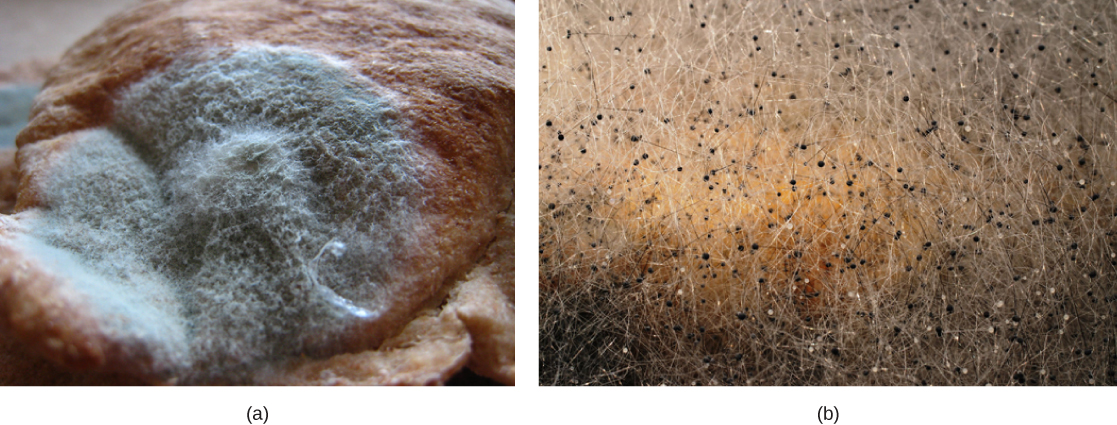
Zygomycetes have a thallus of coenocytic hyphae in which the nuclei are haploid when the organism is in the vegetative stage. The fungi usually reproduce asexually by producing sporangiospores (Figure 24.12). The black tips of bread mold are the swollen sporangia packed with black spores (Figure 24.13). When spores land on a suitable substrate, they germinate and produce a new mycelium. Sexual reproduction starts when environmental conditions become unfavorable. Two opposing mating strains (type + and type –) must be in close proximity for gametangia from the hyphae to be produced and fuse, leading to karyogamy. Each zygospore can contain several diploid nuclei. The developing diploid zygospores have thick coats that protect them from desiccation and other hazards. They may remain dormant until environmental conditions are favorable. When the zygospore germinates, it undergoes meiosis and produces haploid spores, which will, in turn, grow into a new organism. This form of sexual reproduction in fungi is called conjugation (although it differs markedly from conjugation in bacteria and protists), giving rise to the name “conjugated fungi”.
英語のヒント
接合菌類の葉状体は多核体性菌糸からなり、栄養段階の核は半数体である。通常は、胞子嚢胞子を作って無性生殖する(図24.12)。パンカビの黒い先端は、黒い胞子が詰まった、膨らんだ胞子嚢である(図24.13)。胞子が適切な基質に到達すると、発芽して新しい菌糸体を作る。環境条件が不利になると、有性生殖が始まる。菌糸から配偶子嚢が生じて融合し、核融合へ進むには、反対の接合型の2株(+型と−型)が近接していなければならない。各接合胞子は、複数の二倍体核を含みうる。発達中の二倍体接合胞子には、乾燥や他の危険から守る厚い被覆がある。環境が好適になるまで、休眠を続けることもある。接合胞子は、発芽すると減数分裂して半数体の胞子を作り、それが次の新個体へ成長する。菌類のこの有性生殖様式は接合と呼ばれ(細菌や原生生物の接合とは大きく異なるが)、これが「接合菌」という名称の由来である。
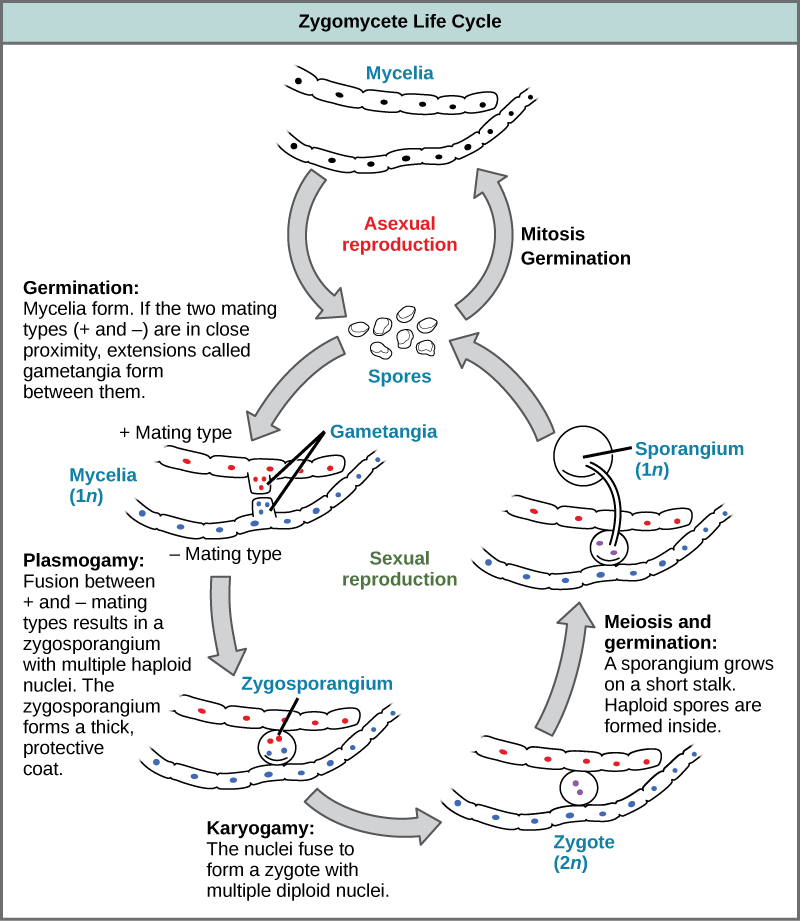


Figure 24.12図 24.12
Zygomycete life cycle. Zygomycetes have asexual and sexual phases in their life cycles. In the asexual phase, spores are produced from haploid sporangia by mitosis (not shown). In the sexual phase, plus and minus haploid mating types conjugate to form a heterokaryotic zygosporangium. Karyogamy then produces a diploid zygote. Diploid cells in the zygote undergo meiosis and germinate to form a haploid sporangium, which releases the next generation of haploid spores.
接合菌類の生活環。生活環には無性段階と有性段階がある。無性段階では、半数体の胞子嚢から、有糸分裂によって胞子が作られる(図示せず)。有性段階では、半数体の+接合型と−接合型が接合し、異核性の接合胞子嚢を作る。続く核融合によって、二倍体の接合子ができる。接合子内の二倍体細胞は減数分裂して発芽し、半数体の胞子嚢を作る。そこから、次世代の半数体胞子が放出される。
OpenStax, Rice University; Biology 2e. (credit b: modification of work by "polandeze"/Flickr) · CC BY 4.0 · Source出典

Figure 24.13図 24.13
Rhizopus spores. Asexual sporangia grow at the end of stalks, which appear as (a) white fuzz seen on this bread mold, Rhizopus stolonifer. The black tips (b) of bread mold are the spore-containing sporangia. (credit b: modification of work by "polandeze"/Flickr)
Rhizopusの胞子。無性の胞子嚢は柄の先端に育つ。このパンカビRhizopus stoloniferでは、柄が(a)白い綿毛として見える。(b)黒い先端は、胞子を含む胞子嚢である。(bのクレジット:“polandeze”/Flickrによる作品を改変)