第24章菌類
Cell Structure and Function細胞の構造と機能
Fungi are eukaryotes, and as such, have a complex cellular organization. As eukaryotes, fungal cells contain a membrane-bound nucleus. The DNA in the nucleus is represented by multiple linear molecules wrapped around histone proteins, as is observed in other eukaryotic cells. A few types of fungi have accessory genomic structures comparable to bacterial plasmids (loops of DNA); however, the horizontal transfer of genetic information that occurs between one bacterium and another rarely occurs in fungi. Fungal cells also contain mitochondria and a complex system of internal membranes, including the endoplasmic reticulum and Golgi apparatus.
英語のヒント
菌類は真核生物であり、それゆえ複雑な細胞構成をもつ。真核生物として、菌類の細胞は膜に囲まれた核を含む。核内のDNAは、他の真核細胞と同様に、ヒストンタンパク質に巻き付いた複数の線状分子として存在する。少数の菌類は、細菌のプラスミド(環状DNA)に相当する補助的なゲノム構造をもつ。しかし、細菌同士に起こる遺伝情報の水平伝播は、菌類ではまれである。菌類の細胞は、ミトコンドリアと、小胞体やゴルジ体を含む複雑な内膜系ももつ。
Unlike plant cells, fungal cells do not have chloroplasts or chlorophyll. Many fungi display bright colors arising from other cellular pigments, ranging from red to green to black. The poisonous Amanita muscaria (fly agaric) is recognizable by its bright red cap with white patches (Figure 24.2). Pigments in fungi are associated with the cell wall and play a protective role against ultraviolet radiation. Some fungal pigments are toxic to humans.
英語のヒント
植物細胞と異なり、菌類細胞には葉緑体も葉緑素もない。多くの菌類は、他の細胞色素によって、赤から緑、黒に至る鮮やかな色を示す。有毒なAmanita muscaria(ベニテングタケ)は、白い斑点のある鮮紅色の傘で見分けられる(図24.2)。菌類の色素は細胞壁と結びつき、紫外線から保護する役割を担う。一部の色素は、ヒトに有毒である。
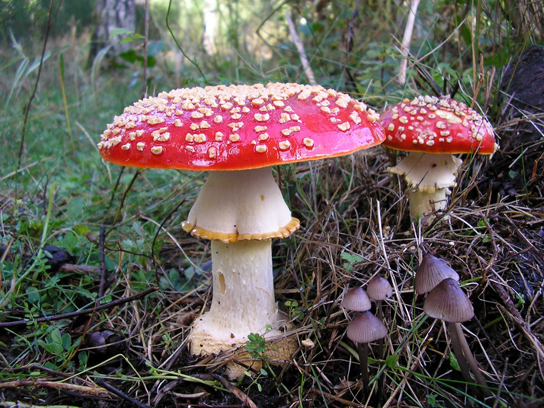
Figure 24.2図 24.2
Amanita. The poisonous Amanita muscaria is native to temperate and boreal regions of North America. (credit: Christine Majul)
テングタケ属。有毒なAmanita muscariaは、北米の温帯・亜寒帯地域に自生する。(クレジット:Christine Majul)
Like plant cells, fungal cells have a thick cell wall. The rigid layers of fungal cell walls contain complex polysaccharides called chitin and glucans. Chitin (N-acetyl-D-glucosamine), also found in the exoskeleton of arthropods such as insects, gives structural strength to the cell walls of fungi. The wall provides structural support and protects the cell from desiccation and some predators. Fungi have plasma membranes similar to those of other eukaryotes, except that the structure is stabilized by ergosterol: a steroid molecule that replaces the cholesterol found in animal cell membranes. Most members of the kingdom Fungi are nonmotile. However, flagella are produced by the spores and gametes in the primitive Phylum Chytridiomycota.
英語のヒント
植物細胞と同様に、菌類細胞は厚い細胞壁をもつ。その硬い層には、キチンとグルカンという複雑な多糖が含まれる。昆虫などの節足動物の外骨格にもあるキチン(N-アセチル-D-グルコサミン)は、菌類の細胞壁に構造的強度を与える。細胞壁は構造を支え、乾燥や一部の捕食者から細胞を守る。菌類の細胞膜は他の真核生物のものに似ているが、構造を安定化するのは、動物細胞膜のコレステロールに代わるステロイド分子、エルゴステロールである。菌界の大部分の成員は運動性をもたない。しかし、原始的なツボカビ門では、胞子と配偶子が鞭毛を作る。
Growth成長
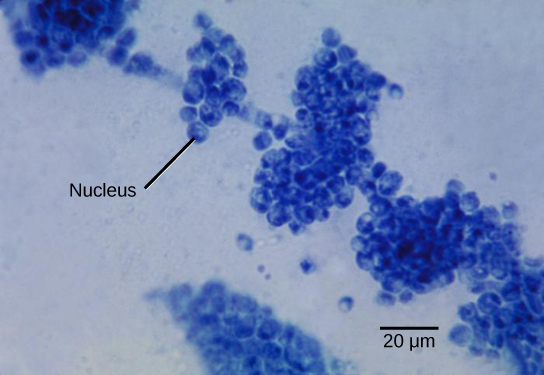
The vegetative body of a fungus is a unicellular or multicellular thallus. Unicellular fungi are called yeasts. Multicellular fungi produce threadlike hyphae (singular hypha). Dimorphic fungi can change from the unicellular to multicellular state depending on environmental conditions. Saccharomyces cerevisiae (baker’s yeast) and Candida species (the agents of thrush, a common fungal infection) are examples of unicellular fungi (Figure 24.3).
英語のヒント
菌類の栄養体は、単細胞または多細胞の葉状体である。単細胞の菌類は酵母と呼ばれる。多細胞の菌類は、糸状の菌糸(複数形hyphae、単数形hypha)を作る。二形性菌類は、環境条件に応じて単細胞状態から多細胞状態へ変わることができる。Saccharomyces cerevisiae(パン酵母)と、一般的な真菌感染症である鵞口瘡の病原体Candida属は、単細胞菌類の例である(図24.3)。
OpenStax, Rice University; Biology 2e. (credit: modification of work by Dr. Godon Roberstad, CDC; scale-bar data from Matt Russell) · CC BY 4.0 · Source出典
Figure 24.3図 24.3
Candida albicans. Candida albicans is a yeast cell and the agent of candidiasis and thrush. This organism has a similar morphology to coccus bacteria; however, yeast is a eukaryotic organism (note the nucleus). (credit: modification of work by Dr. Godon Roberstad, CDC; scale-bar data from Matt Russell)
Candida albicans。Candida albicansは酵母細胞で、カンジダ症と鵞口瘡の病原体である。球菌に似た形態をもつが、酵母は真核生物である(核に注目)。(クレジット:CDCのDr. Godon Roberstadによる作品を改変。スケールバーのデータ:Matt Russell)
Most fungi are multicellular organisms. They display two distinct morphological stages: the vegetative and reproductive. The vegetative stage consists of a tangle of hyphae, whereas the reproductive stage can be more conspicuous. The mass of hyphae is a mycelium (Figure 24.4). It can grow on a surface, in soil or decaying material, in a liquid, or even on living tissue. Although individual hyphae must be observed under a microscope, the mycelium of a fungus can be very large, with some species truly being “the fungus humongous.” The giant Armillaria solidipes (honey mushroom) is considered the largest organism on Earth, spreading across more than 2,000 acres of underground soil in eastern Oregon; it is estimated to be at least 2,400 years old.
英語のヒント
大部分の菌類は多細胞生物であり、栄養段階と生殖段階という、形態的に異なる二つの段階を示す。栄養段階は絡み合う菌糸からなるが、生殖段階はより目立つことがある。菌糸の集まりを菌糸体という(図24.4)。菌糸体は、物の表面、土や腐敗物の中、液体中、さらには生きた組織の上でも成長できる。個々の菌糸は顕微鏡で観察する必要があるが、菌糸体は非常に大きくなる場合があり、本当に「巨大な菌」といえる種もある。巨大なArmillaria solidipes(ナラタケの仲間)は地球最大の生物とされ、オレゴン州東部の地下土壌で2,000エーカー以上に広がり、少なくとも2,400歳と推定される。
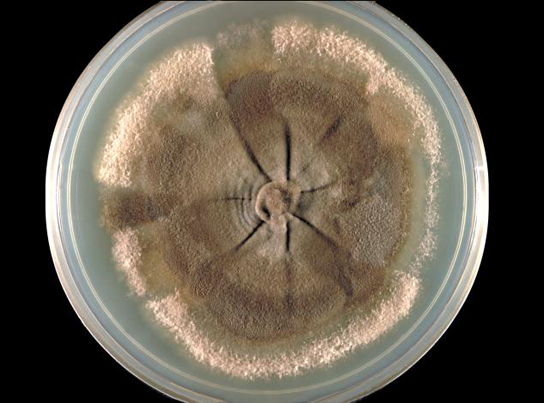


Figure 24.4図 24.4
A fungal mycelium. The mycelium of the fungus Neotestudina rosati can be pathogenic to humans. The fungus enters through a cut or scrape and develops a mycetoma, a chronic subcutaneous infection. (credit: CDC)
菌類の菌糸体。Neotestudina rosatiの菌糸体は、ヒトに病原性を示すことがある。切り傷や擦り傷から侵入し、慢性皮下感染症である菌腫を生じる。(クレジット:CDC)
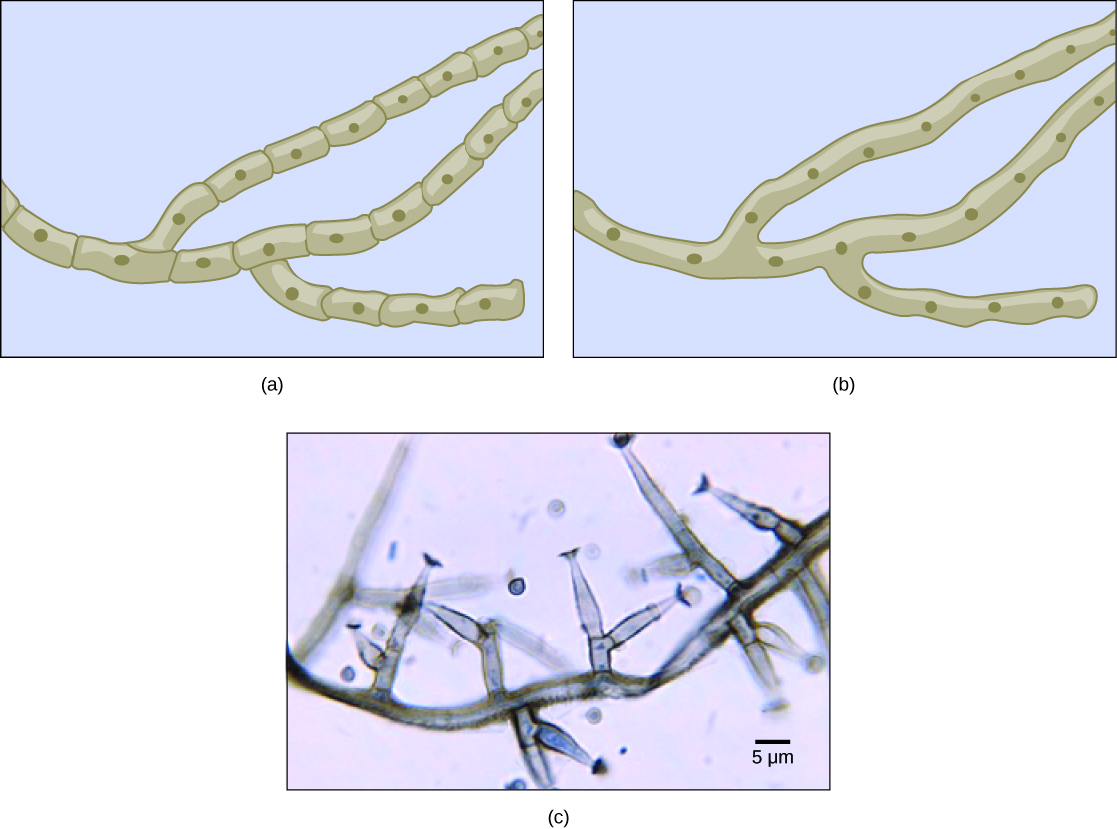
Most fungal hyphae are divided into separate cells by endwalls called septa (singular, septum) (Figure 24.5a, c). In most phyla of fungi, tiny holes in the septa allow for the rapid flow of nutrients and small molecules from cell to cell along the hypha. They are described as perforated septa. The hyphae in bread molds (which belong to the Phylum Zygomycota) are not separated by septa. Instead, they are formed by large cells containing many nuclei (multinucleate), an arrangement described as coenocytic hyphae (Figure 24.5b).
英語のヒント
OpenStax, Rice University; Biology 2e. (credit c: modification of work by Dr. Lucille Georg, CDC; scale-bar data from Matt Russell) · CC BY 4.0 · Source出典

Figure 24.5図 24.5
Fungal hyphae. Fungal hyphae may be (a) septated or (b) coenocytic (coeno- = "common"; -cytic = "cell") with many nuclei present in a single hypha. A bright field light micrograph of (c) Phialophora richardsiae shows septa that divide the hyphae. (credit c: modification of work by Dr. Lucille Georg, CDC; scale-bar data from Matt Russell)
菌類の菌糸。菌糸には、(a)隔壁のあるものと、(b)1本に多数の核がある多核体性のものがある(coeno-は「共有」、-cyticは「細胞」を意味する)。(c)Phialophora richardsiaeの明視野光学顕微鏡像では、菌糸を仕切る隔壁が見える。(cのクレジット:CDCのDr. Lucille Georgによる作品を改変。スケールバーのデータ:Matt Russell)
Fungi thrive in environments that are moist and slightly acidic, and can grow in dark places or places exposed to light. They vary in their oxygen requirement. Most fungi are obligate aerobes, requiring oxygen to survive. Other species, such as members of the Chytridiomycota that reside in the rumen of cattle, are obligate anaerobes, in that they only use anaerobic respiration because oxygen will disrupt their metabolism or kill them. Yeasts are intermediate, being facultative anaerobes. This means that they grow best in the presence of oxygen using aerobic respiration, but can survive using anaerobic respiration when oxygen is not available. The alcohol produced from yeast fermentation is used in wine and beer production.
英語のヒント
菌類は、湿った弱酸性の環境でよく育ち、暗所でも光の当たる場所でも成長できる。酸素の要求性はさまざまである。大部分は偏性好気性で、生存に酸素を必要とする。ウシの第一胃にすむツボカビ門の成員など、別の種は偏性嫌気性である。酸素は代謝を妨げたり、菌を殺したりするため、嫌気呼吸だけを用いる。酵母は中間にあり、通性嫌気性である。つまり、酸素のある所では好気呼吸を用いて最もよく成長するが、酸素が利用できないときには、嫌気呼吸で生き延びられる。酵母の発酵で作られるアルコールは、ワインやビールの製造に用いられる。