第24章菌類
Nutrition栄養
Like animals, fungi are heterotrophs; they use complex organic compounds as a source of carbon, rather than fix carbon dioxide from the atmosphere as do some bacteria and most plants. In addition, fungi do not fix nitrogen from the atmosphere. Like animals, they must obtain it from their diet. However, unlike most animals, which ingest food and then digest it internally in specialized organs, fungi perform these steps in the reverse order; digestion precedes ingestion. First, exoenzymes are transported out of the hyphae, where they process nutrients in the environment. Then, the smaller molecules produced by this external digestion are absorbed through the large surface area of the mycelium. As with animal cells, the polysaccharide of storage is glycogen, a branched polysaccharide, rather than amylopectin, a less densely branched polysaccharide, and amylose, a linear polysaccharide, as found in plants.
英語のヒント
動物と同様に、菌類は従属栄養生物であり、一部の細菌や大部分の植物のように大気中の二酸化炭素を固定するのではなく、複雑な有機化合物を炭素源に用いる。また、菌類は大気中の窒素も固定せず、動物と同様に食物から得なければならない。しかし、食物を摂取した後、特殊化した器官の内部で消化する大部分の動物と異なり、菌類は逆の順序で行う。消化が摂取に先行するのである。まず、菌体外酵素が菌糸の外へ運ばれ、環境中の栄養分を処理する。次に、体外消化で作られた小分子が、菌糸体の広い表面積を通じて吸収される。動物細胞と同様に、貯蔵多糖は枝分かれしたグリコーゲンであり、植物に見られる、枝分かれがより少ないアミロペクチンや、直鎖状のアミロースではない。
Fungi are mostly saprobes (saprophyte is an equivalent term): organisms that derive nutrients from decaying organic matter. They obtain their nutrients from dead or decomposing organic material derived mainly from plants. Fungal exoenzymes are able to break down insoluble compounds, such as the cellulose and lignin of dead wood, into readily absorbable glucose molecules. The carbon, nitrogen, and other elements are thus released into the environment. Because of their varied metabolic pathways, fungi fulfill an important ecological role and are being investigated as potential tools in bioremediation of chemically damaged ecosystems. For example, some species of fungi can be used to break down diesel oil and polycyclic aromatic hydrocarbons (PAHs). Other species take up heavy metals, such as cadmium and lead.
英語のヒント
菌類の大部分は腐生生物(saprophyteも同義)であり、腐敗する有機物から栄養を得る。主として植物由来の、死んだ、あるいは分解中の有機物から栄養分を得る。菌類の菌体外酵素は、枯れ木のセルロースやリグニンなどの不溶性化合物を、容易に吸収できるグルコース分子へ分解できる。こうして、炭素、窒素、その他の元素が環境へ放出される。多様な代謝経路をもつため、菌類は重要な生態的役割を担い、化学物質で損なわれた生態系のバイオレメディエーションに使える可能性が研究されている。たとえば、一部の菌類は、軽油や多環芳香族炭化水素(PAHs)の分解に用いられる。別の種は、カドミウムや鉛などの重金属を取り込む。
Some fungi are parasitic, infecting either plants or animals. Smut and Dutch elm disease affect plants, whereas athlete’s foot and candidiasis (thrush) are medically important fungal infections in humans. In environments poor in nitrogen, some fungi resort to predation of nematodes (small non-segmented roundworms). In fact, species of Arthrobotrys fungi have a number of mechanisms to trap nematodes: One mechanism involves constricting rings within the network of hyphae. The rings swell when they touch the nematode, gripping it in a tight hold. The fungus then penetrates the tissue of the worm by extending specialized hyphae called haustoria. Many parasitic fungi possess haustoria, as these structures penetrate the tissues of the host, release digestive enzymes within the host's body, and absorb the digested nutrients.
英語のヒント
一部の菌類は寄生性で、植物または動物に感染する。黒穂病やニレ立枯病は植物を侵す。一方、水虫やカンジダ症(鵞口瘡)は、ヒトの医学上重要な真菌感染症である。窒素の乏しい環境では、一部の菌類は、線虫(体節のない小さな円形動物)の捕食を行う。実際、Arthrobotrys属の菌類には、線虫を捕らえるいくつもの仕組みがある。一つは、菌糸の網の中にある収縮環である。環は線虫に触れると膨らみ、しっかり捕まえる。続いて菌は、吸器という特殊化した菌糸を伸ばし、線虫の組織へ侵入する。多くの寄生性菌類は吸器をもち、それが宿主組織へ侵入し、体内へ消化酵素を放出して、消化された栄養分を吸収する。
Reproduction生殖
Fungi reproduce sexually and/or asexually. Some fungi reproduce both sexually and asexually, while other fungi reproduce only asexually (by mitosis).
菌類は、有性生殖、無性生殖、またはその両方を行う。両方を行う菌類もいれば、無性生殖(有糸分裂)だけを行う菌類もいる。
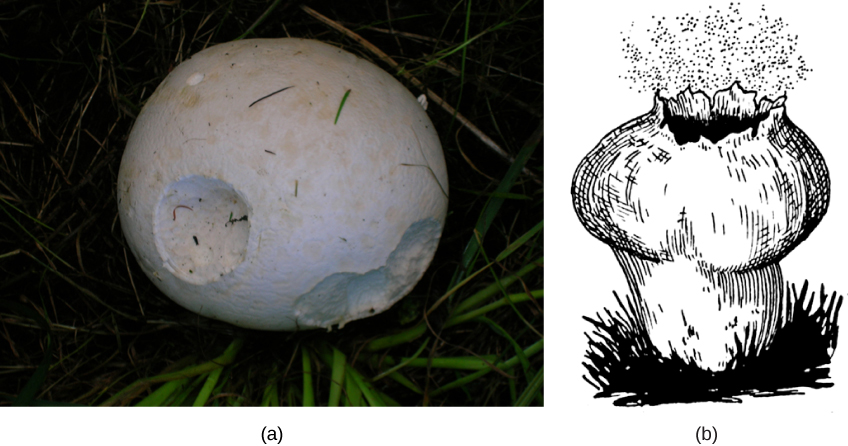
In both sexual and asexual reproduction, fungi produce spores that disperse from the parent organism by either floating on the wind or hitching a ride on an animal. Fungal spores are smaller and lighter than plant seeds. For example, the giant puffball mushroom bursts open and releases trillions of spores in a massive cloud of what looks like finely particulate dust. The huge number of spores released increases the likelihood of landing in an environment that will support growth (Figure 24.6).
英語のヒント
有性生殖でも無性生殖でも、菌類は胞子を作る。胞子は風に乗って浮遊したり、動物に便乗したりして、親個体から散布される。菌類の胞子は、植物の種子より小さく軽い。たとえば、大きなホコリタケの仲間は、裂けて開くと、微細な粉塵のように見える巨大な雲として、数兆個の胞子を放出する。放出する胞子が膨大であることは、成長を支える環境に到達する確率を高める(図24.6)。
OpenStax, Rice University; Biology 2e. (credit a: modification of work by Roger Griffith; credit b: modification of work by Pearson Scott Foresman, donated to the Wikimedia Foundation) · CC BY 4.0 · Source出典
Figure 24.6図 24.6
Puffball and spores. The (a) giant puffball mushroom releases (b) a cloud of spores when it reaches maturity. (credit a: modification of work by Roger Griffith; credit b: modification of work by Pearson Scott Foresman, donated to the Wikimedia Foundation)
ホコリタケの仲間と胞子。(a)大型のホコリタケの仲間は、成熟すると(b)雲のように胞子を放出する。(aのクレジット:Roger Griffithによる作品を改変。b:Pearson Scott Foresmanによる作品を改変、Wikimedia Foundationへ寄贈)
Asexual Reproduction無性生殖
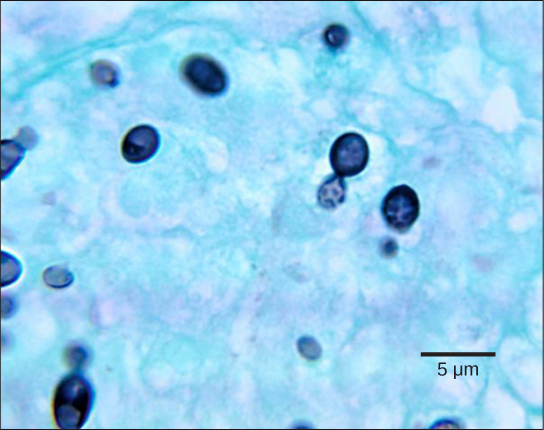
Fungi reproduce asexually by fragmentation, budding, or producing spores. Fragments of hyphae can grow new colonies. Somatic cells in yeast form buds. During budding (an expanded type of cytokinesis), a bulge forms on the side of the cell, the nucleus divides mitotically, and the bud ultimately detaches itself from the mother cell (Figure 24.7).
英語のヒント
菌類は、断片化、出芽、胞子形成によって無性生殖する。菌糸の断片は、新しいコロニーへ成長できる。酵母の体細胞は芽を作る。出芽という、細胞が膨らむ型の細胞質分裂では、細胞の側面に膨らみが生じ、核が有糸分裂し、最終的に芽が母細胞から離れる(図24.7)。
OpenStax, Rice University; Biology 2e. (credit: modification of work by Dr. Libero Ajello, CDC; scale-bar data from Matt Russell) · CC BY 4.0 · Source出典
Figure 24.7図 24.7
Budding in Histoplasma. The dark cells in this bright field light micrograph are the pathogenic yeast Histoplasma capsulatum, seen against a backdrop of light blue tissue. Histoplasma primarily infects lungs but can spread to other tissues, causing histoplasmosis, a potentially fatal disease. (credit: modification of work by Dr. Libero Ajello, CDC; scale-bar data from Matt Russell)
Histoplasmaの出芽。明視野光学顕微鏡像で、淡青色の組織を背景に見える暗い細胞は、病原性酵母Histoplasma capsulatumである。Histoplasmaは主に肺に感染するが、他の組織へ広がり、致死的にもなりうるヒストプラズマ症を起こす。(クレジット:CDCのDr. Libero Ajelloによる作品を改変。スケールバーのデータ:Matt Russell)
The most common mode of asexual reproduction is through the formation of asexual spores, which are produced by a single individual thallus (through mitosis) and are genetically identical to the parent thallus (Figure 24.8). Spores allow fungi to expand their distribution and colonize new environments. They may be released from the parent thallus either outside or within a special reproductive sac called a sporangium.
英語のヒント
最も一般的な無性生殖の様式は、無性胞子の形成である。これは、1個の葉状体から有糸分裂によって作られ、親の葉状体と遺伝的に同一である(図24.8)。胞子によって、菌類は分布を広げ、新しい環境へ定着できる。胞子は親の葉状体から放出され、胞子嚢という特殊な生殖の袋の外側、または内側に作られる場合がある。
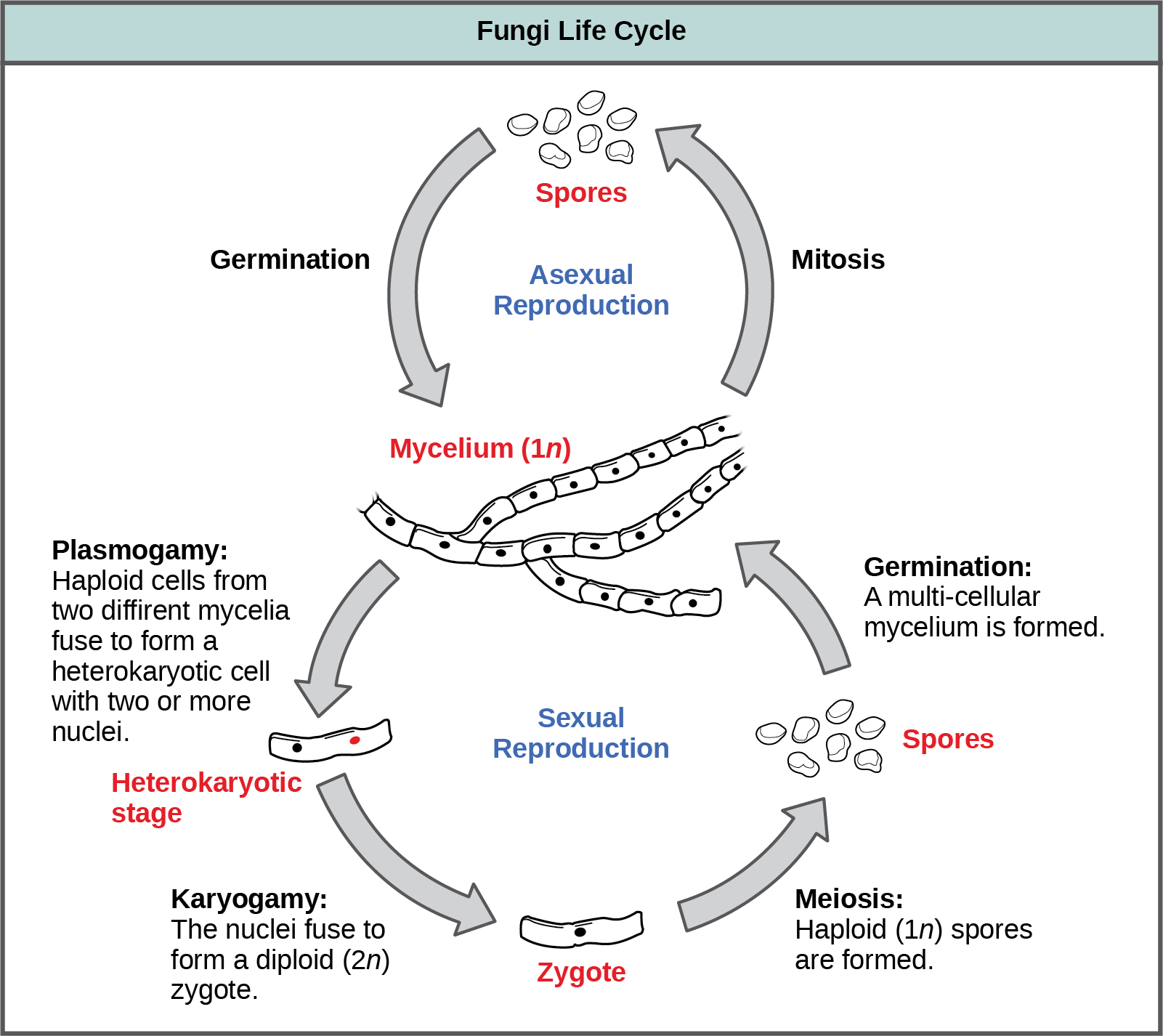


Figure 24.8図 24.8
Generalized fungal life cycle. Fungi may have both asexual and sexual stages of reproduction.
一般化した菌類の生活環。菌類は、無性生殖と有性生殖の両方の段階をもつ場合がある。
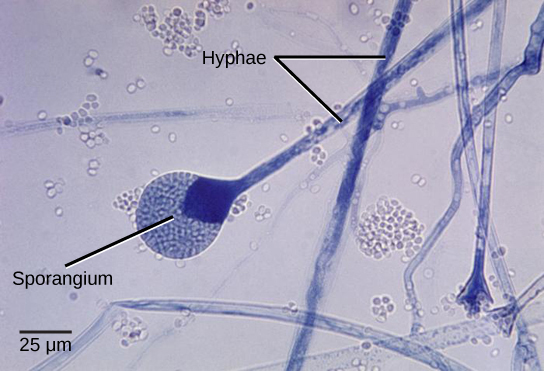
There are many types of asexual spores. Conidiospores are unicellular or multicellular spores that are released directly from the tip or side of the hypha. Other asexual spores originate in the fragmentation of a hypha to form single cells that are released as spores; some of these have a thick wall surrounding the fragment. Yet others bud off the vegetative parent cell. In contrast to conidiospores, sporangiospores are produced directly from a sporangium (Figure 24.9).
英語のヒント
無性胞子には多くの種類がある。分生子は単細胞または多細胞の胞子で、菌糸の先端や側面から直接放出される。別の無性胞子は、菌糸が断片化して単一細胞となり、胞子として放出されることで生じる。その一部では、断片を厚い壁が囲む。さらに別のものは、栄養成長中の親細胞から出芽する。分生子と異なり、胞子嚢胞子は胞子嚢から直接作られる(図24.9)。
OpenStax, Rice University; Biology 2e. (credit: modification of work by Dr. Lucille Georg, CDC; scale-bar data from Matt Russell) · CC BY 4.0 · Source出典

Figure 24.9図 24.9
Sporangiospores. This bright field light micrograph shows the release of spores from a sporangium at the end of a hypha called a sporangiophore. The organism is a Mucor sp. fungus, a mold often found indoors. (credit: modification of work by Dr. Lucille Georg, CDC; scale-bar data from Matt Russell)
胞子嚢胞子。明視野光学顕微鏡像で、胞子嚢柄と呼ばれる菌糸の先端の胞子嚢から、胞子が放出される様子を示す。生物は、屋内によく見られるカビ、Mucor属の一種である。(クレジット:CDCのDr. Lucille Georgによる作品を改変。スケールバーのデータ:Matt Russell)