第24章菌類
Asexual Ascomycota and Basidiomycota無性の子嚢菌類と担子菌類
Imperfect fungi—those that do not display a sexual phase—were formerly classified in the form phylum Deuteromycota, an invalid taxon no longer used in the present, ever-developing classification of organisms. While Deuteromycota was once a classification taxon, recent molecular analysis has shown that some of the members classified in this group belong to the Ascomycota (Figure 24.18) or the Basidiomycota. Because some members of this group have not yet been appropriately classified, they are less well described in comparison to members of other fungal taxa. Most imperfect fungi live on land, with a few aquatic exceptions. They form visible mycelia with a fuzzy appearance and are commonly known as mold.
英語のヒント
有性段階を示さない不完全菌類は、かつて形態門である不完全菌門に分類された。これは、絶えず発展する現在の生物分類では、もはや使われない無効な分類群である。かつては分類群とされていたが、最近の分子解析は、その成員の一部が子嚢菌門(図24.18)または担子菌門に属することを示した。この群の一部は、まだ適切に分類されていないため、他の菌類分類群の成員に比べ、記載が不十分である。大部分の不完全菌類は陸上にすみ、少数の水生の例外がある。目に見える綿毛状の菌糸体を作り、一般にカビとして知られる。
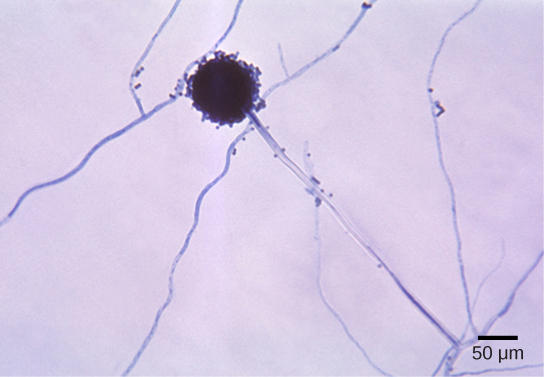
OpenStax, Rice University; Biology 2e. (credit: modification of work by Dr. Lucille Georg, CDC; scale-bar data from Matt Russell) · CC BY 4.0 · Source出典

Figure 24.18図 24.18
Aspergillus. Aspergillus niger is an asexually reproducing fungus (phylum Ascomycota) commonly found as a food contaminant. The spherical structure in this light micrograph is an asexual conidiophore. Molecular studies have placed Aspergillus with the ascomycetes and sexual cycles have been identified in some species. (credit: modification of work by Dr. Lucille Georg, CDC; scale-bar data from Matt Russell)
Aspergillus。Aspergillus nigerは、食品の汚染菌としてよく見られる、無性生殖する菌類(子嚢菌門)である。光学顕微鏡像の球状構造は、無性の分生子柄である。分子研究によってAspergillusは子嚢菌類に置かれ、一部の種では有性周期が確認されている。(クレジット:CDCのDr. Lucille Georgによる作品を改変。スケールバーのデータ:Matt Russell)
The fungi in this group have a large impact on everyday human life. The food industry relies on them for ripening some cheeses. The blue veins in Roquefort cheese and the white crust on Camembert are the result of fungal growth. The antibiotic penicillin was originally discovered on an overgrown Petri plate, on which a colony of Penicillium fungi had killed the bacterial growth surrounding it. Other fungi in this group cause serious diseases, either directly as parasites (which infect both plants and humans), or as producers of potent toxic compounds, as seen in the aflatoxins released by fungi of the genus Aspergillus.
英語のヒント
この群の菌類は、ヒトの日常生活に大きな影響を与える。食品産業は、一部のチーズの熟成に菌類を利用する。ロックフォールの青い筋や、カマンベールの白い外皮は、菌類の生育によるものである。抗生物質ペニシリンは、もともと微生物が生い茂ったペトリ皿で発見された。その皿では、Penicilliumのコロニーが、周囲で生育する細菌を殺していた。この群の別の菌類は、植物とヒトの両方に感染する寄生者として直接、あるいは強力な有毒化合物の生産者として、重大な病気を起こす。後者の例が、Aspergillus属の菌類が放出するアフラトキシンである。
Glomeromycotaグロムス菌門
The Glomeromycota is a newly established phylum that comprises about 230 species, all of which are involved in close associations with the roots of trees. Fossil records indicate that trees and their root symbionts share a long evolutionary history. It appears that nearly all members of this family form arbuscular mycorrhizae: the hyphae interact with the root cells forming a mutually beneficial association in which the plants supply the carbon source and energy in the form of carbohydrates to the fungus, and the fungus supplies essential minerals from the soil to the plant. The exception is Geosiphon pyriformis, which hosts the cyanobacterium Nostoc as an endosymbiont.
英語のヒント
グロムス菌門は、新たに設けられた門で、約230種からなり、すべてが樹木の根と密接な関係をもつ。化石記録は、樹木と根の共生者が、長い進化の歴史を共有することを示す。この科のほぼすべての成員は、アーバスキュラー菌根を作るようである。菌糸は根の細胞と相互作用し、相互に有益な関係を作る。植物は、炭水化物という形で炭素源とエネルギーを菌類に与え、菌類は土壌から必須の無機養分を植物に与える。例外はGeosiphon pyriformisで、シアノバクテリアNostocを細胞内共生体としてすまわせる。
The glomeromycetes do not reproduce sexually and do not survive without the presence of plant roots. Although they have coenocytic hyphae like the zygomycetes, they do not form zygospores. DNA analysis shows that all glomeromycetes probably descended from a common ancestor, making them a monophyletic lineage.
英語のヒント
グロムス菌類は有性生殖せず、植物の根が存在しなければ生存しない。接合菌類のような多核体性菌糸をもつが、接合胞子は作らない。DNA解析は、すべてのグロムス菌類が、おそらく一つの共通祖先から分かれたこと、したがって単系統の系統群であることを示す。
Section Summary節のまとめ
Chytridiomycota (chytrids) are considered the most ancestral group of fungi. They are mostly aquatic, and their gametes are the only fungal cells known to have flagella. They reproduce both sexually and asexually; the asexual spores are called zoospores. Zygomycota (conjugated fungi) produce non-septate hyphae with many nuclei. Their hyphae fuse during sexual reproduction to produce a zygospore in a zygosporangium. Ascomycota (sac fungi) form spores in sacs called asci during sexual reproduction. Asexual reproduction is their most common form of reproduction. In the Basidiomycota (club fungi), the sexual phase predominates, producing showy fruiting bodies that contain club-shaped basidia, within which spores form. Most familiar mushrooms belong to this division. Fungi that have no known sexual cycle were originally classified in the “form phylum” Deuteromycota, but many have been classified by comparative molecular analysis with the Ascomycota and Basidiomycota. Glomeromycota form tight associations (called mycorrhizae) with the roots of plants.
英語のヒント
ツボカビ門は、菌類の最も祖先的な群とされる。大部分は水生で、その配偶子は、鞭毛をもつことが知られた唯一の菌類細胞である。有性生殖と無性生殖の両方を行い、無性胞子は遊走子と呼ばれる。接合菌門は、多数の核を含む、隔壁のない菌糸を作る。有性生殖の際、菌糸が融合し、接合胞子嚢内に接合胞子を作る。子嚢菌門は、有性生殖の際に、子嚢という袋の中に胞子を作る。最も一般的な生殖様式は無性生殖である。担子菌門では有性段階が優勢で、棍棒状の担子器を含む、目立つ子実体を作り、担子器内で胞子が形成される。おなじみのキノコの大部分は、この門に属する。有性周期が知られていない菌類は、もともと「形態門」の不完全菌門に分類されていたが、多くは比較分子解析によって子嚢菌門や担子菌門に分類された。グロムス菌門は、植物の根と、菌根と呼ばれる密接な関係を作る。
Visual Connection Questions図を使った問題
Exercises 9–10練習問題 9–10
Exercise 9問題 9
Figure 24.14 Which of the following statements is true?
図24.14 次の記述のうち、正しいものはどれか。
- A dikaryotic ascus that forms in the ascocarp undergoes karyogamy, meiosis, and mitosis to form eight ascospores.子嚢果内にできる二核性の子嚢は、核融合、減数分裂、有糸分裂を行い、八つの子嚢胞子を作る。
- A diploid ascus that forms in the ascocarp undergoes karyogamy, meiosis, and mitosis to form eight ascospores.子嚢果内にできる二倍体の子嚢は、核融合、減数分裂、有糸分裂を行い、八つの子嚢胞子を作る。
- A haploid zygote that forms in the ascocarp undergoes karyogamy, meiosis, and mitosis to form eight ascospores.子嚢果内にできる半数体の接合子は、核融合、減数分裂、有糸分裂を行い、八つの子嚢胞子を作る。
- A dikaryotic ascus that forms in the ascocarp undergoes plasmogamy, meiosis, and mitosis to form eight ascospores.子嚢果内にできる二核性の子嚢は、細胞質融合、減数分裂、有糸分裂を行い、八つの子嚢胞子を作る。
Solution解き方
Exercise 10問題 10
Figure 24.17 Which of the following statements is true?
図24.17 次の記述のうち、正しいものはどれか。
- A basidium is the fruiting body of a mushroom-producing fungus, and it forms four basidiocarps.担子器は、キノコを作る菌類の子実体であり、四つの担子器果を作る。
- The result of the plasmogamy step is four basidiospores.細胞質融合の段階の結果として、四つの担子胞子ができる。
- Karyogamy results directly in the formation of mycelia.核融合によって、直接菌糸体が形成される。
- A basidiocarp is the fruiting body of a mushroom-producing fungus.担子器果は、キノコを作る菌類の子実体である。
Solution解き方