第18章進化と種の起源
Evidence of Evolution進化の証拠
The evidence for evolution is compelling and extensive. Looking at every level of organization in living systems, biologists see the signature of past and present evolution. Darwin dedicated a large portion of his book, On the Origin of Species, to identifying patterns in nature that were consistent with evolution, and since Darwin, our understanding has become clearer and broader.
英語のヒント
進化の証拠は、説得力が強く、広範に及ぶ。生物学者は、生きたシステムのあらゆる組織化の段階に、過去と現在の進化の痕跡を見る。ダーウィンは『種の起源』の大部分を、進化と一致する自然界のパターンを見いだすことに費やした。ダーウィン以来、私たちの理解は、より明確で幅広いものになってきた。
Fossils化石
Fossils provide solid evidence that organisms from the past are not the same as those today, and fossils show the gradual evolutionary changes over time. Scientists determine the age of fossils and categorize them from all over the world to determine when the organisms lived relative to each other. The resulting fossil record tells the story of the past and shows the evolution of form over millions of years (Figure 18.6). For example, scientists have recovered highly detailed records showing the evolution of humans and horses (Figure 18.6). The whale flipper shares a similar morphology to bird and mammal appendages (Figure 18.7) indicating that these species share a common ancestor.
英語のヒント
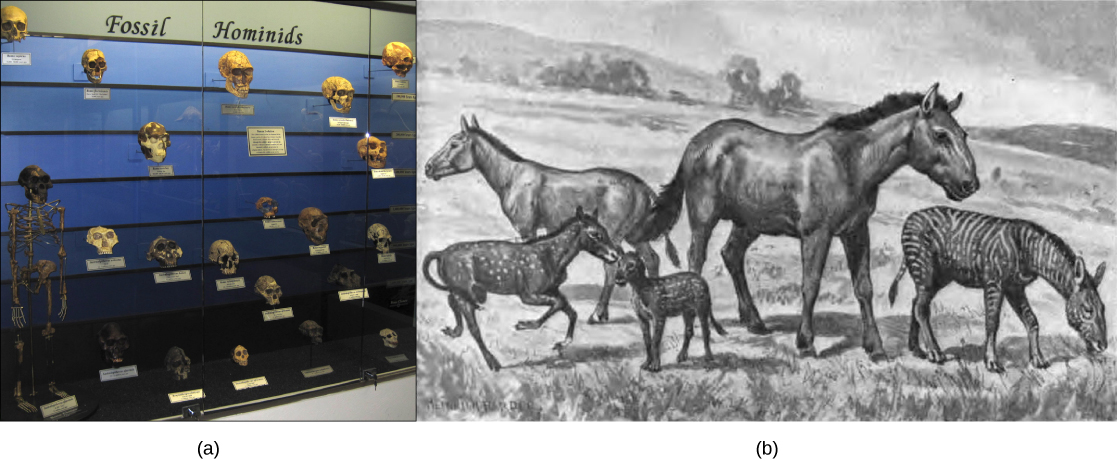
Figure 18.6図 18.6
In this (a) display, fossil hominids are arranged from oldest (bottom) to newest (top). As hominids evolved, the skull's shape changed. An artist’s rendition of (b) extinct species of the genus Equus reveals that these ancient species resembled the modern horse (Equus ferus) but varied in size.
英語のヒント
(a)の展示では、ヒト科の化石が、最も古いもの(下)から最も新しいもの(上)へ並べられている。ヒト科の進化に伴い、頭骨の形が変わった。(b)はウマ属Equusの絶滅種を画家が復元したもので、これらの古代の種は現生のウマ(Equus ferus)に似ていたが、大きさが異なっていたことを示す。
Anatomy and Embryology解剖学と発生学
Another type of evidence for evolution is the presence of structures in organisms that share the same basic form. For example, the bones in human, dog, bird, and whale appendages all share the same overall construction (Figure 18.7) resulting from their origin in a common ancestor's appendages. Over time, evolution led to changes in the bones' shapes and sizes in different species, but they have maintained the same overall layout. Scientists call these synonymous parts homologous structures.
英語のヒント
進化のもう一つの証拠は、生物に、同じ基本形を共有する構造が存在することである。例えば、ヒト、イヌ、鳥、クジラの付属肢の骨は、すべて同じ全体構造を共有する(図18.7)。これは、共通祖先の付属肢に由来するためである。時間とともに進化が進み、種ごとに骨の形や大きさは変わったが、全体の配置は同じまま保たれている。科学者は、こうした対応する部分を相同器官と呼ぶ。
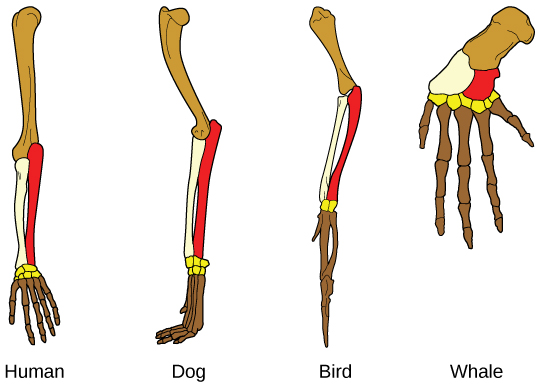


Figure 18.7図 18.7
The similar construction of these appendages indicates that these organisms share a common ancestor.
これらの付属肢の構造が似ていることは、これらの生物が共通祖先をもつことを示す。
Some structures exist in organisms that have no apparent function at all, and appear to be residual parts from a past common ancestor. We call these unused structures without function vestigial structures. Other examples of vestigial structures are wings on flightless birds, leaves on some cacti, and hind leg bones in whales. Not all similarities represent homologous structures. As explained in Determining Evolutionary Relationships, when similar characteristics occur because of environmental constraints and not due to a close evolutionary relationship, it is an analogy or homoplasy. For example, insects use wings to fly like bats and birds, but the wing structure and embryonic origin are completely different. These are analogous structures (Figure 20.8). On the other side, the bird and bat wings are homologous because the bones are inherited from a common ancestor, while the wings themselves are analogous as they evolved independently.
英語のヒント
生物には、明らかな機能がまったくなく、過去の共通祖先から残された部分と思われる構造もある。使われておらず、機能のないこうした構造を痕跡器官と呼ぶ。痕跡器官の例には、飛べない鳥の翼、一部のサボテンの葉、クジラの後肢の骨などがある。似ている構造が、すべて相同器官というわけではない。「進化上の関係を明らかにする」で説明するように、近い進化的な関係ではなく、環境による制約のために似た特徴が生じる場合、それは相似、またはホモプラシーである。例えば、昆虫はコウモリや鳥と同じように翅で飛ぶが、翼の構造も胚発生上の起源も、まったく異なる。これらは相似器官である(図20.8)。一方、鳥とコウモリの翼は、その骨が共通祖先から受け継がれているため、相同である。しかし、翼そのものは独立に進化したので、相似でもある。
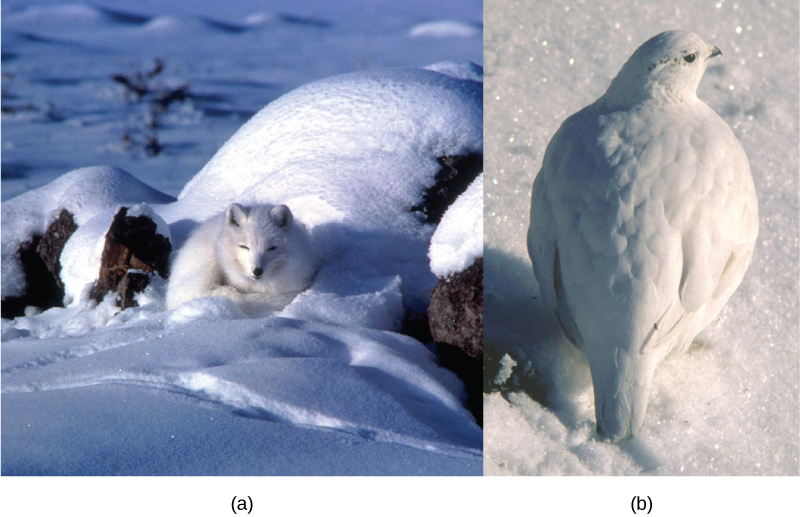
Another piece of evidence of evolution is the convergence of form in organisms that share similar environments. For example, species of unrelated animals, such as the arctic fox and ptarmigan, living in the arctic region have been selected for seasonal white phenotypes during winter to blend with the snow and ice (Figure 18.8). These similarities occur not because of common ancestry, but because of similar selection pressures—the benefits of predators not seeing them.
英語のヒント
進化の別の証拠は、似た環境に生きる生物の形が収斂することである。例えば、北極圏に暮らすホッキョクギツネやライチョウなど、近縁でない動物では、冬に雪や氷へ溶け込むよう、季節的に白くなる表現型が選択されてきた(図18.8)。こうした類似は、共通祖先のためではなく、似た選択圧、すなわち捕食者から見つかりにくいという利点のために生じる。
OpenStax, Rice University; Biology 2e. (credit a: modification of work by Keith Morehouse) · CC BY 4.0 · Source出典

Figure 18.8図 18.8
The white winter coat of the (a) arctic fox and the (b) ptarmigan’s plumage are adaptations to their environments. (credit a: modification of work by Keith Morehouse)
英語のヒント
(a)ホッキョクギツネの白い冬毛と、(b)ライチョウの白い羽毛は、それぞれの環境への適応である。(aのクレジット:Keith Morehouseの作品を改変)
Embryology, the study of the anatomy of an organism's development to its adult form, also provides evidence of relatedness between now widely divergent groups of organisms. Mutational tweaking in the embryo can have such magnified consequences in the adult that embryo formation tends to be conserved. As a result, structures that are absent in some groups often appear in their embryonic forms and disappear when they reach the adult or juvenile form. For example, all vertebrate embryos, including humans, exhibit gill slits and tails at some point in their early development. These disappear in the adults of terrestrial groups but adult forms of aquatic groups such as fish and some amphibians maintain them. Great ape embryos, including humans, have a tail structure during their development that they lose when they are born.
英語のヒント
生物が成体へ発生する過程の構造を研究する発生学も、現在では大きく分かれた生物群の近縁関係の証拠を与える。胚に生じる小さな変異が、成体では大きく増幅された結果をもたらすことがあるため、胚形成は保存される傾向がある。その結果、ある生物群の成体にはない構造が、胚の段階ではしばしば現れ、成体または幼若な形になると消える。例えば、ヒトを含むすべての脊椎動物の胚は、初期発生のある時点で鰓裂と尾を示す。陸生の群では成体になるとこれらが消えるが、魚類や一部の両生類などの水生の群では成体にも残る。ヒトを含む大型類人猿の胚は、発生中に尾の構造をもち、生まれるときにはそれを失う。