第18章進化と種の起源
Processes and Patterns of Evolution進化の過程とパターン
Natural selection can only take place if there is variation, or differences, among individuals in a population. Importantly, these differences must have some genetic basis; otherwise, the selection will not lead to change in the next generation. This is critical because nongenetic reasons can cause variation among individuals such as an individual's height because of better nutrition rather than different genes.
英語のヒント
自然選択が起こるには、集団内の個体間に変異、すなわち違いがなければならない。重要なのは、その違いが何らかの遺伝的基盤をもつ必要があることである。そうでなければ、選択は次世代の変化につながらない。これは重要な点である。個体間の違いは、遺伝以外の理由でも生じるからである。例えば、個体の身長の違いは、異なる遺伝子ではなく、よりよい栄養状態によることもある。
Genetic diversity in a population comes from two main mechanisms: mutation and sexual reproduction. Mutation, a change in DNA, is the ultimate source of new alleles, or new genetic variation in any population. The genetic changes that mutation causes can have one of three outcomes on the phenotype. A mutation affects the organism's phenotype in a way that gives it reduced fitness—lower likelihood of survival or fewer offspring. A mutation may produce a phenotype with a beneficial effect on fitness. Many mutations will also have no effect on the phenotype's fitness. We call these neutral mutations. Mutations may also have a whole range of effect sizes on the organism's fitness that expresses them in their phenotype, from a small effect to a great effect. Sexual reproduction also leads to genetic diversity: when two parents reproduce, unique combinations of alleles assemble to produce the unique genotypes and thus phenotypes in each offspring.
英語のヒント
集団内の遺伝的多様性は、主に二つの仕組み、変異と有性生殖から生じる。DNAの変化である変異は、どの集団においても、新しい対立遺伝子、すなわち新しい遺伝的変異の究極の源である。変異が起こす遺伝的変化は、表現型に三つの結果のいずれかをもたらしうる。変異は、生存の可能性を下げたり、子の数を減らしたりすることで、適応度が低くなるように表現型へ影響することがある。適応度に有利な効果をもつ表現型を生む場合もある。また、多くの変異は表現型の適応度に影響しない。これらを中立変異と呼ぶ。変異が、それを表現型として示す生物の適応度へ与える影響の大きさも、小さいものから大きいものまでさまざまである。有性生殖も遺伝的多様性をもたらす。二つの親が生殖すると、対立遺伝子の固有の組み合わせが作られ、各々の子に固有の遺伝子型、ひいては表現型が生じる。
We call a heritable trait that helps an organism's survival and reproduction in its present environment an adaptation. Scientists describe groups of organisms adapting to their environment when a genetic variation occurs over time that increases or maintains the population's “fit” to its environment. A platypus's webbed feet are an adaptation for swimming. A snow leopard's thick fur is an adaptation for living in the cold. A cheetah's fast speed is an adaptation for catching prey.
英語のヒント
生物が現在の環境で生き残り、繁殖するのを助ける遺伝性の形質を、適応と呼ぶ。時間とともに遺伝的変異が起こり、集団の環境への「適合」が高まったり保たれたりするとき、科学者は生物集団が環境に適応していると表現する。カモノハシの水かきのある足は、泳ぐための適応である。ユキヒョウの厚い毛皮は、寒冷地で暮らすための適応である。チーターの速さは、獲物を捕らえるための適応である。
Whether or not a trait is favorable depends on the current environmental conditions. The same traits are not always selected because environmental conditions can change. For example, consider a plant species that grew in a moist climate and did not need to conserve water. Large leaves were selected because they allowed the plant to obtain more energy from the sun. Large leaves require more water to maintain than small leaves, and the moist environment provided favorable conditions to support large leaves. After thousands of years, the climate changed, and the area no longer had excess water. The direction of natural selection shifted so that plants with small leaves were selected because those populations were able to conserve water to survive the new environmental conditions.
英語のヒント
ある形質が有利かどうかは、その時点の環境条件によって決まる。環境条件は変化しうるため、同じ形質が常に選ばれるわけではない。例えば、湿潤な気候で育ち、水を節約する必要がなかった植物種を考えてみよう。大きな葉は、太陽からより多くのエネルギーを得られるため、選択された。大きな葉を維持するには、小さな葉より多くの水が必要だが、湿潤な環境は大きな葉を支えるのに適した条件を与えた。数千年後、気候が変わり、その地域にはもはや余分な水がなくなった。自然選択の方向は変わり、小さな葉をもつ植物が選ばれるようになった。その集団は、水を節約して、新しい環境条件を生き延びられたためである。
The evolution of species has resulted in enormous variation in form and function. Sometimes, evolution gives rise to groups of organisms that become tremendously different from each other. We call two species that evolve in diverse directions from a common point divergent evolution. We can see such divergent evolution in the forms of the reproductive organs of flowering plants which share the same basic anatomies; however, they can look very different as a result of selection in different physical environments and adaptation to different kinds of pollinators (Figure 18.5).
英語のヒント
種の進化は、形や機能にきわめて大きな多様性を生み出してきた。進化によって、生物の集団が互いに著しく異なるものになることがある。二つの種が、共通の出発点から異なる方向へ進化することを、分岐進化と呼ぶ。このような分岐進化は、被子植物の生殖器官の形に見られる。それらは基本的な構造を共有しているが、異なる物理的環境での選択や、異なる種類の花粉媒介者への適応の結果、見た目は大きく異なりうる(図18.5)。
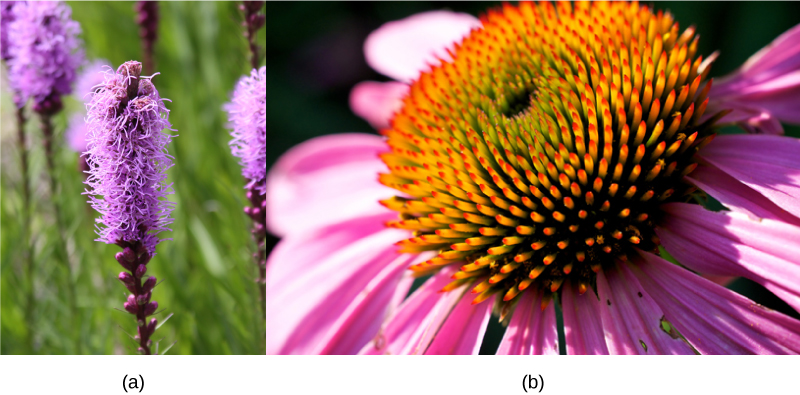
OpenStax, Rice University; Biology 2e. (credit a: modification of work by Drew Avery; credit b: modification of work by Cory Zanker) · CC BY 4.0 · Source出典

Figure 18.5図 18.5
Flowering plants evolved from a common ancestor. Notice that the (a) dense blazing star (Liatrus spicata) and the (b) purple coneflower (Echinacea purpurea) vary in appearance, yet both share a similar basic morphology. (credit a: modification of work by Drew Avery; credit b: modification of work by Cory Zanker)
英語のヒント
被子植物は共通祖先から進化した。(a)リアトリス(Liatrus spicata)と(b)ムラサキバレンギク(Echinacea purpurea)は、外見は異なるが、似た基本形態を共有することに注目しよう。(aのクレジット:Drew Averyの作品を改変。bのクレジット:Cory Zankerの作品を改変)
In other cases, similar phenotypes evolve independently in distantly related species. For example, flight has evolved in both bats and insects, and they both have structures we refer to as wings, which are adaptations to flight. However, bat and insect wings have evolved from very different original structures. We call this phenomenon convergent evolution, where similar traits evolve independently in species that do not share a recent common ancestry. The trait in the two species came to be similar in structure and have the same function, flying, but did so separately from each other.
英語のヒント
別の場合には、系統的に遠い種で、似た表現型が独立に進化する。例えば、飛行はコウモリでも昆虫でも進化しており、どちらも翼と呼ばれる構造をもつ。これは飛行への適応である。しかし、コウモリの翼と昆虫の翅は、もともと非常に異なる構造から進化した。この現象を収斂進化と呼ぶ。これは、近い共通祖先をもたない種において、似た形質が独立に進化することである。二つの種の形質は、互いに別々に、構造が似たものとなり、飛ぶという同じ機能をもつようになった。
These physical changes occur over enormous time spans and help explain how evolution occurs. Natural selection acts on individual organisms, which can then shape an entire species. Although natural selection may work in a single generation on an individual, it can take thousands or even millions of years for an entire species' genotype to evolve. It is over these large time spans that life on earth has changed and continues to change.
英語のヒント
こうした身体の変化は、きわめて長い時間をかけて起こり、進化の起こり方を説明する。自然選択は個々の生物に作用し、それが種全体の姿を形作りうる。自然選択は一世代の間に個体へ働く場合もあるが、種全体の遺伝子型が進化するには、数千年、さらには数百万年かかることもある。このような長い時間の中で、地球の生命は変化してきており、今も変化し続けている。