第18章進化と種の起源
18.1 Understanding Evolution18.1 進化を理解する
Learning Objectives学習目標
By the end of this section, you will be able to do the following:
この節を終えると、次のことができるようになる。
- Describe how scientists developed the present-day theory of evolution科学者が現在の進化論をどのように発展させたかを説明する。
- Define adaptation適応を定義する。
- Explain convergent and divergent evolution収斂進化と分岐進化を説明する。
- Describe homologous and vestigial structures相同器官と痕跡器官を説明する。
- Discuss misconceptions about the theory of evolution進化論についての誤解を論じる。
Evolution by natural selection describes a mechanism for how species change over time. Scientists, philosophers, researchers, and others had made suggestions and debated this topic well before Darwin began to explore this idea. Classical Greek philosopher Plato emphasized in his writings that species were static and unchanging, yet there were also ancient Greeks who expressed evolutionary ideas. In the eighteenth century, naturalist Georges-Louis Leclerc Comte de Buffon reintroduced ideas about the evolution of animals and observed that various geographic regions have different plant and animal populations, even when the environments are similar. Some at this time also accepted that there were extinct species.
英語のヒント
自然選択による進化は、種が時間とともに変化する仕組みを説明する。ダーウィンがこの考えを探究し始めるはるか以前から、科学者、哲学者、研究者などが提案を行い、この問題を議論してきた。古代ギリシャの哲学者プラトンは、種は固定的で変わらないことを著作で強調したが、進化的な考えを表した古代ギリシャ人もいた。18世紀には、博物学者ジョルジュ=ルイ・ルクレール、ビュフォン伯爵が、動物の進化という考えを再び取り上げた。彼は、環境が似ていても、地理的な地域が異なれば、そこにいる植物や動物の集団が異なることを観察した。この時代には、絶滅した種があることを認める人もいた。
Also during the eighteenth century, James Hutton, a Scottish geologist and naturalist, proposed that geological change occurred gradually by accumulating small changes from processes operating like they are today over long periods of time. This contrasted with the predominant view that the planet's geology was a consequence of catastrophic events occurring during a relatively brief past. Nineteenth century geologist Charles Lyell popularized Hutton's view. A friend to Darwin. Lyell’s ideas were influential on Darwin’s thinking: Lyell’s notion of the greater age of Earth gave more time for gradual change in species, and the process of change provided an analogy for this change. In the early nineteenth century, Jean-Baptiste Lamarck published a book that detailed a mechanism for evolutionary change. We now refer to this mechanism as an inheritance of acquired characteristics by which the environment causes modifications in an individual, or offspring could use or disuse of a structure during its lifetime, and thus bring about change in a species. While many discredited this mechanism for evolutionary change, Lamarck’s ideas were an important influence on evolutionary thought.
英語のヒント
同じく18世紀、スコットランドの地質学者・博物学者ジェームズ・ハットンは、現在と同じように働く過程による小さな変化が長期間積み重なることで、地質学的な変化が徐々に起こると提唱した。これは、地球の地質が、比較的短い過去に起きた破局的な出来事の結果だとする、当時の支配的な見方と対照的だった。19世紀の地質学者チャールズ・ライエルは、ハットンの考えを広めた。ダーウィンの友人でもあったライエルの考えは、ダーウィンの思考に影響した。地球の年齢がより古いというライエルの考えは、種が徐々に変わるための時間を長く与え、その変化の過程は、種の変化を考えるたとえにもなった。19世紀初め、ジャン=バティスト・ラマルクは、進化的変化の仕組みを詳しく述べた本を出版した。現在、この仕組みを獲得形質の遺伝と呼ぶ。環境が個体に変化を起こしたり、子が一生の間にある構造を使ったり使わなかったりすることで、種に変化が生じるというものである。この進化的変化の仕組みは多くの人によって否定されたが、ラマルクの考えは進化思想に重要な影響を与えた。
Charles Darwin and Natural Selectionチャールズ・ダーウィンと自然選択
In the mid-nineteenth century, two naturalists, Charles Darwin and Alfred Russel Wallace, independently conceived and described the actual mechanism for evolution. Importantly, each naturalist spent time exploring the natural world on expeditions to the tropics. From 1831 to 1836, Darwin traveled around the world on H.M.S. Beagle, including stops in South America, Australia, and the southern tip of Africa. Wallace traveled to Brazil to collect insects in the Amazon rainforest from 1848 to 1852 and to the Malay Archipelago from 1854 to 1862. Darwin’s journey, like Wallace’s later journeys to the Malay Archipelago, included stops at several island chains, the last being the Galápagos Islands west of Ecuador. On these islands, Darwin observed species of organisms on different islands that were clearly similar, yet had distinct differences. For example, the ground finches inhabiting the Galápagos Islands comprised several species with a unique beak shape (Figure 18.2). The species on the islands had a graded series of beak sizes and shapes with very small differences between the most similar. He observed that these finches closely resembled another finch species on the South American mainland. Darwin imagined that the island species might be species modified from one of the original mainland species. Upon further study, he realized that each finch's varied beaks helped the birds acquire a specific type of food. For example, seed-eating finches had stronger, thicker beaks for breaking seeds, and insect-eating finches had spear-like beaks for stabbing their prey.
英語のヒント
19世紀半ば、二人の博物学者、チャールズ・ダーウィンとアルフレッド・ラッセル・ウォレスは、進化の実際の仕組みを独立に考え出し、記述した。重要なのは、二人とも熱帯への探検で自然界を調べる時間を過ごしたことである。ダーウィンは1831年から1836年にかけてビーグル号で世界を旅し、南米、オーストラリア、アフリカ南端などに立ち寄った。ウォレスは、アマゾンの熱帯雨林で昆虫を採集するため、1848年から1852年にブラジルを、1854年から1862年にマレー諸島を旅した。後のウォレスのマレー諸島への旅と同じく、ダーウィンの旅には、いくつもの島の列への立ち寄りが含まれ、その最後はエクアドル西方のガラパゴス諸島だった。これらの島でダーウィンは、異なる島の生物種が明らかに似ていながら、はっきりした違いをもつことを観察した。例えば、ガラパゴス諸島に生息する地上性のフィンチには、独自のくちばしの形をもつ複数の種がいた(図18.2)。島々の種のくちばしの大きさや形は段階的に変化し、最もよく似た種どうしの違いは非常に小さかった。ダーウィンは、これらのフィンチが南米大陸の別のフィンチ種によく似ていることに気づいた。島の種は、大陸に元からいた種の一つが変化したものかもしれないと考えたのである。さらに調べると、フィンチの多様なくちばしが、それぞれ特定の食物を得るのに役立っていると分かった。例えば、種子を食べるフィンチのくちばしは、種子を割るために丈夫で厚く、昆虫を食べるフィンチのくちばしは、獲物を突き刺す槍のような形だった。
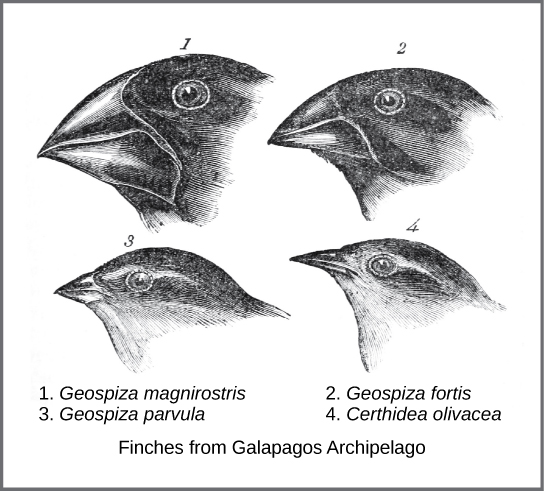
Figure 18.2図 18.2
Darwin observed that beak shape varies among finch species. He postulated that ancestral species' beaks had adapted over time to equip the finches to acquire different food sources.
英語のヒント
ダーウィンは、フィンチの種によってくちばしの形が異なることを観察した。祖先種のくちばしが時間とともに適応し、異なる食物源を利用できるようになったのだと仮定した。
Wallace and Darwin both observed similar patterns in other organisms and they independently developed the same explanation for how and why such changes could take place. Darwin called this mechanism natural selection. Natural selection, or “survival of the fittest,” is the more prolific reproduction of individuals with favorable traits that survive environmental change because of those traits. This leads to evolutionary change.
英語のヒント
ウォレスとダーウィンは、ほかの生物でも似たパターンを観察し、そのような変化がどのように、またなぜ起こりうるのかについて、独立に同じ説明に到達した。ダーウィンは、この仕組みを自然選択と呼んだ。自然選択、すなわち「適者生存」とは、有利な形質をもち、その形質のおかげで環境の変化を生き延びた個体が、より多く繁殖することである。これが進化的な変化につながる。
For example, Darwin observed a population of giant tortoises in the Galápagos Archipelago to have longer necks than those that lived on other islands with dry lowlands. These tortoises were “selected” because they could reach more leaves and access more food than those with short necks. In times of drought when fewer leaves would be available, those that could reach more leaves had a better chance to eat and survive than those that couldn’t reach the food source. Consequently, long-necked tortoises would be more likely to be reproductively successful and pass the long-necked trait to their offspring. Over time, only long-necked tortoises would be present in the population.
英語のヒント
例えばダーウィンは、ガラパゴス諸島のあるゾウガメ集団が、乾燥した低地をもつほかの島に住むゾウガメより、長い首をもつことを観察した。これらのカメが「選ばれた」のは、首の短いカメより多くの葉に届き、より多くの食物を得られたからである。干ばつで葉が少なくなる時期には、多くの葉に届くカメの方が、食物に届かないカメよりも、食べて生き延びる機会が多かった。したがって、首の長いカメの方が繁殖に成功し、長い首という形質を子に伝えやすいと考えられる。時間がたつと、集団には首の長いカメだけが存在するようになるだろう。
Natural selection, Darwin argued, was an inevitable outcome of three principles that operated in nature. First, most characteristics of organisms are inherited, or passed from parent to offspring. Although no one, including Darwin and Wallace, knew how this happened at the time, it was a common understanding. Second, more offspring are produced than are able to survive, so resources for survival and reproduction are limited. The capacity for reproduction in all organisms outstrips the availability of resources to support their numbers. Thus, there is competition for those resources in each generation. Both Darwin and Wallace’s understanding of this principle came from reading economist Thomas Malthus' essay that explained this principle in relation to human populations. Third, offspring vary among each other in regard to their characteristics and those variations are inherited. Darwin and Wallace reasoned that offspring with inherited characteristics which allow them to best compete for limited resources will survive and have more offspring than those individuals with variations that are less able to compete. Because characteristics are inherited, these traits will be better represented in the next generation. This will lead to change in populations over generations in a process that Darwin called descent with modification. Ultimately, natural selection leads to greater adaptation of the population to its local environment. It is the only mechanism known for adaptive evolution.
英語のヒント
ダーウィンは、自然選択は、自然界で働く三つの原理の必然的な結果だと主張した。第一に、生物の特徴の大部分は遺伝する、すなわち親から子へ伝わる。当時はダーウィンもウォレスも含め、誰もその仕組みを知らなかったが、これは共通の理解だった。第二に、生き残れる数より多くの子が生まれるため、生存と繁殖のための資源は限られている。すべての生物の繁殖能力は、その数を支えるために利用できる資源を上回る。そのため、どの世代でも資源をめぐる競争がある。ダーウィンとウォレスはともに、人間の人口に関連してこの原理を説明した、経済学者トマス・マルサスの論文を読んで、この原理を理解した。第三に、子どうしでは特徴に違いがあり、その違いは遺伝する。ダーウィンとウォレスは、限られた資源をめぐって最もうまく競争できる遺伝的特徴をもつ子が生き残り、競争に弱い変異をもつ個体よりも多くの子を残す、と考えた。特徴は遺伝するため、その形質は次世代でより大きな割合を占める。これによって世代を重ねるにつれて集団が変化する。この過程をダーウィンは「変化を伴う由来」と呼んだ。最終的に自然選択は、集団がその地域の環境へさらに適応することをもたらす。これは、適応進化について知られている唯一の仕組みである。
In 1858, Darwin and Wallace (Figure 18.3) presented papers at the Linnean Society in London that discussed the idea of natural selection. The following year Darwin’s book, On the Origin of Species, was published. His book outlined in considerable detail his arguments for evolution by natural selection.
英語のヒント
1858年、ダーウィンとウォレス(図18.3)は、ロンドンのリンネ学会で、自然選択の考えを論じる論文を発表した。翌年、ダーウィンの著書『種の起源』が出版された。この本は、自然選択による進化についての主張を、かなり詳しく述べていた。
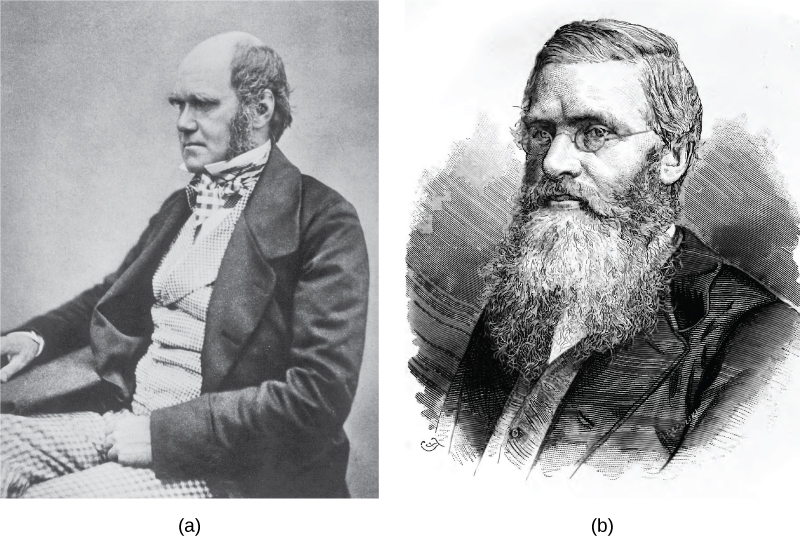


Figure 18.3図 18.3
Both (a) Charles Darwin and (b) Alfred Wallace wrote scientific papers on natural selection that they presented together at the Linnean Society in 1858.
(a)チャールズ・ダーウィンと(b)アルフレッド・ウォレスは、それぞれ自然選択に関する科学論文を書き、1858年にリンネ学会で共同発表した。
Studies of evolution by natural selection are difficult to conduct, as they require analyses of several generations of the investigated species in order to document the changes pointing to evolutionary change. The Galápagos finches are an excellent example. Peter and Rosemary Grant and their colleagues have studied Galápagos finch populations every year since 1976 and have provided important evidence of natural selection. The Grants found changes from one generation to the next in beak shape distribution with the medium ground finch on the Galápagos island of Daphne Major. The birds have inherited a variation in their bill shape with some having wide deep bills and others having thinner bills. During a period in which rainfall was higher than normal because of an El Niño, there was a lack of large hard seeds of which the large-billed birds ate; however, there was an abundance of the small soft seeds which the small-billed birds ate. Therefore, the small-billed birds were able to survive and reproduce. In the years following this El Niño, the Grants measured beak sizes in the population and found that the average bill size was smaller. Since bill size is an inherited trait, parents with smaller bills had more offspring and the bill evolved into a much smaller size. As conditions improved in 1987 and larger seeds became more available, the trend toward smaller average bill size ceased.
英語のヒント
自然選択による進化の研究は、実施が難しい。進化的な変化を示す変化を記録するには、調査する種の何世代にもわたる分析が必要だからである。ガラパゴスのフィンチは、優れた例である。ピーター・グラント、ローズマリー・グラントとその同僚は、1976年以来毎年、ガラパゴスのフィンチ集団を研究し、自然選択の重要な証拠を示してきた。グラント夫妻は、ガラパゴス諸島のダフネ・メジャー島の中型の地上性フィンチで、世代間のくちばし形状の分布の変化を見つけた。これらの鳥は、幅が広く厚みのあるくちばしから、より細いくちばしまで、くちばしの形の遺伝的変異をもつ。エルニーニョによって降水量が平年を上回った時期には、大きなくちばしの鳥が食べる大きく硬い種子が不足した。一方、小さなくちばしの鳥が食べる小さく柔らかい種子は豊富だった。そのため、小さなくちばしの鳥が生き残り、繁殖できた。このエルニーニョの後の数年間、夫妻が集団のくちばしの大きさを測ると、平均が小さくなっていることが分かった。くちばしの大きさは遺伝する形質なので、小さなくちばしの親がより多くの子を残し、くちばしはずっと小さい方向へ進化した。1987年に条件が改善し、大きな種子をより多く利用できるようになると、くちばしの平均サイズが小さくなる傾向は止まった。