第18章進化と種の起源
Adaptive Radiation適応放散
In some cases, a population of one species disperses throughout an area, and each finds a distinct niche or isolated habitat. Over time, the varied demands of their new lifestyles lead to multiple speciation events originating from a single species. We call this adaptive radiation because many adaptations evolve from a single point of origin; thus, causing the species to radiate into several new ones. Island archipelagos like the Hawaiian Islands provide an ideal context for adaptive radiation events because water surrounds each island which leads to geographical isolation for many organisms. The Hawaiian honeycreeper illustrates one example of adaptive radiation. From a single species, the founder species, numerous species have evolved, including the six in Figure 18.13.
英語のヒント
ある種の個体群が地域全体へ分散し、それぞれが別のニッチや隔離された生息環境を見つける場合がある。時間とともに、新しい生活様式のさまざまな要求が、一つの種を起点とする複数の種分化をもたらす。これを適応放散と呼ぶ。一つの起源から多くの適応が進化し、その種がいくつもの新しい種へ放射状に分かれるためである。ハワイ諸島のような群島は、適応放散に理想的な条件を与える。各島が水で囲まれ、多くの生物が地理的に隔離されるためである。ハワイミツスイ類は、適応放散の一例である。一つの始祖種から、図18.13の6種を含む、多数の種が進化した。
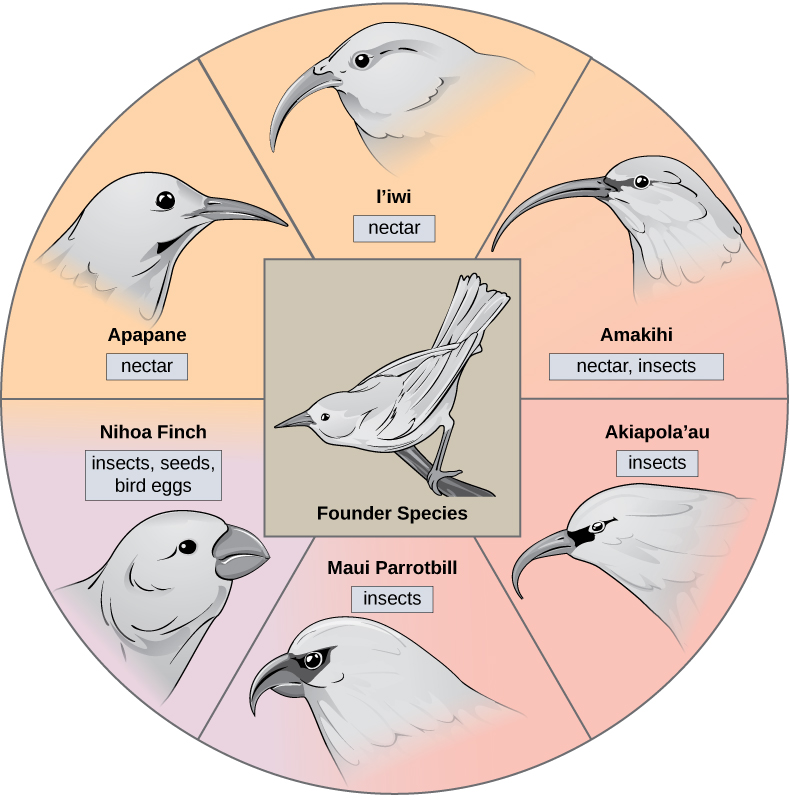
Figure 18.13図 18.13
The honeycreeper birds illustrate adaptive radiation. From one original species of bird, multiple others evolved, each with its own distinctive characteristics.
ハワイミツスイ類は、適応放散を示す。一つの元の鳥種から、それぞれ独自の特徴をもつ複数の種が進化した。
Notice the differences in the species’ beaks in Figure 18.13. Evolution in response to natural selection based on specific food sources in each new habitat led to evolution of a different beak suited to the specific food source. The seed-eating bird has a thicker, stronger beak which is suited to break hard nuts. The nectar-eating birds have long beaks to dip into flowers to reach the nectar. The insect-eating birds have beaks like swords, appropriate for stabbing and impaling insects. Darwin’s finches are another example of adaptive radiation in an archipelago.
英語のヒント
図18.13の種どうしの、くちばしの違いに注目しよう。それぞれの新しい生息環境の特定の食物源に基づく自然選択への応答として進化が起こり、その食物に適した異なるくちばしが進化した。種子を食べる鳥は、硬い木の実を割るのに適した、厚く丈夫なくちばしをもつ。花蜜を食べる鳥は、花の中へ差し込んで蜜に届く長いくちばしをもつ。昆虫を食べる鳥は、昆虫を突き刺すのに適した、剣のようなくちばしをもつ。ダーウィンフィンチ類も、群島で起こった適応放散の例である。
Sympatric Speciation同所的種分化
Can divergence occur if no physical barriers are in place to separate individuals who continue to live and reproduce in the same habitat? The answer is yes. We call the process of speciation within the same space sympatric. The prefix “sym” means same, so “sympatric” means “same homeland” in contrast to “allopatric” meaning “other homeland.” Scientists have proposed and studied many mechanisms.
英語のヒント
同じ生息環境で暮らし、繁殖し続ける個体どうしを隔てる物理的な障壁がなくても、分岐は起こるだろうか。答えは、起こる、である。同じ空間内での種分化の過程を、同所的という。接頭辞symは「同じ」を意味し、sympatricは「同じ故郷」という意味になる。これは、「別の故郷」を意味するallopatricと対照的である。科学者は多くの仕組みを提案し、研究してきた。
One form of sympatric speciation can begin with a serious chromosomal error during cell division. In a normal cell division event chromosomes replicate, pair up, and then separate so that each new cell has the same number of chromosomes. However, sometimes the pairs separate and the end cell product has extra sets of chromosomes in a condition that we call polyploidy (Figure 18.14).
英語のヒント
同所的種分化の一つの形は、細胞分裂中の大きな染色体の誤りから始まることがある。正常な細胞分裂では、染色体が複製され、対を作り、その後に分離して、それぞれの新しい細胞が同じ数の染色体をもつ。しかし、ときには対が分離し、最終的にできた細胞が余分な染色体のセットをもつことがある。この状態を倍数性と呼ぶ(図18.14)。
Polyploidy is a condition in which a cell or organism has an extra set, or sets, of chromosomes. Scientists have identified two main types of polyploidy that can lead to reproductive isolation of an individual in the polyploidy state. Reproductive isolation is the inability to interbreed. In some cases, a polyploid individual will have two or more complete sets of chromosomes from its own species in a condition that we call autopolyploidy (Figure 18.15). The prefix “auto-” means “self,” so the term means multiple chromosomes from one’s own species. Polyploidy results from an error in meiosis in which all of the chromosomes move into one cell instead of separating.
英語のヒント
倍数性は、細胞や生物が、余分な染色体のセットを一つ以上もつ状態である。科学者は、その個体を生殖的に隔離しうる、倍数性の主な二つの型を見いだしている。生殖的隔離とは、互いに交配できないことである。倍数体の個体が、自分の種に由来する完全な染色体のセットを二つ以上もつ場合がある。この状態を同質倍数性と呼ぶ(図18.15)。接頭辞auto-は「自己」を意味するので、この語は自分の種に由来する複数の染色体セットを意味する。倍数性は、減数分裂で染色体が分かれず、すべて一つの細胞へ移動するという誤りから生じる。
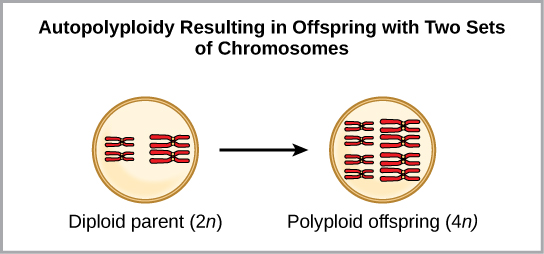
Figure 18.15図 18.15
Autopolyploidy results when mitosis is not followed by cytokinesis.
同質倍数性は、有糸分裂の後に細胞質分裂が起こらないときに生じる。
For example, if a plant species with 2n = 6 produces autopolyploid gametes that are also diploid (2n = 6, when they should be n = 3), the gametes now have twice as many chromosomes as they should have. These new gametes will be incompatible with the normal gametes that this plant species produces. However, they could either self-pollinate or reproduce with other autopolyploid plants with gametes having the same diploid number. In this way, sympatric speciation can occur quickly by forming offspring with 4n that we call a tetraploid. These individuals would immediately be able to reproduce only with those of this new kind and not those of the ancestral species.
英語のヒント
例えば、2n=6の植物種が、同じく二倍体の同質倍数性配偶子を作ったとする。本来はn=3であるべきところが2n=6になっているので、配偶子の染色体数は本来の2倍である。これらの新しい配偶子は、その植物種が作る正常な配偶子とは適合しない。しかし、自家受粉するか、同じ二倍体数の配偶子をもつ別の同質倍数体植物と繁殖することはできる。このように、四倍体と呼ぶ4nの子を作ることで、同所的種分化が急速に起こりうる。これらの個体は、すぐに新しい型の個体とだけ繁殖できるようになり、祖先種の個体とは繁殖できなくなる。
The other form of polyploidy occurs when individuals of two different species reproduce to form a viable offspring that we call an allopolyploid. The prefix “allo-” means “other” (recall from allopatric): therefore, an allopolyploid occurs when gametes from two different species combine. Figure 18.16 illustrates one possible way an allopolyploid can form. Notice how it takes two generations, or two reproductive acts, before the viable fertile hybrid results.
英語のヒント
もう一つの倍数性は、異なる二つの種の個体が繁殖し、異質倍数体と呼ばれる生存可能な子を作るときに生じる。接頭辞allo-は「別の」を意味する(異所的のallopatricを思い出そう)。したがって、異質倍数体は、異なる二つの種の配偶子が結びつくときに生じる。図18.16は、異質倍数体ができる一つの方法を示す。生存可能で繁殖能力のある雑種ができるまでに、二世代、すなわち2回の生殖が必要なことに注目しよう。
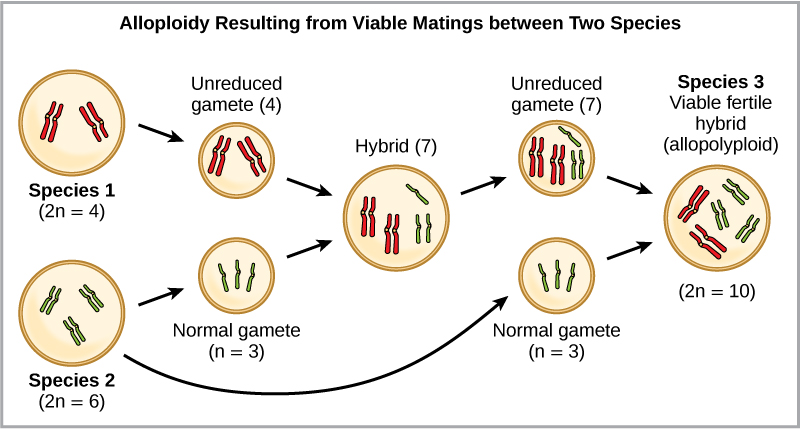


Figure 18.16図 18.16
Alloploidy results when two species mate to produce viable offspring. In this example, a normal gamete from one species fuses with a polyploidy gamete from another. Two matings are necessary to produce viable offspring.
異質倍数性は、二つの種が交配して生存可能な子を作るときに生じる。この例では、一方の種の正常な配偶子が、他方の種の倍数性配偶子と融合する。生存可能な子を作るには、2回の交配が必要である。
The cultivated forms of wheat, cotton, and tobacco plants are all allopolyploids. Although polyploidy occurs occasionally in animals, it takes place most commonly in plants. (Animals with any of the types of chromosomal aberrations that we describe here are unlikely to survive and produce normal offspring.) Scientists have discovered more than half of all plant species studied relate back to a species evolved through polyploidy. With such a high rate of polyploidy in plants, some scientists hypothesize that this mechanism takes place more as an adaptation than as an error.
英語のヒント
栽培されているコムギ、ワタ、タバコは、すべて異質倍数体である。倍数性は動物でもときに起こるが、最もよく見られるのは植物である。(ここで述べたような染色体異常をもつ動物は、生き残って正常な子を残す可能性が低い。)科学者は、調べた植物種の半数を超えるものが、倍数化によって進化した種へさかのぼることを見いだしている。植物の倍数性の割合がこれほど高いため、この仕組みは誤りとしてよりも、適応として起こるのだという仮説を立てる科学者もいる。