第18章進化と種の起源
Speciation種分化
The biological definition of species, which works for sexually reproducing organisms, is a group of actual or potential interbreeding individuals. There are exceptions to this rule. Many species are similar enough that hybrid offspring are possible and may often occur in nature, but for the majority of species this rule generally holds. The presence in nature of hybrids between similar species suggests that they may have descended from a single interbreeding species, and the speciation process may not yet be completed.
英語のヒント
有性生殖する生物に適用される、生物学的な種の定義は、実際に、または潜在的に交配できる個体の集団である。この規則には例外がある。多くの種は十分に似ているため雑種の子を作ることができ、自然界でそれがしばしば起こることもある。しかし大多数の種では、この規則が一般に成り立つ。自然界に近縁種間の雑種が存在することは、それらが、一つの交配可能な種から分かれた可能性を示す。種分化の過程は、まだ完了していないのかもしれない。
Given the extraordinary diversity of life on the planet there must be mechanisms for speciation: the formation of two species from one original species. Darwin envisioned this process as a branching event and diagrammed the process in the only illustration in On the Origin of Species (Figure 18.11a). Compare this illustration to the diagram of elephant evolution (Figure 18.11b), which shows that as one species changes over time, it branches to form more than one new species, repeatedly, as long as the population survives or until the organism becomes extinct.
英語のヒント
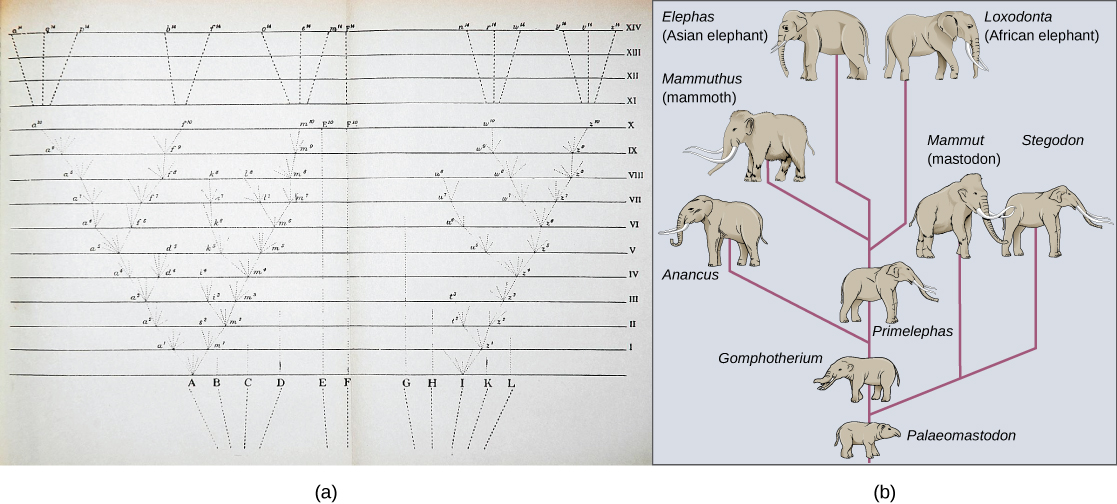

Figure 18.11図 18.11
The only illustration in Darwin's On the Origin of Species is (a) a diagram showing speciation events leading to biological diversity. The diagram shows similarities to phylogenetic charts that today illustrate the relationships of species. (b) Modern elephants evolved from the Palaeomastodon, a species that lived in Egypt 35–50 million years ago.
ダーウィンの『種の起源』にある唯一の挿絵は、(a)生物多様性を生み出す種分化の出来事を示す図である。この図は、現在、種どうしの関係を示すために使われる系統図と似ている。(b)現生のゾウは、3,500万〜5,000万年前のエジプトに生息した種、パレオマストドンから進化した。
For speciation to occur, two new populations must form from one original population and they must evolve in such a way that it becomes impossible for individuals from the two new populations to interbreed. Biologists have proposed mechanisms by which this could occur that fall into two broad categories. Allopatric speciation (allo- = "other"; -patric = "homeland") involves geographic separation of populations from a parent species and subsequent evolution. Sympatric speciation (sym- = "same"; -patric = "homeland") involves speciation occurring within a parent species remaining in one location.
英語のヒント
種分化が起こるには、一つの元の個体群から二つの新しい個体群が形成され、両方の個体群の個体どうしが交配できなくなるように進化しなければならない。生物学者は、これが起こる仕組みを、大きく二つに分けて提案している。異所的種分化(allo-は「別の」、-patricは「故郷」を意味する)は、親種の個体群が地理的に分離し、その後に進化することで起こる。同所的種分化(sym-は「同じ」、-patricは「故郷」)は、親種が同じ場所にとどまったまま、その内部で起こる種分化である。
Biologists think of speciation events as the splitting of one ancestral species into two descendant species. There is no reason why more than two species might not form at one time except that it is less likely and we can conceptualize multiple events as single splits occurring close in time.
英語のヒント
生物学者は、種分化を、一つの祖先種が二つの子孫種へ分かれる出来事として考える。一度に三つ以上の種ができない理由はなく、単にその可能性が低いというだけである。また、複数の出来事も、時間的に近接して起こる一つひとつの分岐として考えることができる。
Allopatric Speciation異所的種分化
A geographically continuous population has a gene pool that is relatively homogeneous. Gene flow, the movement of alleles across a species' range, is relatively free because individuals can move and then mate with individuals in their new location. Thus, an allele's frequency at one end of a distribution will be similar to the allele's frequency at the other end. When populations become geographically discontinuous, it prevents alleles' free-flow. When that separation lasts for a period of time, the two populations are able to evolve along different trajectories. Thus, their allele frequencies at numerous genetic loci gradually become increasingly different as new alleles independently arise by mutation in each population. Typically, environmental conditions, such as climate, resources, predators, and competitors for the two populations will differ causing natural selection to favor divergent adaptations in each group.
英語のヒント
地理的に連続した個体群の遺伝子プールは、比較的均質である。種の分布域を通じた対立遺伝子の移動、すなわち遺伝子流動は、比較的自由に起こる。個体が移動し、新しい場所の個体と交配できるためである。そのため、分布域の一方の端における対立遺伝子頻度は、もう一方の端と似ている。個体群が地理的に不連続になると、対立遺伝子の自由な流れが妨げられる。その分離が続くと、二つの個体群は異なる道筋で進化できる。それぞれの個体群で変異によって新しい対立遺伝子が独立に生じるため、多数の遺伝子座での対立遺伝子頻度は、徐々に違いを増していく。通常、二つの個体群では、気候、資源、捕食者、競争者などの環境条件が異なる。そのため、自然選択はそれぞれの集団で異なる適応を有利にする。
Isolation of populations leading to allopatric speciation can occur in a variety of ways: a river forming a new branch, erosion creating a new valley, a group of organisms traveling to a new location without the ability to return, or seeds floating over the ocean to an island. The nature of the geographic separation necessary to isolate populations depends entirely on the organism's biology and its potential for dispersal. If two flying insect populations took up residence in separate nearby valleys, chances are, individuals from each population would fly back and forth continuing gene flow. However, if a new lake divided two rodent populations continued gene flow would be unlikely; therefore, speciation would be more likely.
英語のヒント
異所的種分化につながる個体群の隔離は、さまざまな方法で起こる。川に新しい支流ができること、侵食で新しい谷ができること、生物集団が戻れない新たな場所へ移動すること、種子が海を漂って島へ届くことなどである。個体群を隔離するのに必要な地理的分離の性質は、その生物の生態と分散能力によってまったく異なる。飛べる昆虫の二つの個体群が、近くにある別々の谷にすみついても、各個体群の個体は行き来して飛び、遺伝子流動が続く可能性が高い。しかし、新しい湖が二つの齧歯類の個体群を隔てた場合、遺伝子流動が続く可能性は低く、そのため種分化が起こりやすくなる。
Biologists group allopatric processes into two categories: dispersal and vicariance. Dispersal is when a few members of a species move to a new geographical area, and vicariance is when a natural situation arises to physically divide organisms.
英語のヒント
生物学者は、異所的な過程を分散と分断の二つに分ける。分散とは、ある種の少数の個体が新しい地域へ移動することであり、分断とは、自然の状況によって生物が物理的に隔てられることである。
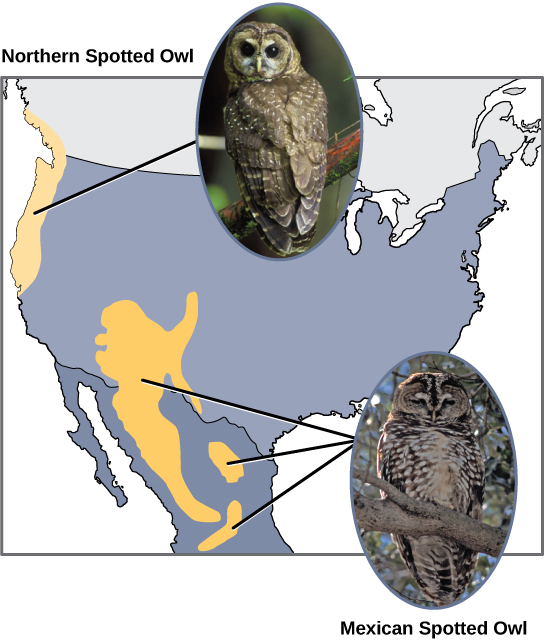
Scientists have documented numerous cases of allopatric speciation taking place. For example, along the west coast of the United States, two separate spotted owl subspecies exist. The northern spotted owl has genetic and phenotypic differences from its close relative: the Mexican spotted owl, which lives in the south (Figure 18.12).
英語のヒント
科学者は、異所的種分化が起こっている例を数多く記録してきた。例えば、米国西海岸沿いには、マダラフクロウの二つの異なる亜種がいる。北方のマダラフクロウは、南に暮らす近縁のメキシコマダラフクロウと、遺伝的にも表現型にも違いがある(図18.12)。
OpenStax, Rice University; Biology 2e. (credit "northern spotted owl": modification of work by John and Karen Hollingsworth; credit "Mexican spotted owl": modification of work by Bill Radke) · CC BY 4.0 · Source出典

Figure 18.12図 18.12
The northern spotted owl and the Mexican spotted owl inhabit geographically separate locations with different climates and ecosystems. The owl is an example of allopatric speciation. (credit "northern spotted owl": modification of work by John and Karen Hollingsworth; credit "Mexican spotted owl": modification of work by Bill Radke)
北方のマダラフクロウとメキシコマダラフクロウは、気候や生態系が異なる、地理的に離れた場所に生息する。このフクロウは、異所的種分化の例である。(「北方のマダラフクロウ」のクレジット:John and Karen Hollingsworthの作品を改変。「メキシコマダラフクロウ」:Bill Radkeの作品を改変)
Additionally, scientists have found that the further the distance between two groups that once were the same species, the more likely it is that speciation will occur. This seems logical because as the distance increases, the various environmental factors would likely have less in common than locations in close proximity. Consider the two owls: in the north, the climate is cooler than in the south. The types of organisms in each ecosystem differ, as do their behaviors and habits. Also, the hunting habits and prey choices of the southern owls vary from the northern owls. These variances can lead to evolved differences in the owls, and speciation likely will occur.
英語のヒント
さらに科学者は、かつて同じ種だった二つの集団の距離が遠いほど、種分化が起こる可能性が高いことを見いだしている。距離が増すにつれて、さまざまな環境要因の共通点は、近接した場所どうしより少なくなるだろうから、これは理にかなっている。二つのフクロウを考えてみよう。北の気候は南より涼しい。各生態系の生物の種類は異なり、それらの行動や習性も異なる。また、南のフクロウの狩りの習性や獲物の選択は、北のフクロウと違う。こうした違いは、フクロウに進化による差異をもたらし、種分化が起こる可能性を高める。