第18章進化と種の起源
18.2 Formation of New Species18.2 新しい種の形成
Learning Objectives学習目標
By the end of this section, you will be able to do the following:
この節を終えると、次のことができるようになる。
- Define species and describe how scientists identify species as different種を定義し、科学者が種の違いをどのように識別するか説明する。
- Describe genetic variables that lead to speciation種分化を引き起こす遺伝的変数を説明する。
- Identify prezygotic and postzygotic reproductive barriers接合前および接合後の生殖障壁を識別する。
- Explain allopatric and sympatric speciation異所的種分化と同所的種分化を説明する。
- Describe adaptive radiation適応放散を説明する。
Although all life on earth shares various genetic similarities, only certain organisms combine genetic information by sexual reproduction and have offspring that can then successfully reproduce. Scientists call such organisms members of the same biological species.
地球上のすべての生命は、遺伝的にさまざまな共通点をもつ。しかし、有性生殖によって遺伝情報を組み合わせ、さらにその子も正常に繁殖できるのは、特定の生物どうしに限られる。科学者は、そのような生物を同じ生物学的種の構成員と呼ぶ。
Species and the Ability to Reproduce種と繁殖能力
A species is a group of individual organisms that interbreed and produce fertile, viable offspring. According to this definition, one species is distinguished from another when, in nature, it is not possible for matings between individuals from each species to produce fertile offspring.
英語のヒント
種とは、互いに交配して、生存可能で、繁殖能力のある子を作る個体の集まりである。この定義によれば、自然界で、それぞれの種の個体どうしが交配しても繁殖能力のある子を作れない場合、一方の種は他方の種と区別される。
Members of the same species share both external and internal characteristics, which develop from their DNA. The closer relationship two organisms share, the more DNA they have in common, just like people and their families. People’s DNA is likely to be more like their father or mother’s DNA than their cousin or grandparent’s DNA. Organisms of the same species have the highest level of DNA alignment and therefore share characteristics and behaviors that lead to successful reproduction.
英語のヒント
同じ種の個体は、DNAに基づいて発達する外部と内部の特徴を共有する。二つの生物が近い関係にあるほど、共通するDNAも多い。これは、人とその家族の場合と同じである。人のDNAは、いとこや祖父母のDNAよりも、父親や母親のDNAによく似ていると考えられる。同じ種の生物は、DNAの一致の程度が最も高く、そのため、繁殖の成功につながる特徴や行動を共有している。
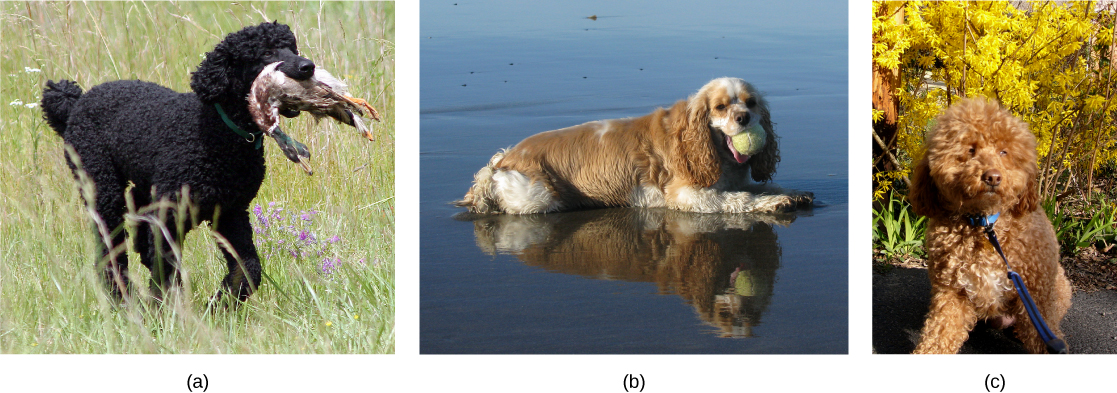
Species’ appearance can be misleading in suggesting an ability or inability to mate. For example, even though domestic dogs (Canis lupus familiaris) display phenotypic differences, such as size, build, and coat, most dogs can interbreed and produce viable puppies that can mature and sexually reproduce (Figure 18.9).
英語のヒント
種の見た目から、交配できるかどうかを判断すると、誤ることがある。例えば、イヌ(Canis lupus familiaris)は、大きさ、体格、毛並みなどの表現型に違いがあるが、ほとんどのイヌどうしは交配でき、生存可能な子犬を作れる。その子犬は成熟して有性生殖できる(図18.9)。
OpenStax, Rice University; Biology 2e. (credit a: modification of work by Sally Eller, Tom Reese; credit b: modification of work by Jeremy McWilliams; credit c: modification of work by Kathleen Conklin) · CC BY 4.0 · Source出典

Figure 18.9図 18.9
The (a) poodle and (b) cocker spaniel can reproduce to produce a breed known as (c) the cockapoo. (credit a: modification of work by Sally Eller, Tom Reese; credit b: modification of work by Jeremy McWilliams; credit c: modification of work by Kathleen Conklin)
(a)プードルと(b)コッカー・スパニエルは交配し、(c)コッカプーという犬種を作れる。(aのクレジット:Sally Eller、Tom Reeseの作品を改変。b:Jeremy McWilliamsの作品を改変。c:Kathleen Conklinの作品を改変)
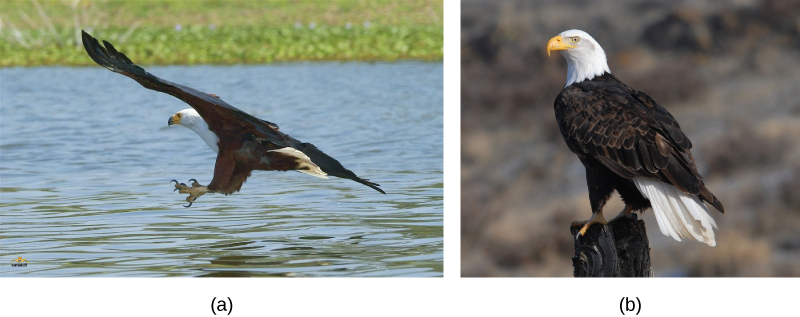
In other cases, individuals may appear similar although they are not members of the same species. For example, even though bald eagles (Haliaeetus leucocephalus) and African fish eagles (Haliaeetus vocifer) are both birds and eagles, each belongs to a separate species group (Figure 18.10). If humans were to artificially intervene and fertilize a bald eagle's egg with an African fish eagle's sperm and a chick did hatch, that offspring, called a hybrid (a cross between two species), would probably be infertile—unable to successfully reproduce after it reached maturity. Different species may have different genes that are active in development; therefore, it may not be possible to develop a viable offspring with two different sets of directions. Thus, even though hybridization may take place, the two species still remain separate.
英語のヒント
別の場合には、同じ種ではないのに、個体の見た目が似ていることがある。例えば、ハクトウワシ(Haliaeetus leucocephalus)とサンショクウミワシ(Haliaeetus vocifer)は、どちらも鳥でありワシだが、別の種に属する(図18.10)。人が人工的に介入し、ハクトウワシの卵をサンショクウミワシの精子で受精させ、ひながかえったとしても、その子はおそらく不妊で、成熟後に正常に繁殖できない。このような、二つの種の交配による子を雑種と呼ぶ。種が異なると、発生の際に働く遺伝子も異なる場合がある。そのため、異なる二組の指示では、生存可能な子が発生できないことがある。このように、交雑が起こっても、二つの種は別のままである。
OpenStax, Rice University; Biology 2e. (credit a: modification of work by Nigel Wedge; credit b: modification of work by U.S. Fish and Wildlife Service) · CC BY 4.0 · Source出典

Figure 18.10図 18.10
The (a) African fish eagle is similar in appearance to the (b) bald eagle, but the two birds are members of different species. (credit a: modification of work by Nigel Wedge; credit b: modification of work by U.S. Fish and Wildlife Service)
(a)サンショクウミワシは(b)ハクトウワシと外見が似ているが、この二つの鳥は別の種である。(aのクレジット:Nigel Wedgeの作品を改変。b:U.S. Fish and Wildlife Serviceの作品を改変)
Populations of species share a gene pool: a collection of all the gene variants in the species. Again, the basis to any changes in a group or population of organisms must be genetic for this is the only way to share and pass on traits. When variations occur within a species, they can only pass to the next generation along two main pathways: asexual reproduction or sexual reproduction. The change will pass on asexually simply if the reproducing cell possesses the changed trait. For the changed trait to pass on by sexual reproduction, a gamete, such as a sperm or egg cell, must possess the changed trait. In other words, sexually-reproducing organisms can experience several genetic changes in their body cells, but if these changes do not occur in a sperm or egg cell, the changed trait will never reach the next generation. Only heritable traits can evolve. Therefore, reproduction plays a paramount role for genetic change to take root in a population or species. In short, organisms must be able to reproduce with each other to pass new traits to offspring.
英語のヒント
ある種の個体群は、遺伝子プール、すなわちその種のすべての遺伝子変異型の集まりを共有する。ここでも、生物の集団や個体群に起こる変化の基盤は、遺伝的でなければならない。それが形質を共有し、伝える唯一の方法だからである。種の内部に変異が生じたとき、それが次世代へ伝わる主な経路は、無性生殖と有性生殖の二つだけである。無性生殖では、増殖する細胞が変化した形質をもっていれば、その変化は伝わる。有性生殖で変化した形質が伝わるには、精子や卵細胞などの配偶子が、その形質をもっていなければならない。つまり、有性生殖する生物では体の細胞にいくつもの遺伝的変化が起こりうるが、その変化が精子や卵細胞に起こらなければ、変化した形質は次世代へ決して届かない。進化できるのは、遺伝する形質だけである。したがって、生殖は、遺伝的変化が個体群や種に定着するうえで、最も重要な役割を果たす。要するに、新しい形質を子に伝えるには、生物どうしが繁殖できなければならない。