第18章進化と種の起源
Habitat Influence on Speciation生息環境が種分化に及ぼす影響
Sympatric speciation may also take place in ways other than polyploidy. For example, consider a fish species that lives in a lake. As the population grows, competition for food increases. Under pressure to find food, suppose that a group of these fish had the genetic flexibility to discover and feed off another resource that other fish did not use. What if this new food source was located at a different depth of the lake? Over time, those feeding on the second food source would interact more with each other than the other fish; therefore, they would breed together as well. Offspring of these fish would likely behave as their parents: feeding and living in the same area and keeping separate from the original population. If this group of fish continued to remain separate from the first population, eventually sympatric speciation might occur as more genetic differences accumulated between them.
英語のヒント
同所的種分化は、倍数性以外の方法でも起こりうる。例えば、ある湖に暮らす魚種を考えよう。個体群が大きくなると、食物をめぐる競争が増える。食物を見つける圧力のもとで、一部の魚が、ほかの魚が使っていない別の資源を発見して食べる遺伝的な柔軟性をもっていたとする。その新しい食物源が、湖の異なる深さにあったらどうだろう。時間とともに、二つ目の食物源を利用する魚は、ほかの魚とよりも、互いに多く関わるようになり、そのため繁殖も仲間どうしで行うだろう。その子も親と同じように、同じ場所で食べて暮らし、元の個体群から離れている可能性が高い。この集団が元の個体群から分かれた状態を保ち続けると、両者の遺伝的な違いが蓄積するにつれ、やがて同所的種分化が起こるかもしれない。
This scenario does play out in nature, as do others that lead to reproductive isolation. One such place is Lake Victoria in Africa, famous for its sympatric speciation of cichlid fish. Researchers have found hundreds of sympatric speciation events in these fish, which have not only happened in great number, but also over a short period of time. Figure 18.21 shows this type of speciation among a cichlid fish population in Nicaragua. In this locale, two types of cichlids live in the same geographic location but have come to have different morphologies that allow them to eat various food sources.
英語のヒント
この筋書きは、生殖的隔離をもたらすほかの筋書きと同様に、実際に自然界で起こる。その一つの場所が、シクリッドという魚の同所的種分化で知られる、アフリカのビクトリア湖である。研究者は、これらの魚で数百の同所的種分化の出来事を見つけた。数が多いだけでなく、短期間に起こっていた。図18.21は、ニカラグアのシクリッド個体群で見られる、この種の種分化を示す。ここでは、二つの型のシクリッドが同じ地理的な場所に暮らしているが、さまざまな食物源を利用できる異なる形態をもつようになった。
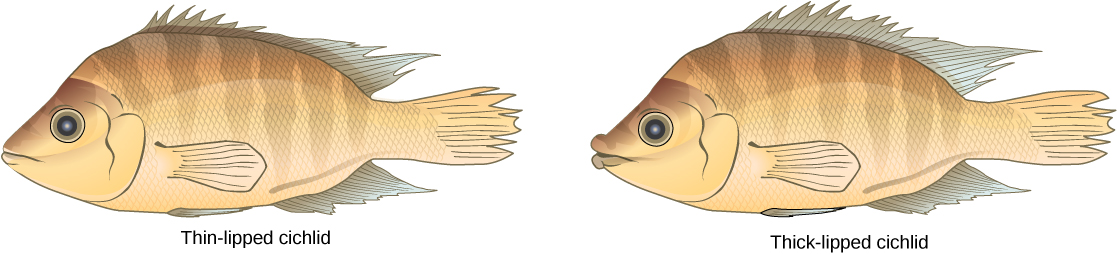

Figure 18.21図 18.21
Cichlid fish from Lake Apoyeque, Nicaragua, show evidence of sympatric speciation. Lake Apoyeque, a crater lake, is 1800 years old, but genetic evidence indicates that a single population of cichlid fish populated the lake only 100 years ago. Nevertheless, two populations with distinct morphologies and diets now exist in the lake, and scientists believe these populations may be in an early stage of speciation.
英語のヒント
ニカラグアのアポイェケ湖のシクリッドは、同所的種分化の証拠を示す。火口湖であるアポイェケ湖は1,800年前にできたが、遺伝的証拠によると、一つのシクリッド個体群が湖にすみついたのは、わずか100年前である。それにもかかわらず、現在は形態と食性の異なる二つの個体群が存在しており、科学者は、これらが種分化の初期段階にある可能性があると考えている。
Section Summaryこの節のまとめ
Speciation occurs along two main pathways: geographic separation (allopatric speciation) and through mechanisms that occur within a shared habitat (sympatric speciation). Both pathways isolate a population reproductively in some form. Mechanisms of reproductive isolation act as barriers between closely related species, enabling them to diverge and exist as genetically independent species. Prezygotic barriers block reproduction prior to formation of a zygote; whereas, postzygotic barriers block reproduction after fertilization occurs. For a new species to develop, something must introduce a reproductive barrier. Sympatric speciation can occur through errors in meiosis that form gametes with extra chromosomes (polyploidy). Autopolyploidy occurs within a single species; whereas, allopolyploidy occurs between closely related species.
種分化は、主に二つの経路で起こる。地理的な分離による異所的種分化と、同じ生息環境内で起こる仕組みによる同所的種分化である。どちらの経路も、何らかの形で個体群を生殖的に隔離する。生殖的隔離の仕組みは近縁種の間の障壁として働き、それらが分岐して、遺伝的に独立した種として存在できるようにする。接合前障壁は接合子ができる前に生殖を妨げ、接合後障壁は受精後に生殖を妨げる。新しい種が生じるには、何かによって生殖障壁が作られなければならない。同所的種分化は、減数分裂の誤りによって、余分な染色体をもつ配偶子ができること(倍数性)で起こりうる。同質倍数性は一つの種の内部で起こり、異質倍数性は近縁種の間で起こる。
Visual Connection Questions図を使った問題
Exercises 9練習問題 9
Exercise 9問題 9
Figure 18.14 Which is most likely to survive, offspring with 2n+1 chromosomes or offspring with 2n-1 chromosomes?
図18.14 染色体数が2n+1の子と2n−1の子では、どちらが生き残る可能性が高いか。
Solution解き方
Figure 18.14 Loss of genetic material is almost always lethal, so offspring with 2n+1 chromosomes are more likely to survive.
図18.14 遺伝物質の欠失は、ほぼ常に致命的である。そのため、染色体数が2n+1の子の方が生き残る可能性が高い。
Review Questions確認問題
Exercises 10–16練習問題 10–16
Exercise 10問題 10
Which situation would most likely lead to allopatric speciation?
異所的種分化につながる可能性が最も高いのは、どの状況か。
- Flood causes the formation of a new lake.洪水によって新しい湖ができる。
- A storm causes several large trees to fall down.嵐によって大木が数本倒れる。
- A mutation causes a new trait to develop.変異によって新しい形質が生じる。
- An injury causes an organism to seek out a new food source.
英語のヒント
けがによって、生物が新しい食物源を探すようになる。
Solution解き方
A
A
Exercise 11問題 11
What is the main difference between dispersal and vicariance?
英語のヒント
分散と分断の主な違いは何か。
- One leads to allopatric speciation, whereas the other leads to sympatric speciation.一方は異所的種分化を、もう一方は同所的種分化を引き起こす。
- One involves the movement of the organism, and the other involves a change in the environment.一方は生物の移動を伴い、もう一方は環境の変化を伴う。
- One depends on a genetic mutation occurring, and the other does not.一方は遺伝的変異の発生に依存するが、もう一方は依存しない。
- One involves closely related organisms, and the other involves only individuals of the same species.一方には近縁の生物が関わり、もう一方には同じ種の個体だけが関わる。
Solution解き方
B
B
Exercise 12問題 12
Which variable increases the likelihood of allopatric speciation taking place more quickly?
英語のヒント
異所的種分化がより速く起こる可能性を高める変数はどれか。
- lower rate of mutation変異率が低いこと
- longer distance between divided groups分かれた集団間の距離が長いこと
- increased instances of hybrid formation雑種が形成される事例が増えること
- equivalent numbers of individuals in each population
英語のヒント
各個体群の個体数が等しいこと
Solution解き方
B
B
Exercise 13問題 13
What is the main difference between autopolyploid and allopolyploid?
同質倍数体と異質倍数体の主な違いは何か。
- the number of chromosomes染色体の数
- the functionality of the chromosomes染色体の機能性
- the source of the extra chromosomes余分な染色体の由来
- the number of mutations in the extra chromosomes余分な染色体に生じた変異の数
Solution解き方
C
C
Exercise 14問題 14
Which reproductive combination produces hybrids?
どのような組み合わせで繁殖すると、雑種が生じるか。
- when individuals of the same species in different geographical areas reproduce異なる地理的地域にいる同種の個体が繁殖した場合
- when any two individuals sharing the same habitat reproduce同じ生息場所を共有する任意の2個体が繁殖した場合
- when members of closely related species reproduce近縁種に属する個体が繁殖した場合
- when offspring of the same parents reproduce同じ親から生まれた子どうしが繁殖した場合
Solution解き方
C
C
Exercise 15問題 15
Which condition is the basis for a species to be reproductively isolated from other members?
ある種が他の種の個体から生殖的に隔離されているとする根拠は、どの条件か。
- It does not share its habitat with related species.近縁種と生息場所を共有していない。
- It does not exist out of a single habitat.単一の生息場所の外には存在しない。
- It does not exchange genetic information with other species.他の種と遺伝情報を交換しない。
- It does not undergo evolutionary changes for a significant period of time.
英語のヒント
長期間にわたって進化的変化を経験しない。
Solution解き方
C
C
Exercise 16問題 16
Which situation is not an example of a prezygotic barrier?
接合前障壁の例ではない状況はどれか。
- Two species of turtles breed at different times of the year.2種のカメが、1年のうち異なる時期に繁殖する。
- Two species of flowers attract different pollinators.2種の花が異なる送粉者を引き寄せる。
- Two species of birds display different mating dances.2種の鳥が異なる求愛ダンスを見せる。
- Two species of insects produce infertile offspring.2種の昆虫が、不妊の子を生む。
Solution解き方
D
D