第20章系統と生命の歴史
20.2 Determining Evolutionary Relationships20.2 進化的関係を決定する
Learning Objectives学習目標
By the end of this section, you will be able to do the following:
この節を終えると、次のことができるようになる。
- Compare homologous and analogous traits相同形質と相似形質を比較する。
- Discuss the purpose of cladistics分岐分類学の目的を論じる。
- Describe maximum parsimony最節約性を説明する。
Scientists must collect accurate information that allows them to make evolutionary connections among organisms. Similar to detective work, scientists must use evidence to uncover the facts. In the case of phylogeny, evolutionary investigations focus on two types of evidence: morphologic (form and function) and genetic.
英語のヒント
科学者は、生物どうしの進化的なつながりを明らかにするための正確な情報を集めなければならない。探偵の仕事に似て、証拠を使って事実を明らかにする必要がある。系統の研究では、進化の調査は、形態的証拠(形と機能)と遺伝的証拠という2種類に焦点を当てる。
Two Options for Similarities類似性の2つの由来
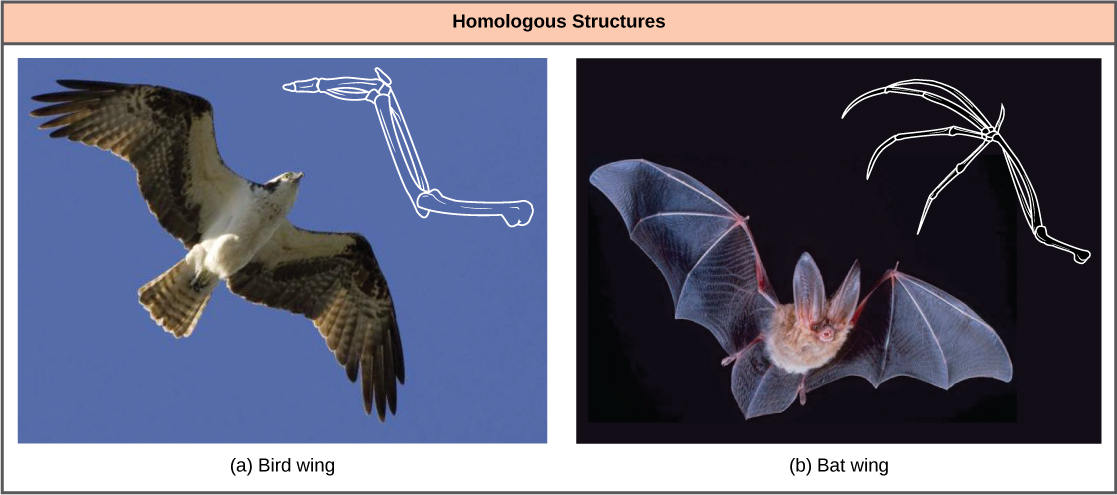
In general, organisms that share similar physical features and genomes are more closely related than those that do not. We refer to such features that overlap both morphologically (in form) and genetically as homologous structures. They stem from developmental similarities that are based on evolution. For example, the bones in bat and bird wings have homologous structures. This is an example of morphological homology (Figure 20.7).
英語のヒント
一般に、体の特徴やゲノムが似ている生物は、そうでない生物より近縁である。形態的、すなわち形の面でも、遺伝的な面でも重なるこのような特徴を、相同器官と呼ぶ。それらは、進化に由来する発生の類似性から生じる。たとえば、コウモリと鳥の翼の骨は相同な構造をもつ。これは形態的相同性の例である(図20.7)。
OpenStax, Rice University; Biology 2e. (credit a: modification of work by Steve Hillebrand, USFWS; credit b: modification of work by U.S. DOI BLM) · CC BY 4.0 · Source出典

Figure 20.7図 20.7
Bat and bird wings are homologous structures, indicating that bats and birds share a common evolutionary past. (credit a: modification of work by Steve Hillebrand, USFWS; credit b: modification of work by U.S. DOI BLM)
コウモリと鳥の翼は相同器官であり、両者が共通の進化の過去をもつことを示している。(a:Steve Hillebrand、USFWSの作品を改変。b:米国内務省土地管理局〔U.S. DOI BLM〕の作品を改変。)
Notice it is not simply a single bone, but rather a grouping of several bones arranged in a similar way. The more complex the feature, the more likely any kind of overlap is due to a common evolutionary past. Imagine two people from different countries both inventing a car with all the same parts and in exactly the same arrangement without any previous or shared knowledge. That outcome would be highly improbable. However, if two people both invented a hammer, we can reasonably conclude that both could have the original idea without the help of the other. The same relationship between complexity and shared evolutionary history is true for homologous structures in organisms.
英語のヒント
単に1本の骨ではなく、複数の骨がよく似た配置でまとまっていることに注目しよう。特徴が複雑であるほど、その重なりが共通の進化の過去に由来する可能性は高くなる。異なる国の2人が、事前の知識も共有知識もないまま、部品も配置もすべて同じ車をそれぞれ発明したと想像してみよう。そのような結果は、非常に起こりにくいだろう。しかし、2人がそれぞれハンマーを発明したのであれば、互いの助けなしに独自に思いついたとしても不合理ではない。複雑さと共通の進化史のこの関係は、生物の相同器官にも当てはまる。
Misleading Appearances誤解を招く外見
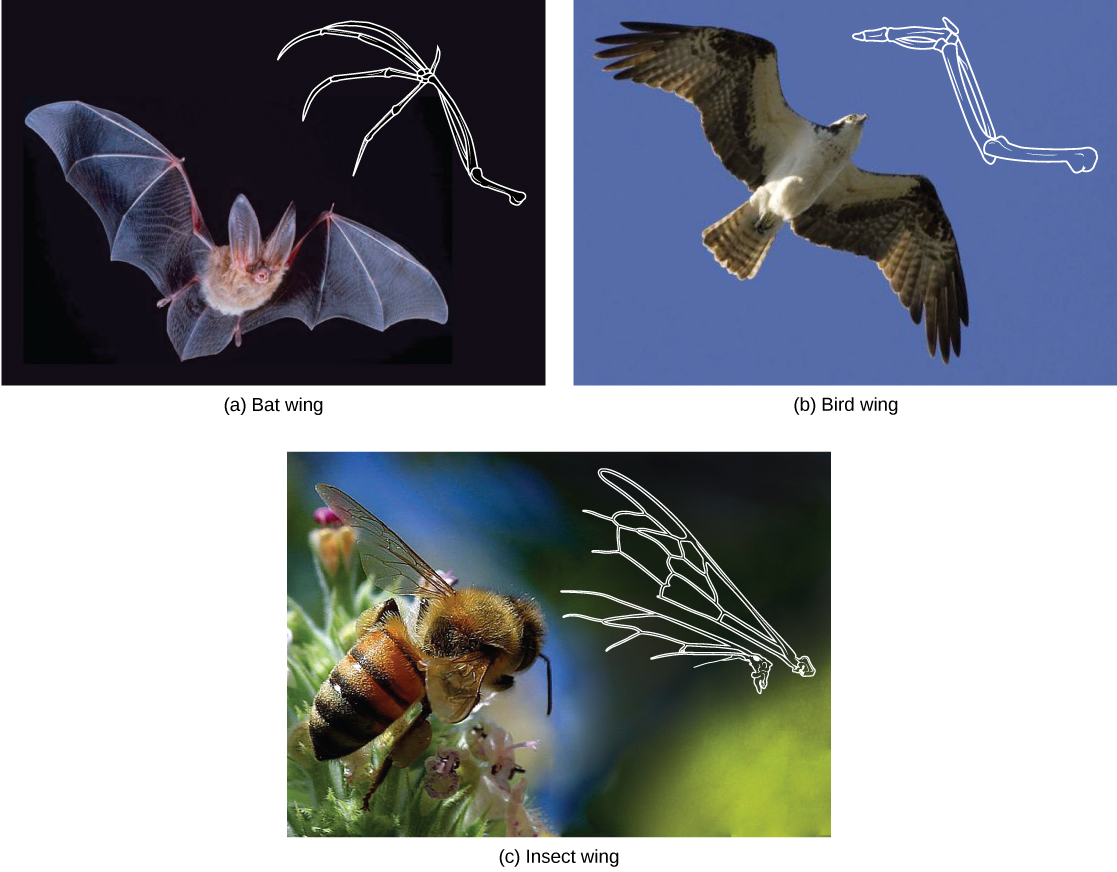
Some organisms may be very closely related, even though a minor genetic change caused a major morphological difference to make them look quite different. Similarly, unrelated organisms may be distantly related, but appear very much alike. This usually happens because both organisms share common adaptations that evolved within similar environmental conditions. When similar characteristics occur because of environmental constraints and not due to a close evolutionary relationship, it is an analogy or homoplasy. For example, insects use wings to fly like bats and birds, but the wing structure and embryonic origin is completely different. These are analogous structures (Figure 20.8). On the other side, the bird and bat wings are homologous because the bones are inherited from a common ancestor, while the wings themselves are analogous as they evolved independently.
英語のヒント
ごく小さな遺伝的変化が大きな形態的違いを生み、見た目が大きく異なっていても、非常に近縁な生物がある。同様に、遠い類縁関係しかない生物が、非常によく似て見えることもある。これは通常、両方の生物が、似た環境条件のもとで進化した共通の適応をもつために起こる。類似した特徴が、近い進化的関係ではなく環境の制約によって生じた場合、それは相似、またはホモプラシーである。たとえば、昆虫はコウモリや鳥と同じように翼を使って飛ぶが、翼の構造と胚での起源はまったく異なる。これらは相似器官である(図20.8)。一方、鳥とコウモリの翼は、骨を共通祖先から受け継いでいるため相同だが、翼そのものは独立に進化したため相似である。
Similar traits can be either homologous or analogous. Homologous structures share a similar embryonic origin. Analogous organs have a similar function. For example, the bones in a whale's front flipper are homologous to the bones in the human arm. These structures are not analogous. A butterfly or bird's wings are analogous but not homologous. Scientists must determine which type of similarity a feature exhibits to decipher the organisms' phylogeny.
英語のヒント
似た形質は、相同の場合も相似の場合もある。相同器官は、胚での起源が似ている。相似器官は、機能が似ている。たとえば、クジラの前びれの骨は、ヒトの腕の骨と相同である。これらの構造は相似ではない。チョウの翼と鳥の翼は相似だが、相同ではない。生物の系統を読み解くには、科学者はその特徴がどちらの種類の類似を示しているかを決めなければならない。
OpenStax, Rice University; Biology 2e. (credit a: modification of work by U.S. DOI BLM; credit b: modification of work by Steve Hillebrand, USFWS; credit c: modification of work by Jon Sullivan) · CC BY 4.0 · Source出典

Figure 20.8図 20.8
The (c) wing of a honeybee is similar in shape to a (b) bird wing and (a) bat wing, and it serves the same function. However, the honeybee wing is not composed of bones and has a distinctly different structure and embryonic origin. These wing types (insect versus bat and bird) illustrate an analogy—similar structures that do not share an evolutionary history. (credit a: modification of work by U.S. DOI BLM; credit b: modification of work by Steve Hillebrand, USFWS; credit c: modification of work by Jon Sullivan)
(c)ミツバチの翼は、(b)鳥や(a)コウモリの翼と形が似ており、同じ機能を果たす。しかしミツバチの翼は骨でできておらず、構造も胚での起源も明らかに異なる。昆虫の翼とコウモリ・鳥の翼は、進化史を共有しない似た構造、すなわち相似を示す。(a:米国内務省土地管理局〔U.S. DOI BLM〕の作品を改変。b:Steve Hillebrand、USFWSの作品を改変。c:Jon Sullivanの作品を改変。)
Molecular Comparisons分子の比較
The advancement of DNA technology has given rise to molecular systematics, which is use of molecular data in taxonomy and biological geography (biogeography). New computer programs not only confirm many earlier classified organisms, but also uncover previously made errors. As with physical characteristics, even the DNA sequence can be tricky to read in some cases. For some situations, two very closely related organisms can appear unrelated if a mutation occurred that caused a shift in the genetic code. Inserting or deleting a mutation would move each nucleotide base over one place, causing two similar codes to appear unrelated.
英語のヒント
DNA技術の進歩により、分類学や生物地理学で分子データを使う、分子系統学が生まれた。新しいコンピュータープログラムは、以前の多くの分類を確認するだけでなく、過去の誤りも明らかにする。体の特徴と同じように、DNA配列であっても読み取るのが難しい場合がある。遺伝暗号のずれを引き起こす変異が起これば、非常に近縁な2つの生物が、無関係に見えることもある。挿入や欠失の変異は、各ヌクレオチド塩基の位置を1つずつずらすため、似た2つの暗号が無関係に見えてしまう。
Sometimes two segments of DNA code in distantly related organisms randomly share a high percentage of bases in the same locations, causing these organisms to appear closely related when they are not. For both of these situations, computer technologies help identify the actual relationships, and, ultimately, the coupled use of both morphologic and molecular information is more effective in determining phylogeny.
英語のヒント
遠縁の生物の2つのDNA領域が、偶然、同じ位置に高い割合で同じ塩基をもち、そのため実際には近縁でないのに、近縁に見えることもある。こうした2つの状況では、コンピューター技術が実際の関係の特定に役立つ。最終的には、形態情報と分子情報を組み合わせて使うほうが、系統の決定に有効である。