第20章系統と生命の歴史
Genome Fusion and Eukaryote Evolutionゲノム融合と真核生物の進化
Scientists believe the ultimate in HGT occurs through genome fusion between different prokaryote species when two symbiotic organisms become endosymbiotic. This occurs when one species is taken inside another species' cytoplasm, which ultimately results in a genome consisting of genes from both the endosymbiont and the host. This mechanism is an aspect of the Endosymbiont Theory, which most biologists accept as the mechanism whereby eukaryotic cells obtained their mitochondria and chloroplasts. However, the role of endosymbiosis in developing the nucleus is more controversial. Scientists believe that nuclear and mitochondrial DNA have different (separate) evolutionary origins, with the mitochondrial DNA being derived from the bacteria's circular genomes engulfed by ancient prokaryotic cells. We can regard mitochondrial DNA as the smallest chromosome. Interestingly enough, mitochondrial DNA is inherited only from females. The mitochondrial DNA degrades in sperm when the sperm degrades in the fertilized egg or in other instances when the mitochondria located in the sperm's flagellum fails to enter the egg.
英語のヒント
科学者は、HGTの究極の形は、共生する2つの生物が細胞内共生へ移る際の、異なる原核生物種間のゲノム融合だと考える。一方の種が他方の種の細胞質内へ取り込まれることで起こり、最終的に、細胞内共生者と宿主の双方の遺伝子からなるゲノムができる。この仕組みは細胞内共生説の一側面であり、真核細胞がミトコンドリアや葉緑体を得た仕組みとして、大半の生物学者が受け入れている。ただし、核の形成における細胞内共生の役割には、より多くの議論がある。核DNAとミトコンドリアDNAは別々の進化的起源をもち、ミトコンドリアDNAは古代の原核細胞に取り込まれた細菌の環状ゲノムに由来すると考えられている。ミトコンドリアDNAは、最小の染色体と見なせる。興味深いことに、ミトコンドリアDNAは雌からだけ遺伝する。受精卵内で精子が分解されるとき、ミトコンドリアDNAも分解される。また、精子の鞭毛内のミトコンドリアが卵へ入らない場合もある。
Within the past decade, James Lake of the UCLA/NASA Astrobiology Institute proposed that the genome fusion process is responsible for the evolution of the first eukaryotic cells (Figure 20.14a). Using DNA analysis and a new mathematical algorithm, conditioned reconstruction (CR), his laboratory proposed that eukaryotic cells developed from an endosymbiotic gene fusion between two species, one an Archaea and the other a Bacteria. As mentioned, some eukaryotic genes resemble those of Archaea; whereas, others resemble those from Bacteria. An endosymbiotic fusion event, such as Lake has proposed, would clearly explain this observation. Alternatively, this work is new and the CR algorithm is relatively unsubstantiated, which causes many scientists to resist this hypothesis.
英語のヒント
過去10年ほどの間に、UCLA/NASA宇宙生物学研究所のジェームズ・レイクは、ゲノム融合が最初の真核細胞の進化をもたらしたと提案した(図20.14a)。彼の研究室は、DNA解析と、条件付き再構成(CR)という新しい数学的アルゴリズムを使い、古細菌1種と細菌1種の間の細胞内共生による遺伝子融合から、真核細胞が発達したと提案した。すでに述べたように、真核生物の一部の遺伝子は古細菌のものに似ており、他は細菌のものに似ている。レイクが提案するような細胞内共生による融合は、この観察を明快に説明できる。一方、この研究は新しく、CRアルゴリズムの裏づけもまだ十分でないため、多くの科学者はこの仮説の受け入れに抵抗している。
Lake's more recent work (Figure 20.14b) proposes that gram-negative bacteria, which are unique within their domain in that they contain two lipid bilayer membranes, resulted from an endosymbiotic fusion of archaeal and bacterial species. The double membrane would be a direct result of the endosymbiosis, with the endosymbiont picking up the second membrane from the host as it was internalized. Scientists have also used this mechanism to explain the double membranes in mitochondria and chloroplasts. Some are skeptical of Lake’s work, and the biological science community still debates his ideas. In addition to Lake’s hypothesis, there are several other competing theories as to the origin of eukaryotes. How did the eukaryotic nucleus evolve? One theory is that the prokaryotic cells produced an additional membrane that surrounded the bacterial chromosome. Some bacteria have the DNA enclosed by two membranes; however, there is no evidence of a nucleolus or nuclear pores. Other proteobacteria also have membrane-bound chromosomes. If the eukaryotic nucleus evolved this way, we would expect one of the two types of prokaryotes to be more closely related to eukaryotes.
英語のヒント
レイクのより新しい研究(図20.14b)は、グラム陰性細菌が古細菌と細菌の細胞内共生による融合から生じたと提案する。グラム陰性細菌は、2枚の脂質二重層膜をもつ点で、同じドメイン内でも独特である。二重の膜は細胞内共生の直接の結果であり、共生者が内部へ取り込まれる際に、宿主から2枚目の膜を得たという。この仕組みは、ミトコンドリアや葉緑体の二重膜の説明にも使われてきた。レイクの研究に懐疑的な人もおり、生物学界ではその考えがなお議論されている。レイクの仮説のほかにも、真核生物の起源には競合する理論がいくつかある。真核細胞の核はどのように進化したのだろうか。1つの理論では、原核細胞が細菌の染色体を包む追加の膜を作ったとする。DNAが2枚の膜に包まれた細菌もあるが、核小体や核膜孔の証拠はない。他のプロテオバクテリアにも膜で囲まれた染色体がある。核がこのように進化したなら、2種類の原核生物の一方が、真核生物により近縁であると予想される。
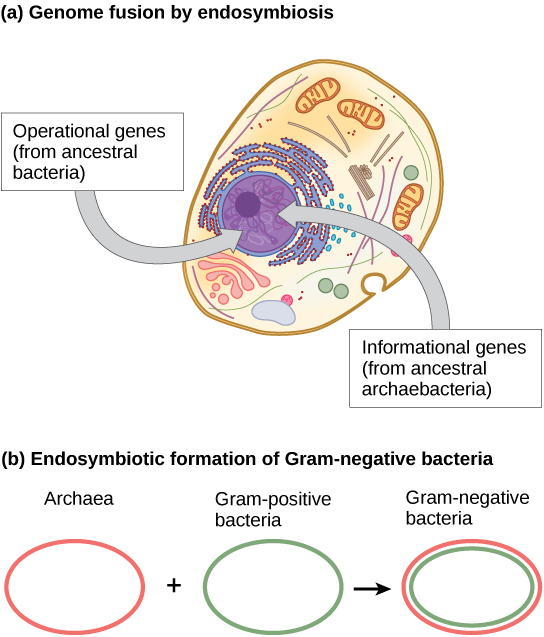
Figure 20.14図 20.14
The scientific community now widely accepts the theory that mitochondria and chloroplasts are endosymbiotic in origin. More controversial is the proposal that (a) the eukaryotic nucleus resulted from fusing archaeal and bacterial genomes with their operational genes (whose products are involved in biochemical pathways) and informational genes (whose products are involved in transcription and translation), and that (b) Gramnegative bacteria, which have two membranes, resulted from fusing Archaea and Gram-positive bacteria, each of which has a single membrane.
英語のヒント
ミトコンドリアと葉緑体の起源が細胞内共生にあるという理論は、現在、科学界で広く受け入れられている。より議論が多いのは、(a)真核細胞の核が、作動遺伝子(産物が生化学的経路に関わる)と情報遺伝子(産物が転写と翻訳に関わる)をもつ古細菌と細菌のゲノムの融合から生じたという提案と、(b)2枚の膜をもつグラム陰性細菌が、それぞれ1枚の膜をもつ古細菌とグラム陽性細菌の融合から生じたという提案である。
The nucleus-first hypothesis proposes that the nucleus evolved in prokaryotes first (Figure 20.15a), followed by a later fusion of the new eukaryote with bacteria that became mitochondria. The mitochondria-first hypothesis proposes that mitochondria were first established in a prokaryotic host (Figure 20.15b), which subsequently acquired a nucleus, by fusion or other mechanisms, to become the first eukaryotic cell. Most interestingly, the eukaryote-first hypothesis proposes that prokaryotes actually evolved from eukaryotes by losing genes and complexity (Figure 20.15c). All of these hypotheses are testable. Only time and more experimentation will determine which hypothesis data best supports.
英語のヒント
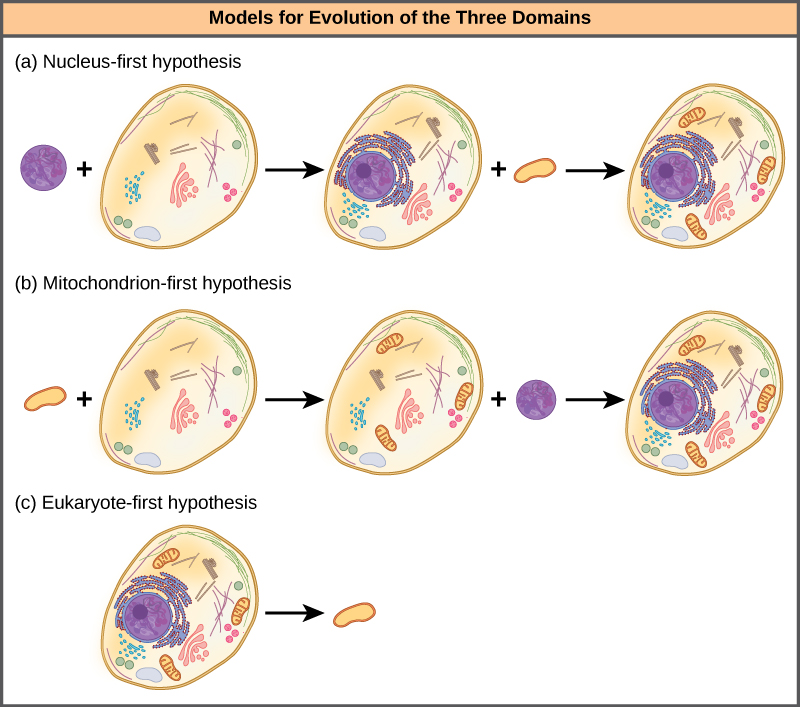


Figure 20.15図 20.15
Three alternate hypotheses of eukaryotic and prokaryotic evolution are (a) the nucleus-first hypothesis, (b) the mitochondrion-first hypothesis, and (c) the eukaryote-first hypothesis.
真核生物と原核生物の進化に関する3つの代替仮説。(a)核先行仮説、(b)ミトコンドリア先行仮説、(c)真核生物先行仮説。