第20章系統と生命の歴史
20.3 Perspectives on the Phylogenetic Tree20.3 系統樹に対する見方
Learning Objectives学習目標
By the end of this section, you will be able to do the following:
この節を終えると、次のことができるようになる。
- Describe horizontal gene transfer水平遺伝子伝達を説明する。
- Illustrate how prokaryotes and eukaryotes transfer genes horizontally原核生物と真核生物が、どのように遺伝子を水平に伝達するかを示す。
- Identify the web and ring models of phylogenetic relationships and describe how they differ from the original phylogenetic tree concept系統関係の網状モデルと環状モデルを識別し、もとの系統樹の概念とどう異なるかを説明する。
Phylogenetic modeling concepts are constantly changing. It is one of the most dynamic fields of study in all biology. Over the last several decades, new research has challenged scientists’ ideas about how organisms are related. The scientific community has proposed new models of these relationships.
英語のヒント
系統をモデル化する概念は、絶えず変化している。生物学全体の中でも、とくに活発に変わる研究分野の1つである。ここ数十年、新しい研究が、生物どうしの関係についての科学者の考えに問いを投げかけてきた。科学界は、その関係について新たなモデルを提案している。
Many phylogenetic trees are models of the evolutionary relationship among species. Phylogenetic trees originated with Charles Darwin, who sketched the first phylogenetic tree in 1837 (Figure 20.12a). This served as a prototype for subsequent studies for more than a century. The phylogenetic tree concept with a single trunk representing a shared ancestry, with the branches representing the divergence of species from this ancestry, fits well with the structure of many common trees, such as the oak (Figure 20.12b). However, evidence from modern DNA sequence analysis and newly developed computer algorithms has caused skepticism about the standard tree model's validity in the scientific community.
英語のヒント
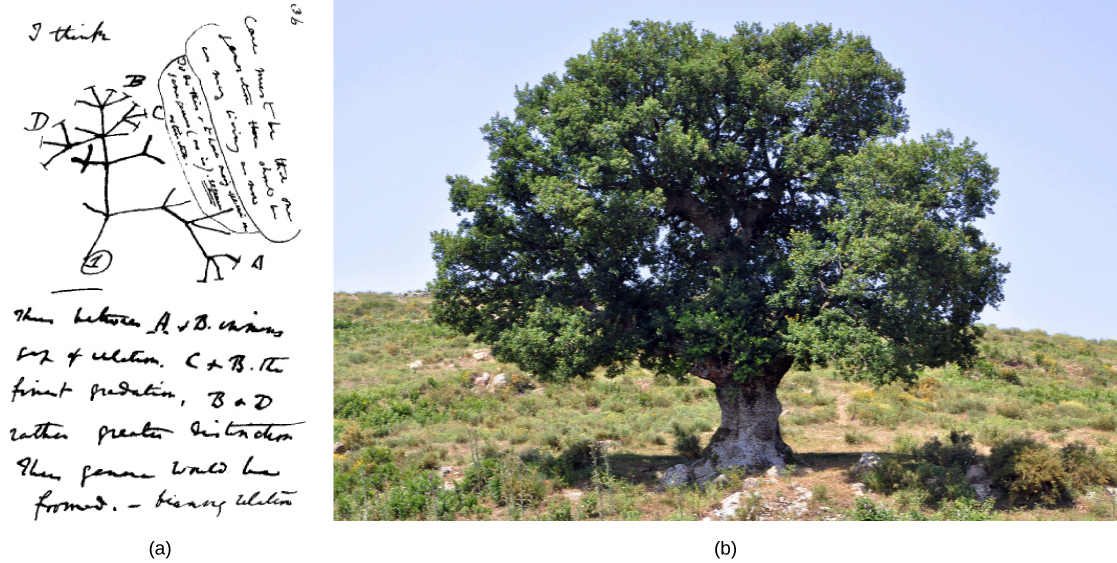
OpenStax, Rice University; Biology 2e. (credit b: modification of work by "Amada44"/Wikimedia Commons) · CC BY 4.0 · Source出典

Figure 20.12図 20.12
The (a) concept of the “tree of life” dates to an 1837 Charles Darwin sketch. Like an (b) oak tree, the “tree of life” has a single trunk and many branches. (credit b: modification of work by "Amada44"/Wikimedia Commons)
(a)「生命の樹」の概念は、1837年のチャールズ・ダーウィンの略図にさかのぼる。(b)オークのように、「生命の樹」には1本の幹と多数の枝がある。(b:“Amada44”/Wikimedia Commonsの作品を改変)
Limitations to the Classic Model古典的モデルの限界
Classical thinking about prokaryotic evolution, included in the classic tree model, is that species evolve clonally. That is, they produce offspring themselves with only random mutations causing the descent into the variety of modern-day and extinct species known to science. This view is somewhat complicated in eukaryotes that reproduce sexually, but the laws of Mendelian genetics explain the variation in offspring, again, to be a result of a mutation within the species. Scientists did not consider the concept of genes transferring between unrelated species as a possibility until relatively recently. Horizontal gene transfer (HGT), or lateral gene transfer, is the transfer of genes between unrelated species. HGT is an ever-present phenomenon, with many evolutionists postulating a major role for this process in evolution, thus complicating the simple tree model. Genes pass between species which are only distantly related using standard phylogeny, thus adding a layer of complexity to understanding phylogenetic relationships.
英語のヒント
古典的な樹状モデルに含まれる原核生物の進化の考え方では、種はクローン的に進化する。つまり、自分自身で子を作り、無作為な変異だけによって、科学で知られている現生種や絶滅種の多様性が生じるというものである。有性生殖をする真核生物では少し複雑になるが、メンデル遺伝学の法則は、子の変異もまた種内の変異の結果として説明する。比較的最近まで、科学者は、類縁の遠い種の間で遺伝子が移る可能性を考えていなかった。水平遺伝子伝達(HGT)、別名側方遺伝子伝達は、類縁の遠い種どうしの遺伝子の移動である。HGTは常に存在する現象であり、多くの進化研究者が進化におけるその大きな役割を想定している。このため、単純な樹状モデルは複雑になる。標準的な系統では遠縁とされる種の間を遺伝子が移るため、系統関係の理解にさらに複雑さが加わる。
The various ways that HGT occurs in prokaryotes is important to understanding phylogenies. Although at present some do not view HGT as important to eukaryotic evolution, HGT does occur in this domain as well. Finally, as an example of the ultimate gene transfer, some scientists have proposed genome fusion theories between symbiotic or endosymbiotic organisms to explain an event of great importance—the evolution of the first eukaryotic cell, without which humans could not have come into existence.
英語のヒント
原核生物でHGTが起こるさまざまな仕方は、系統を理解するうえで重要である。現在、真核生物の進化においてHGTを重要と見なさない人もいるが、このドメインでもHGTは確かに起こる。最後に、究極の遺伝子伝達の例として、一部の科学者は、共生生物または細胞内共生生物の間のゲノム融合説を提案している。これは、きわめて重要な出来事である、最初の真核細胞の進化を説明するためである。その出来事がなければ、ヒトは存在しえなかった。
Horizontal Gene Transfer水平遺伝子伝達
Horizontal gene transfer (HGT) is the introduction of genetic material from one species to another species by mechanisms other than the vertical transmission from parent(s) to offspring. These transfers allow even distantly related species to share genes, influencing their phenotypes. Scientists believe that HGT is more prevalent in prokaryotes, but that this process transfers only about 2% of the prokaryotic genome. Some researchers believe such estimates are premature: we must view the actual importance of HGT to evolutionary processes as a work in progress. As scientists investigate this phenomenon more thoroughly, they may reveal more HGT. Many scientists believe that HGT and mutation are (especially in prokaryotes) a significant source of genetic variation, which is the raw material in the natural selection process. These transfers may occur between any two species that share an intimate relationship (Table 20.1).
英語のヒント
水平遺伝子伝達(HGT)とは、親から子への垂直的な伝達以外の仕組みによって、ある種から別の種へ遺伝物質が導入されることである。この伝達により、遠縁の種でも遺伝子を共有でき、表現型に影響が及ぶ。HGTは原核生物でより広く見られるが、この過程で伝達されるのは原核生物のゲノムの約2%だけだと、科学者は考えている。この見積もりは時期尚早だと考える研究者もいる。進化過程にとってHGTが実際にどれほど重要かは、まだ研究途上と見る必要がある。科学者がこの現象をさらに詳しく調べれば、より多くのHGTが明らかになるかもしれない。多くの科学者は、とくに原核生物では、HGTと変異が遺伝的変異の重要な供給源であり、それが自然選択の素材になると考えている。この伝達は、密接な関係をもつ任意の2種の間で起こりうる(表20.1)。
Prokaryotic and Eukaryotic HGT Mechanisms Summary 原核生物と真核生物のHGTの仕組みのまとめ |
|||
|---|---|---|---|
Mechanism 仕組み |
Mode of Transmission 伝達の方法 |
Example 例 |
|
Prokaryotes 原核生物 |
transformation 形質転換 |
DNA uptake DNAの取り込み |
many prokaryotes 多くの原核生物 |
transduction 形質導入 |
bacteriophage (virus) バクテリオファージ(ウイルス) |
bacteria 細菌 |
|
conjugation 接合 |
pilus 線毛 |
many prokaryotes 多くの原核生物 |
|
gene transfer agents 遺伝子伝達因子 |
phage-like particles ファージ様粒子 |
purple non-sulfur bacteria 紅色非硫黄細菌 |
|
Eukaryotes 真核生物 |
from food organisms 食物となる生物から |
unknown 不明 |
aphid アブラムシ |
jumping genes 跳躍遺伝子 |
transposons トランスポゾン |
rice and millet plants イネと雑穀類の植物 |
|
epiphytes/parasites 着生生物・寄生生物 |
unknown 不明 |
yew tree fungi イチイの菌類 |
|
from viral infections ウイルス感染から |
|||