第20章系統と生命の歴史
Limitations of Phylogenetic Trees系統樹の限界
It may be easy to assume that more closely related organisms look more alike, and while this is often the case, it is not always true. If two closely related lineages evolved under significantly varied surroundings, it is possible for the two groups to appear more different than other groups that are not as closely related. For example, the phylogenetic tree in Figure 20.4 shows that lizards and rabbits both have amniotic eggs; whereas, frogs do not. Yet lizards and frogs appear more similar than lizards and rabbits.
英語のヒント
近縁な生物ほど外見も似ていると考えやすいかもしれない。実際にそうであることは多いが、常に正しいわけではない。近縁な2系統が大きく異なる環境のもとで進化した場合、あまり近縁ではない他の群どうしより、外見が大きく異なることもある。たとえば図20.4の系統樹では、トカゲとウサギはともに羊膜卵をもつが、カエルはもたない。しかし見た目は、トカゲとウサギより、トカゲとカエルのほうが似ている。
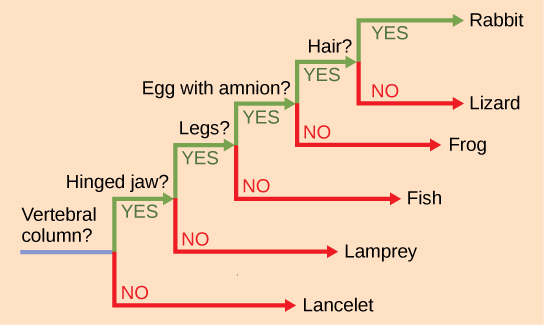

Figure 20.4図 20.4
An organism that lacked a vertebral column roots this ladder-like phylogenetic tree of vertebrates. At each branch point, scientists place organisms with different characters in different groups based on shared characteristics.
このはしご状の脊椎動物の系統樹では、脊柱をもたなかった生物が根となる。各分岐点で、科学者は共通する特徴に基づき、異なる形質をもつ生物を別の群へ分ける。
Another aspect of phylogenetic trees is that, unless otherwise indicated, the branches do not account for length of time, only the evolutionary order. In other words, a branch's length does not typically mean more time passed, nor does a short branch mean less time passed— unless specified on the diagram. For example, in Figure 20.4, the tree does not indicate how much time passed between the evolution of amniotic eggs and hair. What the tree does show is the order in which things took place. Again using Figure 20.4, the tree shows that the oldest trait is the vertebral column, followed by hinged jaws, and so forth. Remember that any phylogenetic tree is a part of the greater whole, and like a real tree, it does not grow in only one direction after a new branch develops. Thus, for the organisms in Figure 20.4, just because a vertebral column evolved does not mean that invertebrate evolution ceased. It only means that a new branch formed. Also, groups that are not closely related, but evolve under similar conditions, may appear more phenotypically similar to each other than to a close relative.
英語のヒント
系統樹の別の側面は、特に示されていない限り、枝が時間の長さを表さず、進化の順序だけを示すことである。つまり、図に明示されていなければ、長い枝は長い時間が経ったことを通常は意味せず、短い枝も短い時間を意味しない。たとえば図20.4の樹は、羊膜卵の進化と毛の進化の間にどれだけの時間が経ったかを示さない。樹が示しているのは、出来事が起こった順序である。再び図20.4を見ると、最も古い形質は脊柱で、その次に関節のある顎が続くことなどが分かる。どの系統樹も、より大きな全体の一部であることを忘れてはいけない。本物の樹木と同様、新しい枝ができた後に一方向にしか伸びないわけではない。したがって図20.4の生物についても、脊柱が進化したからといって、無脊椎動物の進化が止まったことにはならない。新しい枝ができたという意味にすぎない。また、近縁ではなくても似た条件で進化した群どうしは、近縁群との比較よりも、表現型が似て見えることがある。
Classification Levels分類の階級
Taxonomy (which literally means “arrangement law”) is the science of classifying organisms to construct internationally shared classification systems with each organism placed into increasingly more inclusive groupings. Think about a grocery store's organization. One large space is divided into departments, such as produce, dairy, and meats. Then each department further divides into aisles, then each aisle into categories and brands, and then finally a single product. We call this organization from larger to smaller, more specific categories a hierarchical system.
英語のヒント
分類学(文字どおりには「配列の法則」)は、生物を分類し、国際的に共通の分類体系を作る科学である。各生物を、次第により広く包含する群へ位置づける。食料品店の配置を考えてみよう。大きな空間が、青果、乳製品、精肉などの売り場に分かれる。各売り場はさらに通路ごとに、その通路はカテゴリーやブランドごとに分かれ、最後は1つの商品に至る。このように、大きなものから小さく具体的なカテゴリーへ整理する仕組みを、階層体系と呼ぶ。
The taxonomic classification system (also called the Linnaean system after its inventor, Carl Linnaeus, a Swedish botanist, zoologist, and physician) uses a hierarchical model. Moving from the point of origin, the groups become more specific, until one branch ends as a single species. For example, after the common beginning of all life, scientists divide organisms into three large categories called domains: Bacteria, Archaea, and Eukarya. Within each domain is a second category called a kingdom. After kingdoms, the subsequent categories of increasing specificity are: phylum, class, order, family, genus, and species (Figure 20.5).
英語のヒント
生物の分類体系は、階層モデルを用いる。考案者であるスウェーデンの植物学者・動物学者・医師カール・リンネにちなみ、リンネ式体系とも呼ばれる。出発点から進むにつれて群はより限定され、1本の枝の末端が1つの種になる。たとえば、すべての生命に共通する始まりの後、生物は細菌、古細菌、真核生物という、ドメインと呼ばれる3つの大きなカテゴリーに分けられる。各ドメインの中には、界という第2のカテゴリーがある。界の後には、より限定的な順に、門、綱、目、科、属、種というカテゴリーが続く(図20.5)。
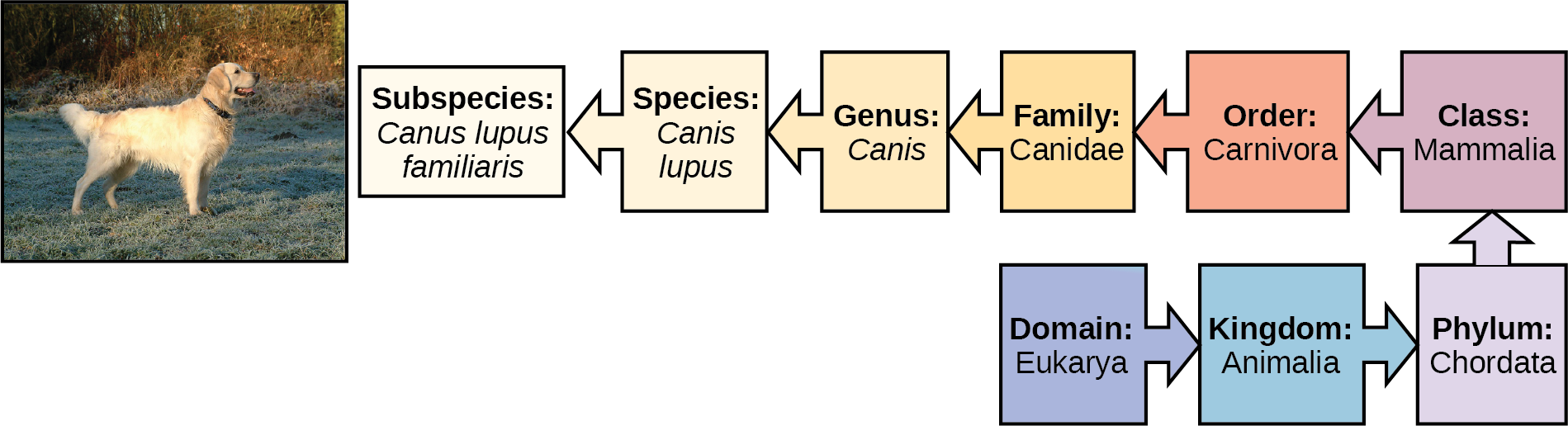
OpenStax, Rice University; Biology 2e. (credit “dog”: modification of work by Janneke Vreugdenhil) · CC BY 4.0 · Source出典

Figure 20.5図 20.5
The taxonomic classification system uses a hierarchical model to organize living organisms into increasingly specific categories. The common dog, Canis lupus familiaris, is a subspecies of Canis lupus, which also includes the wolf and dingo. (credit “dog”: modification of work by Janneke Vreugdenhil)
生物の分類体系は階層モデルを使い、生物を次第に限定的なカテゴリーへ整理する。一般的なイヌCanis lupus familiarisは、オオカミとディンゴも含む種Canis lupusの亜種である。(「イヌ」:Janneke Vreugdenhilの作品を改変)
The kingdom Animalia stems from the Eukarya domain. Figure 20.5 above shows the classification for the common dog. Therefore, the full name of an organism technically has eight terms. For the dog it is: Eukarya, Animalia, Chordata, Mammalia, Carnivora, Canidae, Canis, and lupus. Notice that each name is capitalized except for species, and the genus and species names are italicized. Scientists generally refer to an organism only by its genus and species, which is its two-word scientific name, or binomial nomenclature. Therefore, the scientific name of the dog is Canis lupus. The name at each level is also a taxon. In other words, dogs are in order Carnivora. Carnivora is the name of the taxon at the order level; Canidae is the taxon at the family level, and so forth. Organisms also have a common name that people typically use, in this case, dog. Note that the dog is additionally a subspecies: the “familiaris” in Canis lupus familiaris. Subspecies are members of the same species that are capable of mating and reproducing viable offspring, but they are separate subspecies due to geographic or behavioral isolation or other factors.
英語のヒント
動物界は真核生物ドメインに由来する。上の図20.5は、一般的なイヌの分類を示す。したがって、厳密には生物の完全な名称は8つの語からなる。イヌでは、Eukarya、Animalia、Chordata、Mammalia、Carnivora、Canidae、Canis、lupusである。種を除く各名称の先頭は大文字で、属名と種名はイタリック体にすることに注目しよう。科学者は通常、生物を属名と種名だけで呼ぶ。これが2語からなる学名、すなわち二名法である。したがって、イヌの学名はCanis lupusとなる。各階級の名称も分類群である。たとえばイヌは食肉目に属する。Carnivoraは目の階級での分類群名、Canidaeは科の階級での分類群名というようになる。生物には、人々が普段使う一般名もあり、この場合は「イヌ」である。イヌはさらに亜種でもあり、Canis lupus familiarisのfamiliarisがそれを示す。亜種は同じ種の一員で、交配して生存可能な子を生めるが、地理的隔離や行動的隔離などの要因により、別々の亜種に分けられる。
Figure 20.6 shows how the levels move toward specificity with other organisms. Notice how the dog shares a domain with the widest diversity of organisms, including plants and butterflies. At each sublevel, the organisms become more similar because they are more closely related. Historically, scientists classified organisms using characteristics, but as DNA technology developed, they have determined more precise phylogenies.
英語のヒント
図20.6は、他の生物との比較で、分類階級がどのように限定的になっていくかを示す。イヌは、植物やチョウを含む最も多様な生物と、同じドメインを共有している。階級を下るごとに、生物はより近縁になるため、互いに似てくる。かつて科学者は特徴を使って生物を分類したが、DNA技術の発展に伴い、より正確な系統を決定するようになった。
Recent genetic analysis and other advancements have found that some earlier phylogenetic classifications do not align with the evolutionary past; therefore, researchers must make changes and updates as new discoveries occur. Recall that phylogenetic trees are hypotheses and are modified as data becomes available. In addition, classification historically has focused on grouping organisms mainly by shared characteristics and does not necessarily illustrate how the various groups relate to each other from an evolutionary perspective. For example, despite the fact that a hippopotamus resembles a pig more than a whale, the hippopotamus may be the whale's closest living relative.
英語のヒント
近年の遺伝解析などの進歩により、以前の系統分類の一部は進化の過去と一致しないことが分かってきた。そのため研究者は、新しい発見に応じて分類を変更し、更新しなければならない。系統樹は仮説であり、データが得られるたびに修正されることを思い出そう。また、分類は歴史的に、主に共通する特徴によって生物をまとめることに重点を置いてきた。そのため、進化の観点から各群が互いにどう関係するかを必ずしも示していない。たとえばカバはクジラよりブタに似ているが、現生生物の中ではクジラに最も近縁である可能性がある。