第20章系統と生命の歴史
HGT in Prokaryotes原核生物におけるHGT
HGT mechanisms are quite common in the Bacteria and Archaea domains, thus significantly changing the way scientists view their evolution. The majority of evolutionary models, such as in the Endosymbiont Theory, propose that eukaryotes descended from multiple prokaryotes, which makes HGT all the more important to understanding the phylogenetic relationships of all extant and extinct species. The Endosymbiont Theory purports that the eukaryotes' mitochondria and the green plants' chloroplasts and flagellates originated as free-living prokaryotes that invaded primitive eukaryotic cells and become established as permanent symbionts in the cytoplasm.
英語のヒント
HGTの仕組みは、細菌と古細菌のドメインで非常に一般的であり、その進化についての科学者の見方を大きく変えている。細胞内共生説など、多くの進化モデルは、真核生物が複数の原核生物に由来すると提案する。そのため、現生種と絶滅種のすべての系統関係を理解するうえで、HGTはますます重要になる。細胞内共生説は、真核生物のミトコンドリア、緑色植物の葉緑体、および鞭毛虫は、自由生活性の原核生物に由来するとする。それらが原始的な真核細胞へ侵入し、細胞質内に恒久的な共生者として定着したというのである。
Microbiology students are well aware that genes transfer among common bacteria. These gene transfers between species are the major mechanism whereby bacteria acquire resistance to antibiotics. Classically, scientists believe that three different mechanisms drive such transfers.
英語のヒント
微生物学を学ぶ学生は、一般的な細菌の間で遺伝子が移ることをよく知っている。種間のこうした遺伝子伝達は、細菌が抗生物質耐性を獲得する主な仕組みである。従来、科学者は次の3つの仕組みがその伝達を担うと考えてきた。
- Transformation: bacteria takes up naked DNA形質転換:細菌が裸のDNAを取り込む。
- Transduction: a virus transfers the genes形質導入:ウイルスが遺伝子を運ぶ。
- Conjugation: a hollow tube, or pilus transfers genes between organisms接合:中空の管である線毛が、生物間で遺伝子を運ぶ。
More recently, scientists have discovered a fourth gene transfer mechanism between prokaryotes. Small, virus-like particles, or gene transfer agents (GTAs) transfer random genomic segments from one prokaryote species to another. GTAs are responsible for genetic changes, sometimes at a very high frequency compared to other evolutionary processes. Scientists characterized the first GTA in 1974 using purple, non-sulfur bacteria. These GTAs, which are most likely derived from bacteriophage DNA inserted in a prokaryote that lost the ability to produce new bacteriophages, carry random DNA pieces from one organism to another. Controlled studies using marine bacteria have demonstrated GTAs' ability to act with high frequency. Scientists have estimated gene transfer events in marine prokaryotes, either by GTAs or by viruses, to be as high as 1013 per year in the Mediterranean Sea alone. GTAs and viruses are efficient HGT vehicles with a major impact on prokaryotic evolution.
英語のヒント
より最近、科学者は原核生物間の第4の遺伝子伝達の仕組みを発見した。ウイルスに似た小さな粒子、遺伝子伝達因子(GTA)が、ある原核生物種から別の種へ、ゲノムの断片を無作為に運ぶのである。GTAは、他の進化過程に比べ、ときには非常に高い頻度で遺伝的変化を引き起こす。最初のGTAは1974年、紅色非硫黄細菌を用いて特徴が調べられた。GTAはおそらく、原核生物に挿入されたバクテリオファージDNAに由来し、新しいファージを作る能力を失ったものである。ある生物から別の生物へ、無作為なDNA断片を運ぶ。海洋細菌を使った対照実験では、GTAが高頻度で働けることが示された。科学者の推定では、GTAまたはウイルスによる海洋原核生物の遺伝子伝達は、地中海だけでも年間1013回に達する。GTAとウイルスは効率的なHGTの運び手であり、原核生物の進化に大きな影響を及ぼす。
As a consequence of this modern DNA analysis, the idea that eukaryotes evolved directly from Archaea has fallen out of favor. While eukaryotes share many features that are absent in bacteria, such as the TATA box (located in many genes' promoter region), the discovery that some eukaryotic genes were more homologous with bacterial DNA than Archaea DNA made this idea less tenable. Furthermore, scientists have proposed genome fusion from Archaea and Bacteria by endosymbiosis as the ultimate event in eukaryotic evolution.
英語のヒント
こうした現代のDNA解析の結果、真核生物が古細菌から直接進化したという考えは、支持を失いつつある。真核生物は、多くの遺伝子のプロモーター領域にあるTATAボックスなど、細菌にはない特徴を多数共有する。しかし、一部の真核生物の遺伝子が、古細菌のDNAより細菌のDNAと高い相同性をもつという発見によって、この考えは維持しにくくなった。さらに科学者は、細胞内共生による古細菌と細菌のゲノム融合を、真核生物の進化における決定的な出来事として提案している。
HGT in Eukaryotes真核生物におけるHGT
Although it is easy to see how prokaryotes exchange genetic material by HGT, scientists initially thought that this process was absent in eukaryotes. After all, prokaryotes are but single cells exposed directly to their environment; whereas, the multicellular organisms' sex cells are usually sequestered in protected parts of the body. It follows from this idea that the gene transfers between multicellular eukaryotes should be more difficult. Scientists believe this process is rarer in eukaryotes and has a much smaller evolutionary impact than in prokaryotes. In spite of this, HGT between distantly related organisms is evident in several eukaryotic species, and it is possible that scientists will discover more examples in the future.
英語のヒント
原核生物がHGTによって遺伝物質を交換することは理解しやすいが、当初、科学者は真核生物にはこの過程がないと考えていた。結局のところ、原核生物は環境に直接さらされた単細胞にすぎないのに対し、多細胞生物の生殖細胞は通常、体の保護された部分に隔てられている。この考えからすれば、多細胞の真核生物どうしの遺伝子伝達は、より難しいはずである。科学者は、真核生物でのこの過程は原核生物よりまれで、進化への影響もはるかに小さいと考えている。それでも、遠縁生物間のHGTは真核生物のいくつかの種で明らかに見られ、今後さらに多くの例が見つかる可能性がある。
In plants, researchers have observed gene transfer in species that cannot cross-pollinate by normal means. Transposons or “jumping genes” have shown a transfer between rice and millet plant species. Furthermore, fungal species feeding on yew trees, from which the anti-cancer drug TAXOL® is derived from the bark, have acquired the ability to make taxol themselves, a clear example of gene transfer.
英語のヒント
植物では、通常の方法で交差受粉できない種の間でも、遺伝子伝達が観察されている。トランスポゾン、いわゆる「跳躍遺伝子」は、イネと雑穀類の種の間を移ったことが示されている。さらに、樹皮から抗がん剤TAXOL®が得られるイチイを食物とする菌類は、自らタキソールを作る能力を獲得している。これは遺伝子伝達の明確な例である。
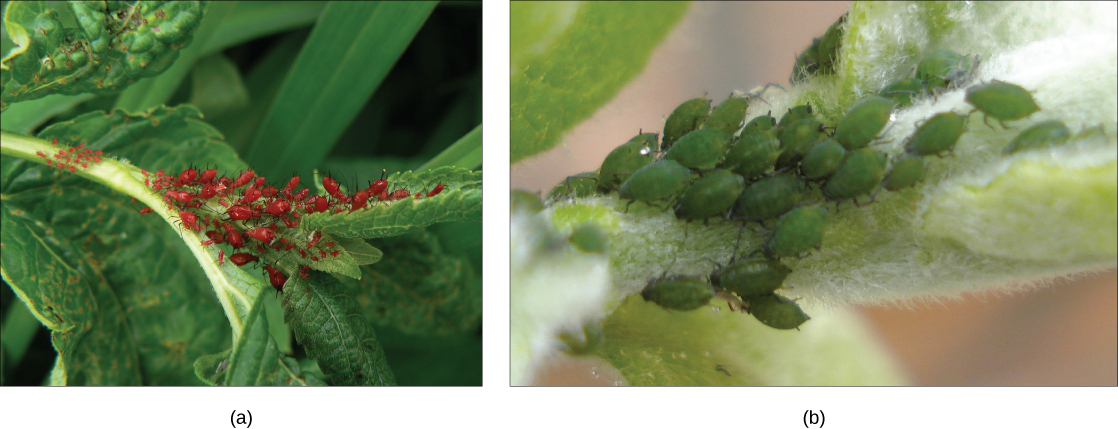
In animals, a particularly interesting example of HGT occurs within the aphid species (Figure 20.13). Aphids are insects that vary in color based on carotenoid content. Carotenoids are pigments that a variety of plants, fungi, and microbes produce, and they serve a variety of functions in animals, who obtain these chemicals from their food. Humans require carotenoids to synthesize vitamin A, and we obtain them by eating orange fruits and vegetables: carrots, apricots, mangoes, and sweet potatoes. Alternatively, aphids have acquired the ability to make the carotenoids on their own. According to DNA analysis, this ability is due to fungal genes transferring into the insect by HGT, presumably as the insect consumed fungi for food. A carotenoid enzyme, or desaturase, is responsible for the red coloration in certain aphids, and when mutation of this gene leads to formation of inactive enzyme, the aphids revert to their more common green color (Figure 20.13).
英語のヒント
動物でとくに興味深いHGTの例は、アブラムシに見られる(図20.13)。アブラムシは、カロテノイドの含有量に応じて体色が変わる昆虫である。カロテノイドは、さまざまな植物、菌類、微生物が作る色素であり、食物から取り込む動物の体内で多様な機能を果たす。ヒトはビタミンAの合成にカロテノイドを必要とし、ニンジン、アンズ、マンゴー、サツマイモなど、オレンジ色の果物や野菜を食べて得る。これに対し、アブラムシはカロテノイドを自分で作る能力を獲得している。DNA解析によると、この能力は菌類の遺伝子がHGTによって昆虫へ移ったことに由来する。おそらく、昆虫が菌類を食物として食べた際に起こったのだろう。カロテノイドに関わる酵素、すなわち不飽和化酵素が一部のアブラムシの赤い体色を生む。この遺伝子の変異によって不活性な酵素ができると、アブラムシはより一般的な緑色に戻る(図20.13)。
OpenStax, Rice University; Biology 2e. (credit a: modification of work by Benny Mazur; credit b: modification of work by Mick Talbot) · CC BY 4.0 · Source出典

Figure 20.13図 20.13
(a) Red aphids get their color from red carotenoid pigment. Genes necessary to make this pigment are present in certain fungi, and scientists speculate that aphids acquired these genes through HGT after consuming fungi for food. If mutation inactivates the genes for making carotenoids, the aphids revert back to (b) their green color. Red coloration makes the aphids considerably more conspicuous to predators, but evidence suggests that red aphids are more resistant to insecticides than green ones. Thus, red aphids may be more fit to survive in some environments than green ones. (credit a: modification of work by Benny Mazur; credit b: modification of work by Mick Talbot)
英語のヒント
(a)赤いアブラムシの体色は、赤いカロテノイド色素による。この色素の合成に必要な遺伝子は一部の菌類にあり、科学者は、アブラムシが菌類を食べた後、HGTによってそれらの遺伝子を獲得したと推測する。変異でカロテノイド合成の遺伝子が不活性になると、アブラムシは(b)緑色へ戻る。赤い体色は捕食者にかなり目立つが、赤い個体は緑の個体より殺虫剤に強いことを示す証拠がある。そのため、環境によっては赤い個体のほうが生存に有利かもしれない。(a:Benny Mazurの作品を改変。b:Mick Talbotの作品を改変。)