第20章系統と生命の歴史
20.1 Organizing Life on Earth20.1 地球上の生命を整理する
Learning Objectives学習目標
By the end of this section, you will be able to do the following:
この節を終えると、次のことができるようになる。
- Discuss the need for a comprehensive classification system包括的な分類体系が必要な理由を論じる。
- List the different levels of the taxonomic classification system生物の分類体系の各階級を列挙する。
- Describe how systematics and taxonomy relate to phylogeny系統分類学と分類学が系統にどう関係するかを説明する。
- Discuss a phylogenetic tree's components and purpose系統樹の構成要素と目的を論じる。
In scientific terms, phylogeny is the evolutionary history and relationship of an organism or group of organisms. A phylogeny describes the organism's relationships, such as from which organisms it may have evolved, or to which species it is most closely related. Phylogenetic relationships provide information on shared ancestry but not necessarily on how organisms are similar or different.
英語のヒント
科学用語でいう系統とは、ある生物または生物群の進化の歴史と関係である。系統は、その生物がどのような生物から進化した可能性があるか、どの種と最も近縁かなど、生物どうしの関係を記述する。系統関係は、共通の祖先についての情報を与えるが、生物がどのように似ているか、または異なるかを必ずしも示すわけではない。
Phylogenetic Trees系統樹
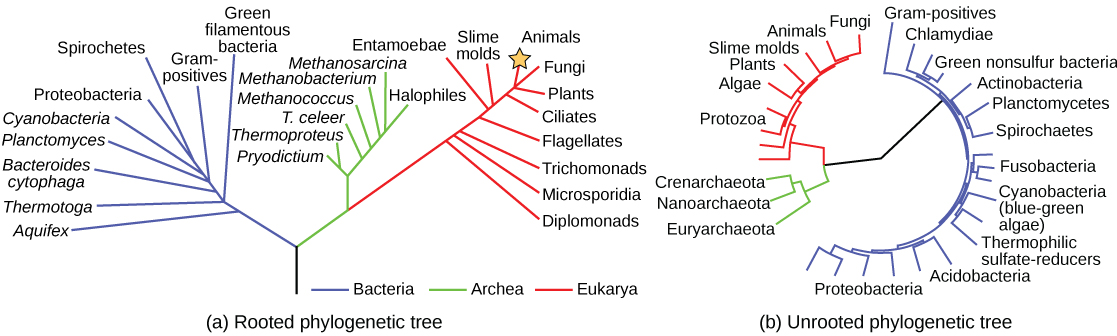
Scientists use a tool called a phylogenetic tree to show the evolutionary pathways and connections among organisms. A phylogenetic tree is a diagram used to reflect evolutionary relationships among organisms or groups of organisms. Scientists consider phylogenetic trees to be a hypothesis of the evolutionary past since one cannot go back to confirm the proposed relationships. In other words, we can construct a “tree of life” to illustrate when different organisms evolved and to show the relationships among different organisms (Figure 20.2).
英語のヒント
科学者は、生物間の進化の道筋とつながりを示すために、系統樹という道具を使う。系統樹は、生物または生物群の進化的関係を表す図である。過去に戻って提案された関係を確かめることはできないため、科学者は系統樹を進化の過去についての仮説と考える。言い換えると、異なる生物がいつ進化したか、そして生物どうしがどのような関係にあるかを示す「生命の樹」を構築できるのである(図20.2)。
Unlike a taxonomic classification diagram, we can read a phylogenetic tree like a map of evolutionary history. Many phylogenetic trees have a single lineage at the base representing a common ancestor. Scientists call such trees rooted, which means there is a single ancestral lineage (typically drawn from the bottom or left) to which all organisms represented in the diagram relate. Notice in the rooted phylogenetic tree that the three domains— Bacteria, Archaea, and Eukarya—diverge from a single point and branch off. The small branch that plants and animals (including humans) occupy in this diagram shows how recent and miniscule these groups are compared with other organisms. Unrooted trees do not show a common ancestor but do show relationships among species.
英語のヒント
分類を示す図とは異なり、系統樹は進化史の地図のように読める。多くの系統樹では、共通祖先を表す1本の系統が根元にある。このような樹を有根樹と呼ぶ。これは、図に表されたすべての生物につながる1本の祖先系統があることを意味し、通常は下端または左端から描かれる。有根系統樹では、細菌、古細菌、真核生物の3つのドメインが1つの点から分岐していることに注目しよう。植物と、ヒトを含む動物が占める小さな枝は、他の生物と比べてこれらの群がいかに新しく、わずかな部分にすぎないかを示す。無根樹は共通祖先を示さないが、種間の関係は示す。
OpenStax, Rice University; Biology 2e. (credit a: modification of work by Eric Gaba) · CC BY 4.0 · Source出典
Figure 20.2図 20.2
Both of these phylogenetic trees show the relationship of the three domains of life—Bacteria, Archaea, and Eukarya—but the (a) rooted tree attempts to identify when various species diverged from a common ancestor while the (b) unrooted tree does not. (credit a: modification of work by Eric Gaba)
どちらの系統樹も、生命の3ドメインである細菌、古細菌、真核生物の関係を示す。ただし、(a)有根樹は各種がいつ共通祖先から分岐したかを示そうとするが、(b)無根樹はそれを示さない。(a:Eric Gabaの作品を改変)
In a rooted tree, the branching indicates evolutionary relationships (Figure 20.3). The point where a split occurs, a branch point, represents where a single lineage evolved into a distinct new one. We call a lineage that evolved early from the root that remains unbranched a basal taxon. We call two lineages stemming from the same branch point sister taxa. A branch with more than two lineages is a polytomy and serves to illustrate where scientists have not definitively determined all of the relationships. Note that although sister taxa and polytomy do share an ancestor, it does not mean that the groups of organisms split or evolved from each other. Organisms in two taxa may have split at a specific branch point, but neither taxon gave rise to the other.
英語のヒント
有根樹では、分岐が進化的関係を示す(図20.3)。分かれる点である分岐点は、1つの系統から異なる新しい系統が進化した位置を表す。根から早期に進化して分岐しないまま残る系統を、基部分類群と呼ぶ。同じ分岐点から生じた2つの系統を、姉妹群と呼ぶ。2本を超える系統をもつ分岐は多分岐であり、科学者がすべての関係を確定していない部分を示すために使われる。姉妹群や多分岐に含まれる群が祖先を共有していても、各生物群が互いから分かれたり進化したりしたという意味ではないことに注意しよう。2つの分類群の生物は、ある分岐点で分かれたかもしれないが、どちらか一方が他方を生み出したわけではない。
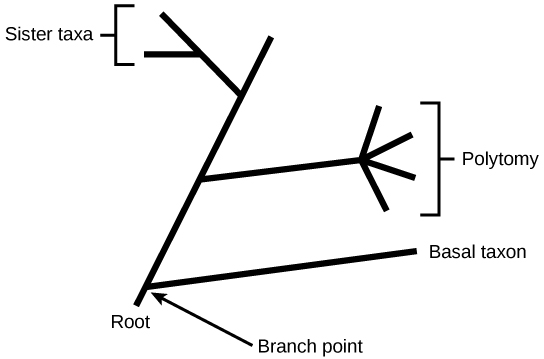


Figure 20.3図 20.3
A phylogenetic tree's root indicates that an ancestral lineage gave rise to all organisms on the tree. A branch point indicates where two lineages diverged. A lineage that evolved early and remains unbranched is a basal taxon. When two lineages stem from the same branch point, they are sister taxa. A branch with more than two lineages is a polytomy.
系統樹の根は、1つの祖先系統が樹上のすべての生物を生み出したことを示す。分岐点は2つの系統が分かれた位置を示す。早期に進化し、分岐しないまま残る系統は基部分類群である。2つの系統が同じ分岐点から生じる場合、それらは姉妹群である。2本を超える系統をもつ分岐は多分岐である。
The diagrams above can serve as a pathway to understanding evolutionary history. We can trace the pathway from the origin of life to any individual species by navigating through the evolutionary branches between the two points. Also, by starting with a single species and tracing back towards the "trunk" of the tree, one can discover species' ancestors, as well as where lineages share a common ancestry. In addition, we can use the tree to study entire groups of organisms.
英語のヒント
上の図は、進化史を理解する道筋になる。2点の間の進化的な枝をたどれば、生命の起源から任意の種までの道筋を追える。また、1つの種から始めて樹の「幹」へ向けてさかのぼることで、その種の祖先や、系統どうしが共通祖先をもつ位置を見いだせる。さらに、系統樹を使って生物群全体を研究することもできる。
Another point to mention on phylogenetic tree structure is that rotation at branch points does not change the information. For example, if a branch point rotated and the taxon order changed, this would not alter the information because each taxon's evolution from the branch point was independent of the other.
英語のヒント
系統樹の構造について、もう1つ述べておくべき点は、分岐点で回転させても情報は変わらないことである。たとえば、分岐点を回転させて分類群の並び順を変えても、情報は変わらない。分岐点からの各分類群の進化は、他方とは独立していたからである。
Many disciplines within the study of biology contribute to understanding how past and present life evolved over time; these disciplines together contribute to building, updating, and maintaining the “tree of life.” Systematics is the field that scientists use to organize and classify organisms based on evolutionary relationships. Researchers may use data from fossils, from studying the body part structures, or molecules that an organism uses, and DNA analysis. By combining data from many sources, scientists can construct an organism's phylogeny. Since phylogenetic trees are hypotheses, they will continue to change as researchers discover new types of life and learn new information.
英語のヒント
生物学の多くの分野が、過去と現在の生命が時間とともにどう進化したかの理解に寄与する。それらの分野が一緒になって、「生命の樹」の構築、更新、維持を支えている。系統分類学は、進化的関係に基づいて生物を整理し、分類するための分野である。研究者は、化石、体の各部の構造、生物が使う分子、DNAの分析などから得られたデータを用いる。多くの情報源からのデータを組み合わせることで、生物の系統を構築できる。系統樹は仮説なので、研究者が新しい種類の生物を発見し、新しい情報を得るにつれ、今後も変わり続ける。