第33章動物の体:基本的な形態と機能
33.3 Homeostasis33.3 恒常性
Learning Objectives学習目標
By the end of this section, you will be able to do the following:
この節を学ぶと、次のことができるようになる。
- Define homeostasis恒常性を定義する。
- Describe the factors affecting homeostasis恒常性に影響する要因を説明する。
- Discuss positive and negative feedback mechanisms used in homeostasis恒常性に使われる正と負のフィードバックの仕組みを論じる。
- Describe thermoregulation of endothermic and ectothermic animals内温動物と外温動物の体温調節を説明する。
Animal organs and organ systems constantly adjust to internal and external changes through a process called homeostasis (“steady state”). These changes might be in the level of glucose or calcium in blood or in external temperatures. Homeostasis means to maintain dynamic equilibrium in the body. It is dynamic because it is constantly adjusting to the changes that the body’s systems encounter. It is equilibrium because body functions are kept within specific ranges. Even an animal that is apparently inactive is maintaining this homeostatic equilibrium.
英語のヒント
動物の器官や器官系は、恒常性(「定常状態」)という過程によって、内外の変化に絶えず適応している。その変化には、血液中のグルコースやカルシウムの濃度、外気温の変化などがある。恒常性とは、体内の動的平衡を維持することである。体の諸系が直面する変化に絶えず適応するので「動的」であり、体の機能が一定の範囲内に保たれるので「平衡」である。一見活動していない動物でも、この恒常的な平衡を維持している。
Homeostatic Process恒常性の過程
The goal of homeostasis is the maintenance of equilibrium around a point or value called a set point. While there are normal fluctuations from the set point, the body’s systems will usually attempt to go back to this point. A change in the internal or external environment is called a stimulus and is detected by a receptor; the response of the system is to adjust the deviation parameter toward the set point. For instance, if the body becomes too warm, adjustments are made to cool the animal. If the blood’s glucose rises after a meal, adjustments are made to lower the blood glucose level by getting the nutrient into tissues that need it or to store it for later use.
英語のヒント
恒常性の目標は、設定値と呼ばれる点や値の周辺で平衡を維持することである。設定値からの通常の変動はあるが、体の諸系は一般にこの値へ戻そうとする。内的または外的環境の変化は刺激と呼ばれ、受容器によって検出される。系の応答は、設定値からずれた指標を設定値の方向へ調節することである。例えば、体が温まりすぎると、動物の体を冷やす調節が行われる。食後に血糖値が上がると、グルコースを必要とする組織へ取り込ませたり、後で使うために貯蔵させたりして、血糖値を下げる調節が行われる。
Control of Homeostasis恒常性の制御
When a change occurs in an animal’s environment, an adjustment must be made. The receptor senses the change in the environment, then sends a signal to the control center (in most cases, the brain) which in turn generates a response that is signaled to an effector. The effector is a muscle (that contracts or relaxes) or a gland that secretes. Homeostatsis is maintained by negative feedback loops. Positive feedback loops actually push the organism further out of homeostasis, but may be necessary for life to occur. Homeostasis is controlled by the nervous and endocrine system of mammals.
英語のヒント
動物を取り巻く環境に変化が起これば、調節が必要になる。受容器は環境の変化を感知し、制御中枢(大半の場合は脳)へ信号を送る。制御中枢は続いて応答を生み出し、それが効果器へ信号として伝えられる。効果器は、収縮または弛緩する筋、あるいは分泌を行う腺である。恒常性は負のフィードバック回路によって維持される。正のフィードバック回路は、生物を実際には恒常性からさらに遠ざけるが、生命活動が起こるために必要な場合もある。哺乳類の恒常性は神経系と内分泌系によって制御される。
Negative Feedback Mechanisms負のフィードバックの仕組み
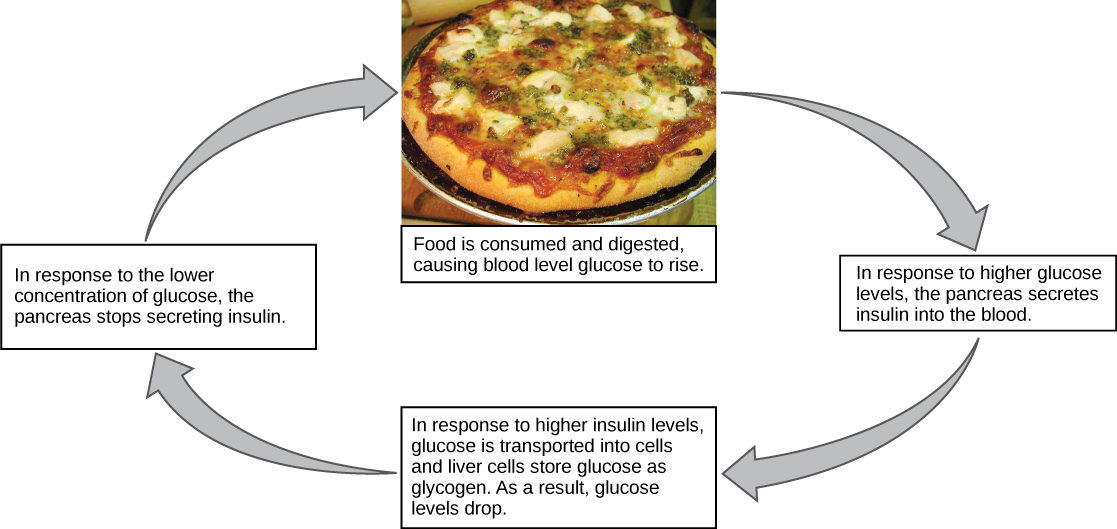
Any homeostatic process that changes the direction of the stimulus is a negative feedback loop. It may either increase or decrease the stimulus, but the stimulus is not allowed to continue as it did before the receptor sensed it. In other words, if a level is too high, the body does something to bring it down, and conversely, if a level is too low, the body does something to make it go up. Hence the term negative feedback. An example is animal maintenance of blood glucose levels. When an animal has eaten, blood glucose levels rise. This is sensed by the nervous system. Specialized cells in the pancreas sense this, and the hormone insulin is released by the endocrine system. Insulin causes blood glucose levels to decrease, as would be expected in a negative feedback system, as illustrated in Figure 33.20. However, if an animal has not eaten and blood glucose levels decrease, this is sensed in another group of cells in the pancreas, and the hormone glucagon is released causing glucose levels to increase. This is still a negative feedback loop, but not in the direction expected by the use of the term “negative.” Another example of an increase as a result of the feedback loop is the control of blood calcium. If calcium levels decrease, specialized cells in the parathyroid gland sense this and release parathyroid hormone (PTH), causing an increased absorption of calcium through the intestines and kidneys and, possibly, the breakdown of bone in order to liberate calcium. The effects of PTH are to raise blood levels of the element. Negative feedback loops are the predominant mechanism used in homeostasis.
英語のヒント
刺激の方向を変える恒常性の過程は、いずれも負のフィードバック回路である。刺激を増大させることも減少させることもあるが、受容器が感知する前と同じまま刺激が続くことは許されない。言い換えれば、ある値が高すぎれば体はそれを下げるために働き、逆に低すぎれば上げるために働く。これが「負のフィードバック」という名称の由来である。一例が、動物による血糖値の維持である。動物が食事をすると血糖値が上がり、神経系がこれを感知する。膵臓の特殊な細胞もこれを感知し、内分泌系からインスリンというホルモンが放出される。図33.20に示すように、負のフィードバック系で予想されるとおり、インスリンは血糖値を低下させる。しかし、動物が食事を取らずに血糖値が低下すると、膵臓の別の細胞群がこれを感知し、グルカゴンというホルモンを放出して血糖値を上げる。これも負のフィードバック回路だが、「負」という言葉から予想する方向とは異なる。フィードバック回路の結果として値が上昇する別の例は、血中カルシウムの制御である。カルシウム濃度が低下すると、副甲状腺の特殊な細胞がこれを感知し、副甲状腺ホルモン(PTH)を放出する。その結果、腸および腎臓でのカルシウム吸収が増え、場合によってはカルシウムを遊離させるために骨が分解される。PTHの作用は、この元素の血中濃度を上げることである。負のフィードバック回路は、恒常性で使われる主要な仕組みである。
OpenStax, Rice University; Biology 2e. (credit: modification of work by Jon Sullivan) · CC BY 4.0 · Source出典

Figure 33.20図 33.20
Blood sugar levels are controlled by a negative feedback loop. (credit: modification of work by Jon Sullivan)
血糖値は負のフィードバック回路によって制御される。(クレジット:Jon Sullivanの作品を改変)
Positive Feedback Loop正のフィードバック回路
A positive feedback loop maintains the direction of the stimulus, possibly accelerating it. Few examples of positive feedback loops exist in animal bodies, but one is found in the cascade of chemical reactions that result in blood clotting, or coagulation. As one clotting factor is activated, it activates the next factor in sequence until a fibrin clot is achieved. The final factor, a protein called thrombin, converts inactive fibrinogen to fibrin. Thrombin also activates additional clotting factor molecules earlier in the cascade, resulting in the activation of even more thrombin. This positive feedback loop amplifies the cascade for faster, more effective formation of a blood clot. Another example of positive feedback is uterine contractions during childbirth, as illustrated in Figure 33.21. The hormone oxytocin, made by the endocrine system, stimulates the contraction of the uterus. This stimulation is sensed by the nervous system. Instead of lowering the oxytocin, more oxytocin is produced until the contractions are powerful enough to produce childbirth.
英語のヒント
正のフィードバック回路は刺激の方向を維持し、ときにはそれを加速させる。動物の体に正のフィードバック回路の例は少ないが、その一つが、血液凝固をもたらす化学反応の連鎖である。一つの凝固因子が活性化されると、次の因子を順番に活性化し、やがてフィブリンの凝血塊ができる。最後の因子であるトロンビンというタンパク質は、不活性なフィブリノーゲンをフィブリンへ変換する。トロンビンはまた、連鎖のそれより前の段階にある凝固因子分子も追加で活性化し、その結果、さらに多くのトロンビンが活性化される。この正のフィードバック回路が反応連鎖を増幅し、より速く、より効果的に凝血塊を形成する。正のフィードバックの別の例は、図33.21に示す、出産時の子宮収縮である。内分泌系でつくられるオキシトシンというホルモンが、子宮の収縮を促す。神経系はこの刺激を感知する。オキシトシンを減らす代わりに、出産を起こすのに十分な強さの収縮になるまで、さらに多くのオキシトシンが産生される。