第33章動物の体:基本的な形態と機能
33.1 Animal Form and Function33.1 動物の形と機能
Learning Objectives学習目標
By the end of this section, you will be able to do the following:
この節を学ぶと、次のことができるようになる。
- Describe the various types of body plans that occur in animals動物に見られるさまざまな体制を説明する。
- Describe limits on animal size and shape動物の大きさと形への制約を説明する。
- Relate bioenergetics to body size, levels of activity, and the environment生体エネルギー学を、体の大きさ、活動水準、環境と関連づける。
Animals vary in form and function. From a sponge to a worm to a goat, an organism has a distinct body plan that limits its size and shape. Animals’ bodies are also designed to interact with their environments, whether in the deep sea, a rainforest canopy, or the desert. Therefore, a large amount of information about the structure of an organism's body (anatomy) and the function of its cells, tissues and organs (physiology) can be learned by studying that organism's environment.
英語のヒント
動物の形と機能はさまざまである。海綿からミミズ、ヤギに至るまで、生物はそれぞれ特有の体制をもち、それが大きさや形を制約する。また、動物の体は、深海、熱帯雨林の林冠、砂漠など、どの環境でも周囲と相互作用できるようにできている。したがって、生物の環境を調べることから、体の構造を扱う解剖学や、細胞・組織・器官の機能を扱う生理学について、多くの情報を得られる。
Body Plans体制
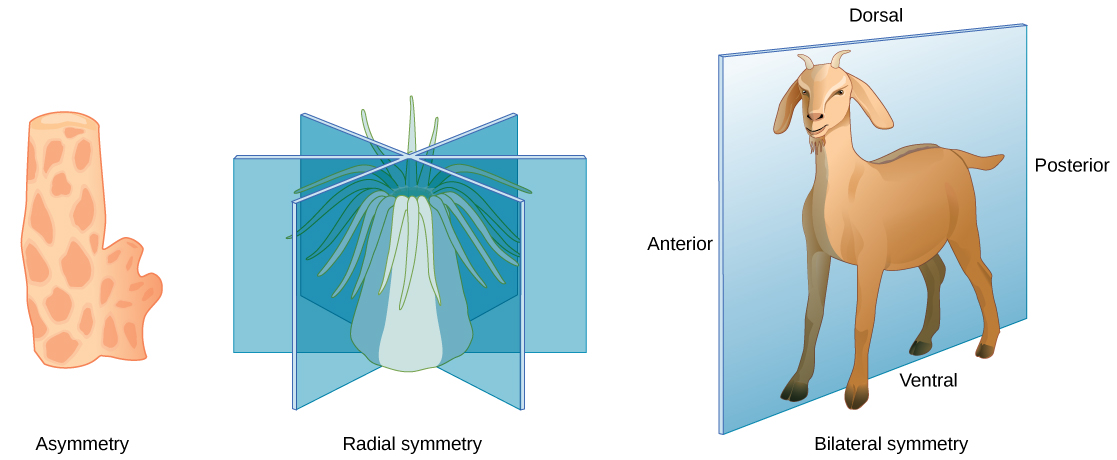
Figure 33.2図 33.2
Animals exhibit different types of body symmetry. The sponge is asymmetrical, the sea anemone has radial symmetry, and the goat has bilateral symmetry.
動物には、さまざまな体の対称性が見られる。海綿は非対称、イソギンチャクは放射相称、ヤギは左右相称である。
Animal body plans follow set patterns related to symmetry. They are asymmetrical, radial, or bilateral in form as illustrated in Figure 33.2. Asymmetrical animals are animals with no pattern or symmetry; an example of an asymmetrical animal is a sponge. Radial symmetry, as illustrated in Figure 33.2, describes when an animal has an up-and-down orientation: any plane cut along its longitudinal axis through the organism produces equal halves, but not a definite right or left side. This plan is found mostly in aquatic animals, especially organisms that attach themselves to a base, like a rock or a boat, and extract their food from the surrounding water as it flows around the organism. Bilateral symmetry is illustrated in the same figure by a goat. The goat also has an upper and lower component to it, but a plane cut from front to back separates the animal into definite right and left sides. Additional terms used when describing positions in the body are anterior (front), posterior (rear), dorsal (toward the back), and ventral (toward the stomach). Bilateral symmetry is found in both land-based and aquatic animals; it enables a high level of mobility.
動物の体制には、対称性に関わる一定のパターンがある。図33.2に示すように、非対称、放射相称、左右相称の形がある。非対称の動物は、決まったパターンや対称性をもたない。海綿がその例である。図33.2の放射相称は、上下の方向がある動物について、長軸に沿って体を通るどの面で切っても等しい半分に分かれるが、明確な右側と左側はない状態を指す。この体制は主に水生動物に見られる。とくに、岩や船のような基盤に付着し、周囲を流れる水から食物を取り出す生物に多い。同じ図のヤギが示すのは左右相称である。ヤギにも上下の部分があるが、前から後ろへ通る面で切ると、明確な右側と左側に分かれる。体内の位置を表す用語には、前方、後方、背側(背中の方向)、腹側(腹の方向)もある。左右相称は陸上動物と水生動物の両方に見られ、高い運動能力を可能にする。
Limits on Animal Size and Shape動物の大きさと形の制約
Animals with bilateral symmetry that live in water tend to have a fusiform shape: this is a tubular shaped body that is tapered at both ends. This shape decreases the drag on the body as it moves through water and allows the animal to swim at high speeds. Table 33.1 lists the maximum speed of various animals. Certain types of sharks can swim at fifty kilometers per hour and some dolphins at 32 to 40 kilometers per hour. Land animals frequently travel faster, although the tortoise and snail are significantly slower than cheetahs. Another difference in the adaptations of aquatic and land-dwelling organisms is that aquatic organisms are constrained in shape by the forces of drag in the water since water has higher viscosity than air. On the other hand, land-dwelling organisms are constrained mainly by gravity, and drag is relatively unimportant. For example, most adaptations in birds are for gravity not for drag.
英語のヒント
水中に暮らす左右相称の動物は、両端が細くなった管状の体、すなわち紡錘形になる傾向がある。この形は、水中を移動するときの抗力を減らし、高速で泳ぐことを可能にする。表33.1は、さまざまな動物の最高速度を示す。ある種のサメは時速50 kmで、一部のイルカは時速32~40 kmで泳げる。陸上動物はさらに速く移動することも多いが、リクガメやカタツムリはチーターよりはるかに遅い。水生生物と陸上生物の適応の別の違いは、水生生物の形が水の抗力によって制約されることである。水は空気より粘性が高いためである。一方、陸上生物は主に重力による制約を受け、抗力は比較的重要でない。たとえば、鳥の適応の大部分は抗力ではなく重力への適応である。
Maximum Speed of Assorted Land & Marine Animals さまざまな陸上動物・海洋動物の最高速度 |
||
|---|---|---|
Animal 動物 |
Speed (kmh) 速度(km/時) |
Speed (mph) 速度(マイル/時) |
Cheetah チーター |
113 |
70 |
Quarter horse クォーターホース |
77 |
48 |
Fox キツネ |
68 |
42 |
Shortfin mako shark アオザメ |
50 |
31 |
Domestic house cat イエネコ |
48 |
30 |
Human ヒト |
45 |
28 |
Dolphin イルカ |
32–40 |
20–25 |
Mouse マウス |
13 |
8 |
Snail カタツムリ |
0.05 |
0.03 |
Most animals have an exoskeleton, including insects, spiders, scorpions, horseshoe crabs, centipedes, and crustaceans. Scientists estimate that, of insects alone, there are over 30 million species on our planet. The exoskeleton is a hard covering or shell that provides benefits to the animal, such as protection against damage from predators and from water loss (for land animals); it also provides for the attachments of muscles.
昆虫、クモ、サソリ、カブトガニ、ムカデ、甲殻類など、大部分の動物は外骨格をもつ。科学者は、地球上には昆虫だけでも3,000万種以上いると推定している。外骨格は硬い覆いや殻であり、捕食者による損傷や、陸上動物では水分の損失から守るなどの利点を与える。また、筋肉が付着する場所にもなる。
As the tough and resistant outer cover of an arthropod, the exoskeleton may be constructed of a tough polymer such as chitin and is often biomineralized with materials such as calcium carbonate. This is fused to the animal’s epidermis. Ingrowths of the exoskeleton, called apodemes, function as attachment sites for muscles, similar to tendons in more advanced animals (Figure 33.3). In order to grow, the animal must first synthesize a new exoskeleton underneath the old one and then shed or molt the original covering. This limits the animal’s ability to grow continually, and may limit the individual’s ability to mature if molting does not occur at the proper time. The thickness of the exoskeleton must be increased significantly to accommodate any increase in weight. It is estimated that a doubling of body size increases body weight by a factor of eight. The increasing thickness of the chitin necessary to support this weight limits most animals with an exoskeleton to a relatively small size. The same principles apply to endoskeletons, but they are more efficient because muscles are attached on the outside, making it easier to compensate for increased mass.
英語のヒント
節足動物の丈夫で抵抗力のある外側の覆いとして、外骨格はキチンのような強い高分子で作られることがあり、炭酸カルシウムなどの物質によって生体鉱物化されている場合も多い。これは動物の表皮と一体化している。外骨格が内側へ伸びた部分をアポデームといい、より進化した動物の腱と同様、筋肉の付着部として働く(図33.3)。成長するには、動物はまず古い外骨格の下に新しい外骨格を合成し、それから元の覆いを脱ぐ、すなわち脱皮しなければならない。このため連続的な成長は制限され、適切な時期に脱皮できなければ、成熟できるかどうかも制約される可能性がある。体重が増えると、それに対応するため外骨格を大幅に厚くする必要がある。体の大きさが2倍になると、体重は8倍になると見積もられる。この重量を支えるために必要なキチンの厚さが増すことによって、外骨格をもつ動物の大部分は比較的小さなサイズに制限される。内骨格にも同じ原理が当てはまるが、筋肉が外側に付着しており、増えた質量に対応しやすいため、より効率がよい。
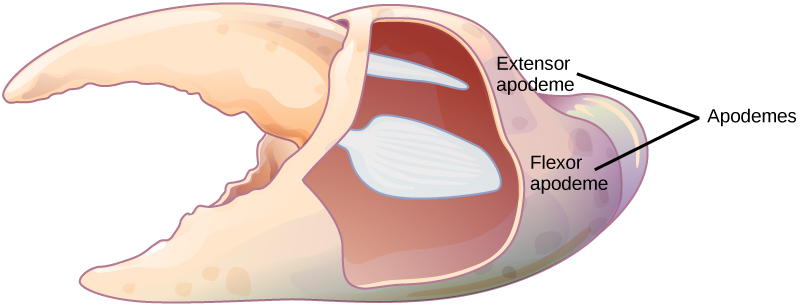


Figure 33.3図 33.3
Apodemes are ingrowths on arthropod exoskeletons to which muscles attach. The apodemes on this crab leg are located above and below the fulcrum of the claw. Contraction of muscles attached to the apodemes pulls the claw closed.
アポデームは節足動物の外骨格が内側へ伸びた部分で、筋肉が付着する。このカニの脚では、はさみの支点の上下にある。アポデームに付く筋肉が収縮すると、はさみが引かれて閉じる。
An animal with an endoskeleton has its size determined by the amount of skeletal system it needs in order to support the other tissues and the amount of muscle it needs for movement. As the body size increases, both bone and muscle mass increase. The speed achievable by the animal is a balance between its overall size and the bone and muscle that provide support and movement.
内骨格をもつ動物の大きさは、ほかの組織を支えるために必要な骨格系の量と、運動に必要な筋肉の量によって決まる。体が大きくなると、骨と筋肉の質量も増える。動物が達成できる速度は、全体の大きさと、支持・運動を担う骨や筋肉との釣り合いで決まる。