第33章動物の体:基本的な形態と機能
Limiting Effects of Diffusion on Size and Development拡散が大きさと発達に及ぼす制限
The exchange of nutrients and wastes between a cell and its watery environment occurs through the process of diffusion. All living cells are bathed in liquid, whether they are in a single-celled organism or a multicellular one. Diffusion is effective over a specific distance and limits the size that an individual cell can attain. If a cell is a single-celled microorganism, such as an amoeba, it can satisfy all of its nutrient and waste needs through diffusion. If the cell is too large, then diffusion is ineffective and the center of the cell does not receive adequate nutrients nor is it able to effectively dispel its waste.
英語のヒント
細胞とその周囲の水性環境の間での栄養分や老廃物の交換は、拡散によって起こる。単細胞生物であっても多細胞生物であっても、生きた細胞はすべて液体に浸されている。拡散が効果を発揮する距離は限られており、一つの細胞が到達できる大きさを制約する。アメーバのような単細胞微生物であれば、栄養分の取り込みと老廃物の排出をすべて拡散でまかなえる。しかし細胞が大きすぎると拡散は十分に働かず、細胞の中央は必要な栄養分を受け取れず、老廃物も効果的に排出できない。
An important concept in understanding how efficient diffusion is as a means of transport is the surface to volume ratio. Recall that any three-dimensional object has a surface area and volume; the ratio of these two quantities is the surface-to-volume ratio. Consider a cell shaped like a perfect sphere: it has a surface area of 4πr2, and a volume of (4/3)πr3. The surface-to-volume ratio of a sphere is 3/r; as the cell gets bigger, its surface to volume ratio decreases, making diffusion less efficient. The larger the size of the sphere, or animal, the less surface area for diffusion it possesses.
英語のヒント
輸送手段として拡散がどれほど効率的かを理解するうえで重要なのが、表面積対体積比である。どんな三次元物体にも表面積と体積があり、この二つの量の比が表面積対体積比であることを思い出そう。完全な球形の細胞を考えると、表面積は4πr2、体積は(4/3)πr3である。球の表面積対体積比は3/rなので、細胞が大きくなるほどこの比は小さくなり、拡散の効率が下がる。球や動物の大きさが大きいほど、拡散に使える表面積は少なくなる。
The solution to producing larger organisms is for them to become multicellular. Specialization occurs in complex organisms, allowing cells to become more efficient at doing fewer tasks. For example, circulatory systems bring nutrients and remove waste, while respiratory systems provide oxygen for the cells and remove carbon dioxide from them. Other organ systems have developed further specialization of cells and tissues and efficiently control body functions. Moreover, surface-to-volume ratio applies to other areas of animal development, such as the relationship between muscle mass and cross-sectional surface area in supporting skeletons, and in the relationship between muscle mass and the generation and dissipation of heat.
より大きな生物を作るための解決策は、多細胞になることである。複雑な生物では特殊化が起こり、各細胞は少数の仕事をより効率よく行えるようになる。たとえば、循環系は栄養分を運び、老廃物を除去する。呼吸系は細胞へ酸素を供給し、二酸化炭素を取り除く。ほかの器官系でも、細胞や組織の特殊化がさらに進み、体の機能を効率的に制御する。表面積対体積比は、動物の発達のほかの面にも当てはまる。たとえば、骨格を支える際の筋肉量と断面積の関係や、筋肉量と熱の発生・放散の関係などである。
Animal Bioenergetics動物の生体エネルギー学
All animals must obtain their energy from food they ingest or absorb. These nutrients are converted to adenosine triphosphate (ATP) for short-term storage and use by all cells. Some animals store energy for slightly longer times as glycogen, and others store energy for much longer times in the form of triglycerides housed in specialized adipose tissues. No energy system is one hundred percent efficient, and an animal’s metabolism produces waste energy in the form of heat. If an animal can conserve that heat and maintain a relatively constant body temperature, it is classified as a warm-blooded animal and called an endotherm. The insulation used to conserve the body heat comes in the forms of fur, fat, or feathers. The absence of insulation in ectothermic animals increases their dependence on the environment for body heat.
英語のヒント
すべての動物は、摂取または吸収した食物からエネルギーを得なければならない。これらの栄養分はアデノシン三リン酸(ATP)へ変換され、短期的に蓄えられ、すべての細胞に利用される。やや長い期間、グリコーゲンとしてエネルギーを蓄える動物もいれば、特殊な脂肪組織の中のトリグリセリドとして、はるかに長く蓄える動物もいる。効率が100%のエネルギー系はなく、動物の代謝でも、使われないエネルギーが熱として生じる。その熱を保ち、体温を比較的一定に維持できる動物は、温血動物に分類され、内温動物と呼ばれる。体熱を保つ断熱材となるのは、毛、脂肪、羽毛などである。外温動物には断熱構造がないため、体熱を環境により強く依存する。
The amount of energy expended by an animal over a specific time is called its metabolic rate. The rate is measured variously in joules, calories, or kilocalories (1000 calories). Carbohydrates and proteins contain about 4.5 to 5 kcal/g, and fat contains about 9 kcal/g. Metabolic rate is estimated as the basal metabolic rate (BMR) in endothermic animals at rest and as the standard metabolic rate (SMR) in ectotherms. Human males have a BMR of 1600 to 1800 kcal/day, and human females have a BMR of 1300 to 1500 kcal/day. Even with insulation, endothermal animals require extensive amounts of energy to maintain a constant body temperature. An ectotherm such as an alligator has an SMR of 60 kcal/day.
動物が一定の時間に消費するエネルギー量を代謝率という。ジュール、カロリー、キロカロリー(1,000カロリー)など、さまざまな単位で測られる。炭水化物とタンパク質には約4.5~5 kcal/g、脂肪には約9 kcal/gのエネルギーが含まれる。安静時の内温動物では基礎代謝率(BMR)、外温動物では標準代謝率(SMR)として代謝率を見積もる。ヒトの男性のBMRは1,600~1,800 kcal/日、女性では1,300~1,500 kcal/日である。断熱構造があっても、内温動物は一定の体温を保つために多量のエネルギーを必要とする。アリゲーターのような外温動物のSMRは60 kcal/日である。
Energy Requirements Related to Body Size体の大きさとエネルギー要求
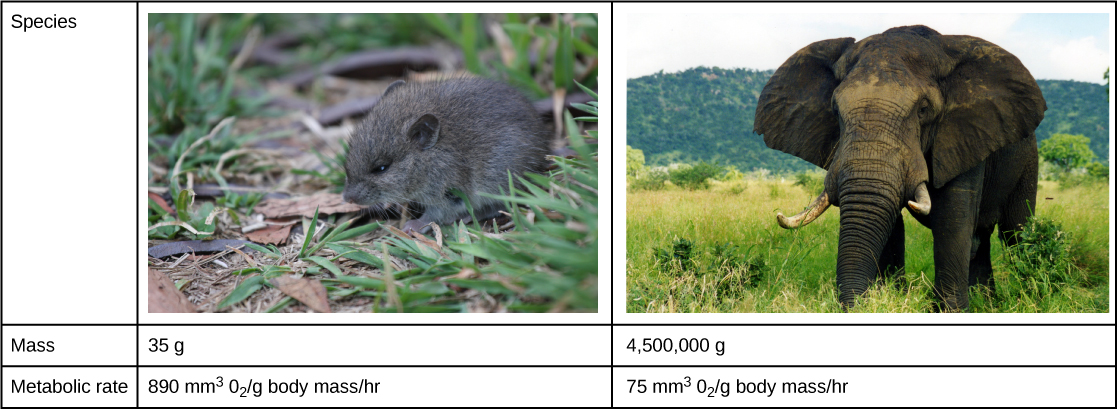
Smaller endothermic animals have a greater surface area for their mass than larger ones (Figure 33.4). Therefore, smaller animals lose heat at a faster rate than larger animals and require more energy to maintain a constant internal temperature. This results in a smaller endothermic animal having a higher BMR, per body weight, than a larger endothermic animal.
英語のヒント
小さな内温動物は、大きな内温動物よりも、質量に対する表面積が大きい(図33.4)。そのため、小さな動物は大きな動物より速く熱を失い、体内温度を一定に保つために、より多くのエネルギーを必要とする。その結果、小さな内温動物の体重当たりのBMRは、大きな内温動物より高くなる。
OpenStax, Rice University; Biology 2e. (credit “mouse”: modification of work by Magnus Kjaergaard; credit “elephant”: modification of work by “TheLizardQueen”/Flickr) · CC BY 4.0 · Source出典

Figure 33.4図 33.4
The mouse has a much higher metabolic rate than the elephant. (credit “mouse”: modification of work by Magnus Kjaergaard; credit “elephant”: modification of work by “TheLizardQueen”/Flickr)
マウスの代謝率は、ゾウよりはるかに高い。(マウスのクレジット:Magnus Kjaergaardの作品を改変;ゾウ:"TheLizardQueen"/Flickrの作品を改変)