第33章動物の体:基本的な形態と機能
Smooth Muscle平滑筋
Smooth muscle does not have striations in its cells. It has a single, centrally located nucleus, as shown in Figure 33.18. Constriction of smooth muscle occurs under involuntary, autonomic nervous control and in response to local conditions in the tissues. Smooth muscle tissue is also called non-striated as it lacks the banded appearance of skeletal and cardiac muscle. The walls of blood vessels, the tubes of the digestive system, and the tubes of the reproductive systems are composed of mostly smooth muscle.
英語のヒント
平滑筋の細胞には横紋がない。図33.18のように、中央に核が一つある。収縮は不随意的な自律神経の制御と、組織の局所的な条件への応答によって起こる。骨格筋や心筋のような縞模様を欠くため、非横紋筋とも呼ばれる。血管の壁、消化系の管、生殖系の管は、主に平滑筋でできている。

Figure 33.18図 33.18
Smooth muscle cells do not have striations, while skeletal muscle cells do. Cardiac muscle cells have striations, but, unlike the multinucleate skeletal cells, they have only one nucleus. Cardiac muscle tissue also has intercalated discs, specialized regions running along the plasma membrane that join adjacent cardiac muscle cells and assist in passing an electrical impulse from cell to cell.
平滑筋細胞には横紋がなく、骨格筋細胞にはある。心筋細胞にも横紋があるが、多核の骨格筋細胞とは異なり、核は一つだけである。心筋組織には介在板もある。これは細胞膜に沿う特殊な領域で、隣り合う心筋細胞をつなぎ、電気的インパルスが細胞間を伝わるのを助ける。
Skeletal Muscle骨格筋
Skeletal muscle has striations across its cells caused by the arrangement of the contractile proteins actin and myosin. These muscle cells are relatively long and have multiple nuclei along the edge of the cell. Skeletal muscle is under voluntary, somatic nervous system control and is found in the muscles that move bones. Figure 33.18 illustrates the histology of skeletal muscle.
骨格筋の細胞には、収縮タンパク質のアクチンとミオシンの配列による横紋がある。細胞は比較的長く、周辺部に複数の核をもつ。骨格筋は随意的な体性神経系の制御下にあり、骨を動かす筋に見られる。図33.18は、骨格筋の組織構造を示す。
Cardiac Muscle心筋
Cardiac muscle, shown in Figure 33.18, is found only in the heart. Like skeletal muscle, it has cross striations in its cells, but cardiac muscle has a single, centrally located nucleus. Cardiac muscle is not under voluntary control but can be influenced by the autonomic nervous system to speed up or slow down. An added feature to cardiac muscle cells is a line than extends along the end of the cell as it abuts the next cardiac cell in the row. This line is called an intercalated disc: it assists in passing electrical impulse efficiently from one cell to the next and maintains the strong connection between neighboring cardiac cells.
英語のヒント
図33.18に示す心筋は、心臓だけに存在する。骨格筋と同様、細胞に横紋があるが、核は中央に一つである。心筋は随意的には制御されないが、自律神経系の影響で速くなったり遅くなったりする。心筋細胞にはさらに、隣の心筋細胞と接する端に沿って走る線がある。この線は介在板と呼ばれ、一つの細胞から次の細胞へ電気的インパルスを効率よく伝えるのを助けるとともに、隣接する心筋細胞間の強いつながりを維持する。
Nervous Tissues神経組織
Nervous tissues are made of cells specialized to receive and transmit electrical impulses from specific areas of the body and to send them to specific locations in the body. The main cell of the nervous system is the neuron, illustrated in Figure 33.19. The large structure with a central nucleus is the cell body of the neuron. Projections from the cell body are either dendrites specialized in receiving input or a single axon specialized in transmitting impulses. Some glial cells are also shown. Astrocytes regulate the chemical environment of the nerve cell, and oligodendrocytes insulate the axon so the electrical nerve impulse is transferred more efficiently. Other glial cells that are not shown support the nutritional and waste requirements of the neuron. Some of the glial cells are phagocytic and remove debris or damaged cells from the tissue. A nerve consists of neurons and glial cells.
英語のヒント
神経組織は、体の特定の領域から電気的インパルスを受け取り、体内の特定の場所へ伝えることに特化した細胞からなる。神経系の主な細胞は、図33.19のニューロンである。中央に核をもつ大きな部分が細胞体である。細胞体から出る突起には、入力を受けることに特化した樹状突起と、インパルスを伝えることに特化した一本の軸索がある。図にはグリア細胞もいくつか示されている。アストロサイト(星状膠細胞)は神経細胞の化学的環境を調節し、オリゴデンドロサイト(希突起膠細胞)は軸索を絶縁して、電気的な神経インパルスをより効率よく伝えられるようにする。図にないほかのグリア細胞は、ニューロンの栄養供給や老廃物処理を支える。一部のグリア細胞は貪食性で、組織から残骸や傷ついた細胞を除去する。神経はニューロンとグリア細胞からなる。
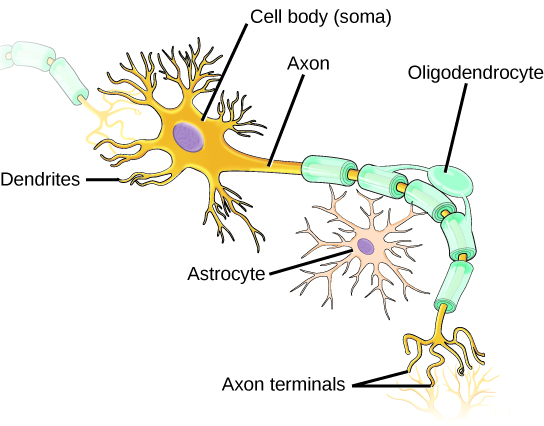


Figure 33.19図 33.19
The neuron has projections called dendrites that receive signals and projections called axons that send signals. Also shown are two types of glial cells: astrocytes regulate the chemical environment of the nerve cell, and oligodendrocytes insulate the axon so the electrical nerve impulse is transferred more efficiently.
英語のヒント
ニューロンには、信号を受ける樹状突起と、信号を送る軸索という突起がある。2種類のグリア細胞も示す。アストロサイトは神経細胞の化学的環境を調節し、オリゴデンドロサイトは軸索を絶縁して、電気的な神経インパルスをより効率よく伝えられるようにする。
Section Summaryこの節のまとめ
The basic building blocks of complex animals are four primary tissues. These are combined to form organs, which have a specific, specialized function within the body, such as the skin or kidney. Organs are organized together to perform common functions in the form of systems. The four primary tissues are epithelia, connective tissues, muscle tissues, and nervous tissues.
複雑な動物を構成する基本単位は、四つの基本組織である。それらが組み合わさって、皮膚や腎臓のように、体内で特定の専門的な機能をもつ器官を作る。器官は、共通の機能を果たす器官系へまとめられる。四つの基本組織は、上皮組織、結合組織、筋組織、神経組織である。