第33章動物の体:基本的な形態と機能
Adipose Tissue脂肪組織
Adipose tissue, or fat tissue, is considered a connective tissue even though it does not have fibroblasts or a real matrix. Adipose tissue is made up of cells called adipocytes that collect and store fat in the form of triglycerides, for energy metabolism. Adipose tissues additionally serve as insulation to help maintain body temperatures, allowing animals to be endothermic, and they function as cushioning against damage to body organs. Under a microscope, adipose tissue cells appear empty due to the extraction of fat during the processing of the material for viewing, as seen in Figure 33.16. The thin lines in the image are the cell membranes, and the nuclei are the small, black dots at the edges of the cells.
英語のヒント
脂肪組織は、線維芽細胞や本格的な細胞外基質をもたないにもかかわらず、結合組織とみなされる。脂肪細胞という細胞からなり、エネルギー代謝に備えて、トリグリセリドの形で脂肪を集めて蓄える。脂肪組織は体温維持を助ける断熱材として働き、動物の内温性を可能にする。また、器官を損傷から守るクッションにもなる。顕微鏡で見ると、観察用の標本処理中に脂肪が抜き取られるため、図33.16のように脂肪細胞は空に見える。画像の細い線は細胞膜、細胞の端の小さな黒い点は核である。
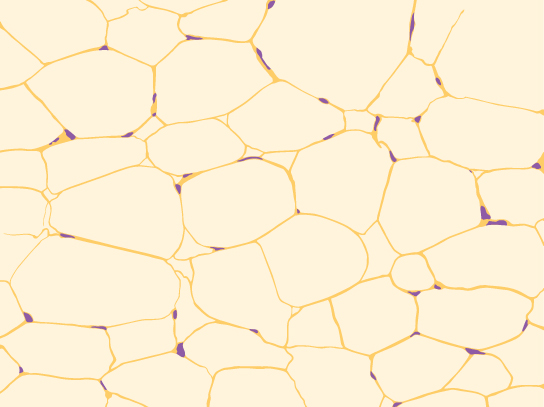
Figure 33.16図 33.16
Adipose is a connective tissue made up of cells called adipocytes. Adipocytes have small nuclei localized at the cell edge.
脂肪組織は、脂肪細胞からなる結合組織である。脂肪細胞の小さな核は、細胞の端に位置する。
Blood血液
Blood is considered a connective tissue because it has a matrix, as shown in Figure 33.17. The living cell types are red blood cells (RBC), also called erythrocytes, and white blood cells (WBC), also called leukocytes. The fluid portion of whole blood, its matrix, is commonly called plasma.
図33.17のように、血液には基質があるため、結合組織とみなされる。生きた細胞には、赤血球(RBC)と白血球(WBC)がある。英語では、それぞれerythrocytes、leukocytesとも呼ばれる。全血の液体部分である基質は、一般に血漿という。
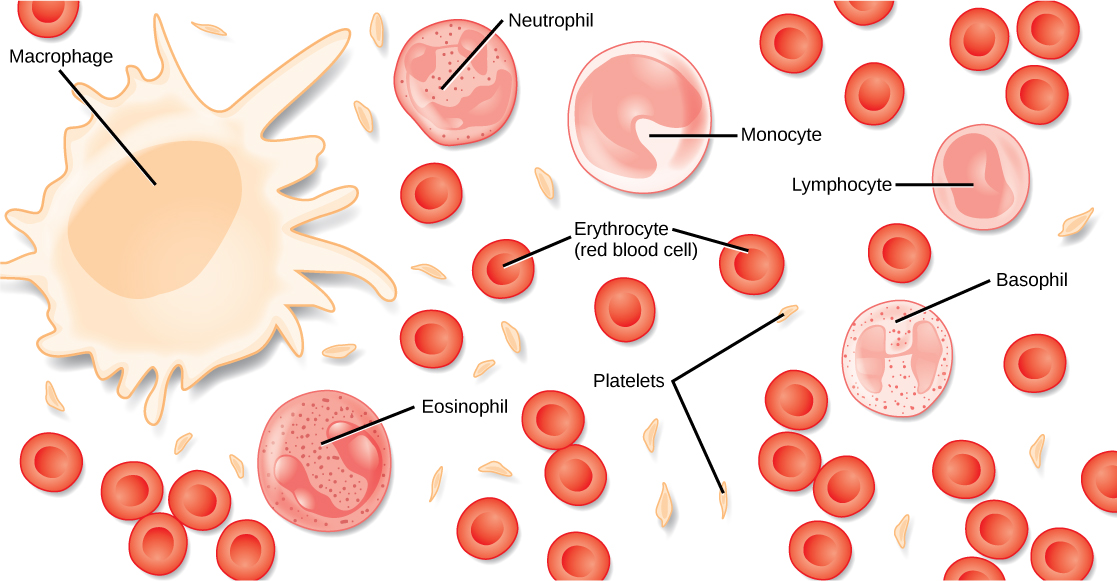


Figure 33.17図 33.17
Blood is a connective tissue that has a fluid matrix, called plasma, and no fibers. Erythrocytes (red blood cells), the predominant cell type, are involved in the transport of oxygen and carbon dioxide. Also present are various leukocytes (white blood cells) involved in immune response.
血液は、血漿という液体の基質をもち、線維をもたない結合組織である。もっとも多い細胞種である赤血球は、酸素と二酸化炭素の輸送に関わる。免疫応答に関わる、さまざまな白血球も存在する。
The cell found in greatest abundance in blood is the erythrocyte. Erythrocytes are counted in millions in a blood sample: the average number of red blood cells in primates is 4.7 to 5.5 million cells per microliter. Erythrocytes are consistently the same size in a species, but vary in size between species. For example, the average diameter of a primate red blood cell is 7.5 µm, a dog is close at 7.0 µm, but a cat’s RBC diameter is 5.9 µm. Sheep erythrocytes are even smaller at 4.6 µm. Mammalian erythrocytes lose their nuclei and mitochondria when they are released from the bone marrow where they are made. Fish, amphibian, and avian red blood cells maintain their nuclei and mitochondria throughout the cell’s life. The principal job of an erythrocyte is to carry and deliver oxygen to the tissues.
血液中でもっとも多い細胞は赤血球である。血液試料では数百万個の単位で数えられ、霊長類では平均して1 µL当たり470万~550万個ある。同じ種の赤血球は一定の大きさだが、種によって大きさが異なる。たとえば、霊長類の平均直径は7.5 µmで、イヌはそれに近い7.0 µmだが、ネコは5.9 µmである。ヒツジはさらに小さく、4.6 µmである。哺乳類の赤血球は、作られた骨髄から放出される際、核とミトコンドリアを失う。魚類、両生類、鳥類の赤血球は、生存期間を通して核とミトコンドリアを保つ。赤血球の主な仕事は、酸素を運んで組織へ届けることである。
Leukocytes are the predominant white blood cells found in the peripheral blood. Leukocytes are counted in the thousands in the blood with measurements expressed as ranges: primate counts range from 4,800 to 10,800 cells per µl, dogs from 5,600 to 19,200 cells per µl, cats from 8,000 to 25,000 cells per µl, cattle from 4,000 to 12,000 cells per µl, and pigs from 11,000 to 22,000 cells per µl.
白血球は、末梢血に見られる主要な白い血液細胞である。血液中の白血球は数千個の単位で数えられ、測定値は範囲で表される。1 µL当たりの数は、霊長類で4,800~10,800個、イヌで5,600~19,200個、ネコで8,000~25,000個、ウシで4,000~12,000個、ブタで11,000~22,000個である。
Lymphocytes function primarily in the immune response to foreign antigens or material. Different types of lymphocytes make antibodies tailored to the foreign antigens and control the production of those antibodies. Neutrophils are phagocytic cells and they participate in one of the early lines of defense against microbial invaders, aiding in the removal of bacteria that have entered the body. Another leukocyte that is found in the peripheral blood is the monocyte. Monocytes give rise to phagocytic macrophages that clean up dead and damaged cells in the body, whether they are foreign or from the host animal. Two additional leukocytes in the blood are eosinophils and basophils—both help to facilitate the inflammatory response.
英語のヒント
リンパ球は主に、外来抗原や異物に対する免疫応答で働く。さまざまな型のリンパ球が、外来抗原に合わせた抗体を作り、その生産を制御する。好中球は食細胞であり、侵入微生物に対する初期の防御線の一つを担い、体内へ入った細菌の除去を助ける。末梢血に見られる別の白血球が単球である。単球は貪食性のマクロファージとなり、外来性か宿主動物由来かを問わず、体内の死んだ細胞や損傷した細胞を片づける。血液にはさらに好酸球と好塩基球もあり、どちらも炎症応答を促す助けとなる。
The slightly granular material among the cells is a cytoplasmic fragment of a cell in the bone marrow. This is called a platelet or thrombocyte. Platelets participate in the stages leading up to coagulation of the blood to stop bleeding through damaged blood vessels. Blood has a number of functions, but primarily it transports material through the body to bring nutrients to cells and remove waste material from them.
細胞の間にあるやや顆粒状の物質は、骨髄の細胞の細胞質の断片である。これを血小板という。血小板は、損傷した血管からの出血を止めるための、血液凝固に至る段階に関与する。血液には多くの機能があるが、主として体内で物質を輸送し、細胞に栄養分を届け、老廃物を取り除く。
Muscle Tissues筋組織
There are three types of muscle in animal bodies: smooth, skeletal, and cardiac. They differ by the presence or absence of striations or bands, the number and location of nuclei, whether they are voluntarily or involuntarily controlled, and their location within the body. Table 33.4 summarizes these differences.
動物の体には、平滑筋、骨格筋、心筋という3種類の筋がある。横紋、すなわち縞模様の有無、核の数と位置、随意的または不随意的に制御されるかどうか、体内の存在場所が異なる。表33.4にその違いをまとめる。
Types of Muscles 筋の種類 |
||||
|---|---|---|---|---|
Type of Muscle 筋の種類 |
Striations 横紋 |
Nuclei 核 |
Control 制御 |
Location 存在する場所 |
smooth 平滑筋 |
no なし |
single, in center 一つ、中央 |
involuntary 不随意 |
visceral organs 内臓器官 |
skeletal 骨格筋 |
yes あり |
many, at periphery 多数、周辺部 |
voluntary 随意 |
skeletal muscles 骨格筋 |
cardiac 心筋 |
yes あり |
single, in center 一つ、中央 |
involuntary 不随意 |
heart 心臓 |