第33章動物の体:基本的な形態と機能
Energy Requirements Related to Levels of Activity活動水準とエネルギー要求
The more active an animal is, the more energy is needed to maintain that activity, and the higher its BMR or SMR. The average daily rate of energy consumption is about two to four times an animal’s BMR or SMR. Humans are more sedentary than most animals and have an average daily rate of only 1.5 times the BMR. The diet of an endothermic animal is determined by its BMR. For example: the type of grasses, leaves, or shrubs that an herbivore eats affects the number of calories that it takes in. The relative caloric content of herbivore foods, in descending order, is tall grasses > legumes > short grasses > forbs (any broad-leaved plant, not a grass) > subshrubs > annuals/biennials.
英語のヒント
動物が活発になるほど、その活動を維持するのに必要なエネルギーは多くなり、BMRまたはSMRも高くなる。1日の平均エネルギー消費率は、BMRまたはSMRの約2~4倍である。ヒトは大部分の動物より動かない生活をしており、1日の平均はBMRのわずか1.5倍である。内温動物の食餌はBMRによって決まる。たとえば植食動物が食べる草、葉、低木の種類は、摂取カロリーに影響する。植食動物の食物の相対的なカロリー量を多い順に並べると、背の高いイネ科草本>マメ科植物>背の低いイネ科草本>広葉草本(イネ科でない広い葉の植物)>亜低木>一年生・二年生植物となる。
Energy Requirements Related to Environment環境とエネルギー要求
Animals adapt to extremes of temperature or food availability through torpor. Torpor is a process that leads to a decrease in activity and metabolism and allows animals to survive adverse conditions. Torpor can be used by animals for long periods, such as entering a state of hibernation during the winter months, in which case it enables them to maintain a reduced body temperature. During hibernation, ground squirrels can achieve an abdominal temperature of 0° C (32° F), while a bear’s internal temperature is maintained higher at about 37° C (99° F).
英語のヒント
動物は休眠によって、極端な温度や食物の得やすさの変化に適応する。休眠は活動と代謝を低下させ、不利な条件を生き延びられるようにする過程である。冬の間に冬眠状態へ入る場合のように、長期間の休眠を利用することもある。この場合、低下した体温を保つことができる。冬眠中、ジリスの腹部温度は0℃(32℉)に達することがあるが、クマの体内温度はそれより高い約37℃(99℉)に維持される。
If torpor occurs during the summer months with high temperatures and little water, it is called estivation. Some desert animals use this to survive the harshest months of the year. Torpor can occur on a daily basis; this is seen in bats and hummingbirds. While endothermy is limited in smaller animals by surface to volume ratio, some organisms can be smaller and still be endotherms because they employ daily torpor during the part of the day that is coldest. This allows them to conserve energy during the colder parts of the day, when they consume more energy to maintain their body temperature.
英語のヒント
高温で水の少ない夏の間に起こる休眠を、夏眠という。砂漠の動物の一部は、これによって一年のうちもっとも厳しい時期を生き抜く。休眠が毎日起こることもあり、コウモリやハチドリに見られる。小さな動物の内温性は表面積対体積比によって制約されるが、一日のうちもっとも寒い時間帯に日々の休眠を使うことで、小さくても内温動物でいられる生物がいる。体温の維持により多くのエネルギーがかかる寒い時間帯に、エネルギーを節約できるからである。
Animal Body Planes and Cavities動物の体を分ける面と体腔
A standing vertebrate animal can be divided by several planes. A sagittal plane divides the body into right and left portions. A midsagittal plane divides the body exactly in the middle, making two equal right and left halves. A frontal plane (also called a coronal plane) separates the front from the back. A transverse plane (or, horizontal plane) divides the animal into upper and lower portions. This is sometimes called a cross section, and, if the transverse cut is at an angle, it is called an oblique plane. Figure 33.5 illustrates these planes on a goat (a four-legged animal) and a human being.
英語のヒント
立った脊椎動物の体は、いくつかの面で分けられる。矢状面は体を右と左に分ける。正中矢状面は正確に中央を通り、左右の等しい半分に分ける。前額面(冠状面)は前と後ろを分ける。横断面(水平面)は上部と下部を分ける。これは横断とも呼ばれ、斜めの角度で切る場合は斜断面という。図33.5は、四足動物のヤギとヒトで、これらの面を示す。
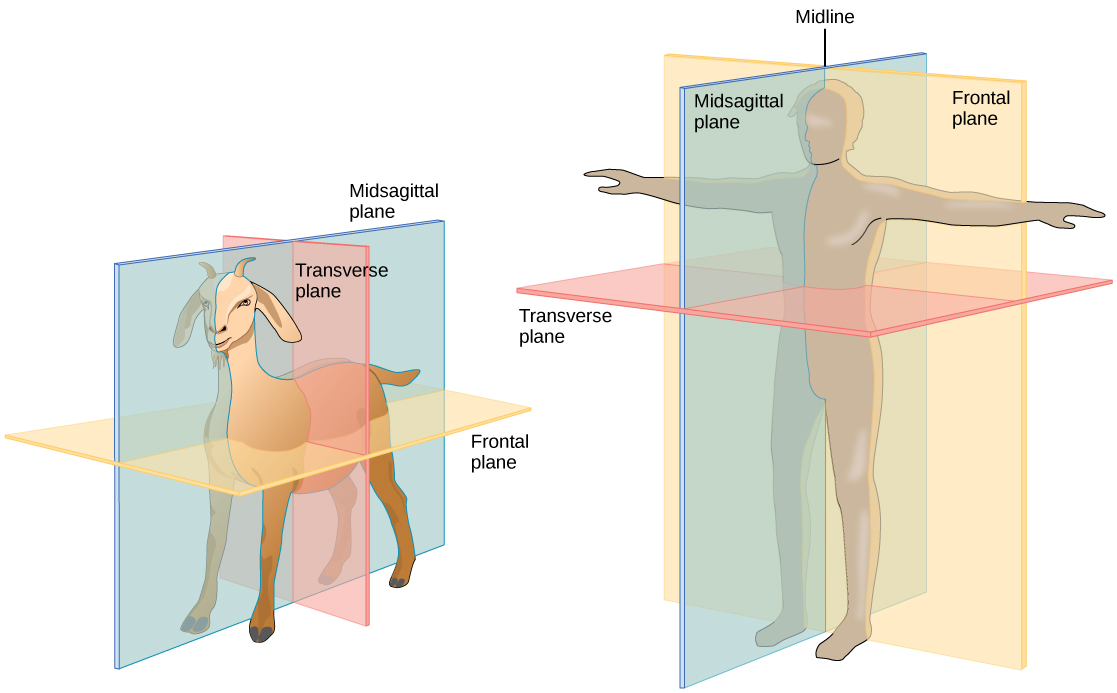
Figure 33.5図 33.5
Shown are the planes of a quadrupedal goat and a bipedal human. The midsagittal plane divides the body exactly in half, into right and left portions. The frontal plane divides the front and back, and the transverse plane divides the body into upper and lower portions.
四足歩行のヤギと二足歩行のヒトの体を分ける面。正中矢状面は体を正確に半分ずつ、左右に分ける。前額面は前後を分け、横断面は体を上部と下部に分ける。
Vertebrate animals have a number of defined body cavities, as illustrated in Figure 33.6. Two of these are major cavities that contain smaller cavities within them. The dorsal cavity contains the cranial and the vertebral (or spinal) cavities. The ventral cavity contains the thoracic cavity, which in turn contains the pleural cavity around the lungs and the pericardial cavity, which surrounds the heart. The ventral cavity also contains the abdominopelvic cavity, which can be separated into the abdominal and the pelvic cavities.
脊椎動物には、図33.6に示すような、いくつかの区別される体腔がある。そのうち二つは、内部に小さな腔を含む主要な体腔である。背側体腔には、頭蓋腔と脊柱腔(脊髄腔)が含まれる。腹側体腔には胸腔があり、その胸腔には肺の周囲の胸膜腔と、心臓を囲む心膜腔が含まれる。腹側体腔には腹骨盤腔もあり、これは腹腔と骨盤腔に分けられる。
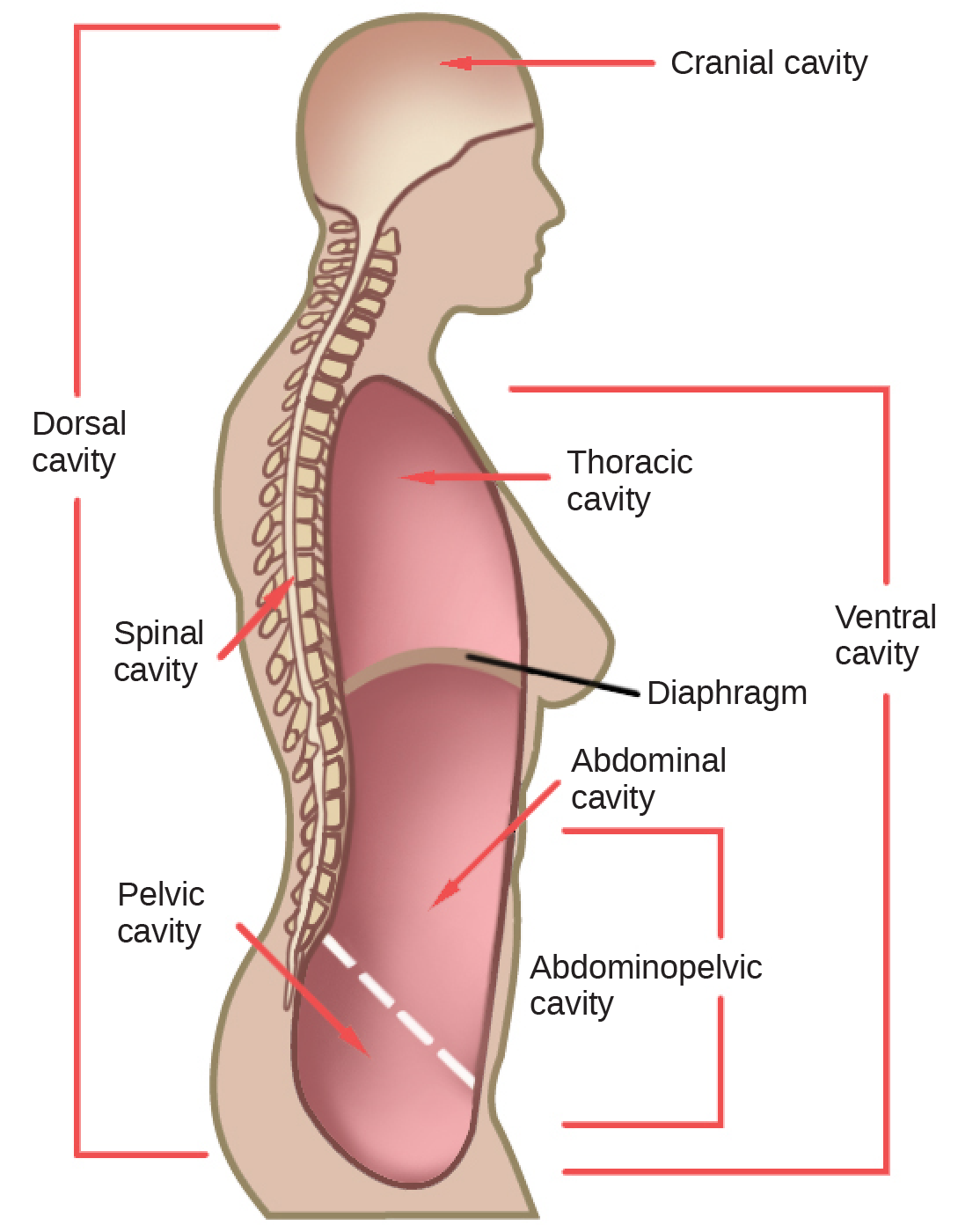


Figure 33.6図 33.6
Vertebrate animals have two major body cavities. The dorsal cavity contains the cranial and the spinal cavity. The ventral cavity contains the thoracic cavity and the abdominopelvic cavity. The thoracic cavity is separated from the abdominopelvic cavity by the diaphragm. The abdominopelvic cavity is separated into the abdominal cavity and the pelvic cavity by an imaginary line parallel to the pelvis bones. (credit: modification of work by NCI)
脊椎動物には二つの主要な体腔がある。背側体腔は頭蓋腔と脊髄腔を含み、腹側体腔は胸腔と腹骨盤腔を含む。胸腔と腹骨盤腔は横隔膜で隔てられる。腹骨盤腔は、骨盤の骨に平行な想像上の線によって、腹腔と骨盤腔に分けられる。(クレジット:NCIの作品を改変)