第33章動物の体:基本的な形態と機能
Set Point設定値
It is possible to adjust a system’s set point. When this happens, the feedback loop works to maintain the new setting. An example of this is blood pressure: over time, the normal or set point for blood pressure can increase as a result of continued increases in blood pressure. The body no longer recognizes the elevation as abnormal and no attempt is made to return to the lower set point. The result is the maintenance of an elevated blood pressure that can have harmful effects on the body. Medication can lower blood pressure and lower the set point in the system to a more healthy level. This is called a process of alteration of the set point in a feedback loop.
英語のヒント
系の設定値は調整されることがある。その場合、フィードバック回路は新たな設定を維持するように働く。例として血圧がある。血圧の上昇が続くと、時間の経過とともに、血圧の正常値すなわち設定値が高くなることがある。体はその上昇を異常と認識しなくなり、より低い設定値に戻そうとしなくなる。その結果、体に有害な影響を与えうる高い血圧が維持される。薬物療法は血圧を下げ、系の設定値をより健康な水準へ下げることができる。これを、フィードバック回路の設定値変更の過程という。
Changes can be made in a group of body organ systems in order to maintain a set point in another system. This is called acclimatization. This occurs, for instance, when an animal migrates to a higher altitude than that to which it is accustomed. In order to adjust to the lower oxygen levels at the new altitude, the body increases the number of red blood cells circulating in the blood to ensure adequate oxygen delivery to the tissues. Another example of acclimatization is animals that have seasonal changes in their coats: a heavier coat in the winter ensures adequate heat retention, and a light coat in summer assists in keeping body temperature from rising to harmful levels.
英語のヒント
ある系の設定値を維持するため、体の別の器官系の一群に変化が起こることがある。これを順化という。例えば、動物が慣れ親しんだ場所より標高の高い場所へ移動するときに起こる。新たな標高における低い酸素濃度に適応するため、体は血中を循環する赤血球の数を増やし、組織への十分な酸素供給を確保する。順化の別の例は、季節によって被毛が変化する動物である。冬の厚い被毛は十分な保温を確保し、夏の薄い被毛は体温が有害な水準まで上がるのを防ぐ助けになる。
Homeostasis: Thermoregulation恒常性:体温調節
Body temperature affects body activities. Generally, as body temperature rises, enzyme activity rises as well. For every ten degree centigrade rise in temperature, enzyme activity doubles, up to a point. Body proteins, including enzymes, begin to denature and lose their function with high heat (around 50oC for mammals). Enzyme activity will decrease by half for every ten degree centigrade drop in temperature, to the point of freezing, with a few exceptions. Some fish can withstand freezing solid and return to normal with thawing.
英語のヒント
体温は体の活動に影響する。一般に、体温が上がると酵素活性も上がる。ある限度までは、温度が摂氏10度上がるごとに酵素活性は2倍になる。酵素を含む体のタンパク質は、高温(哺乳類では約50oC)で変性し始め、機能を失う。一部の例外を除き、温度が摂氏10度下がるごとに、凍結する温度に至るまで酵素活性は半分になる。魚の中には、完全に凍結しても耐え、解凍とともに正常な状態へ戻るものがいる。
Endotherms and Ectotherms内温動物と外温動物
Animals can be divided into two groups: some maintain a constant body temperature in the face of differing environmental temperatures, while others have a body temperature that is the same as their environment and thus varies with the environment. Animals that rely on external temperatures to set their body temperature are ectotherms. This group has been called cold-blooded, but the term may not apply to an animal in the desert with a very warm body temperature. In contrast to ectotherms, poikilotherms are animals with constantly varying internal temperatures. An animal that maintains a constant body temperature in the face of environmental changes is called a homeotherm. Endotherms are animals that rely on internal sources for maintenance of relatively constant body temperature in varying environmental temperatures. These animals are able to maintain a level of metabolic activity in cooler external temperatures, which an ectotherm cannot due to differing enzyme levels of activity. It is worth mentioning that some ectotherms and poikilotherms have relatively constant body temperatures due to the constant environmental temperatures in their habitats. These animals are so-called ectothermic homeotherms, like some deep sea fish species.
英語のヒント
動物は二つの群に分けられる。環境温度が変わっても一定の体温を維持するものと、体温が環境温度と同じで、環境に伴って変化するものである。体温を決めるのを外部の温度に頼る動物は外温動物である。この群は冷血動物とも呼ばれてきたが、砂漠で体温が非常に高くなっている動物には、この呼び名は当てはまらないかもしれない。外温動物という呼び方に対し、変温動物とは体内の温度が絶えず変化する動物である。環境が変化しても一定の体温を維持する動物は恒温動物と呼ばれる。内温動物は、環境温度が変化しても比較的一定の体温を維持するために、体内の熱源に頼る動物である。これらの動物は、外気温が低くても一定の代謝活動を維持できるが、外温動物は酵素活性の水準が異なるため、それができない。外温動物や変温動物の中にも、生息環境の温度が一定であるために、比較的一定の体温を保つものがいる。深海魚の一部などがその例で、こうした動物はいわゆる外温性の恒温動物である。
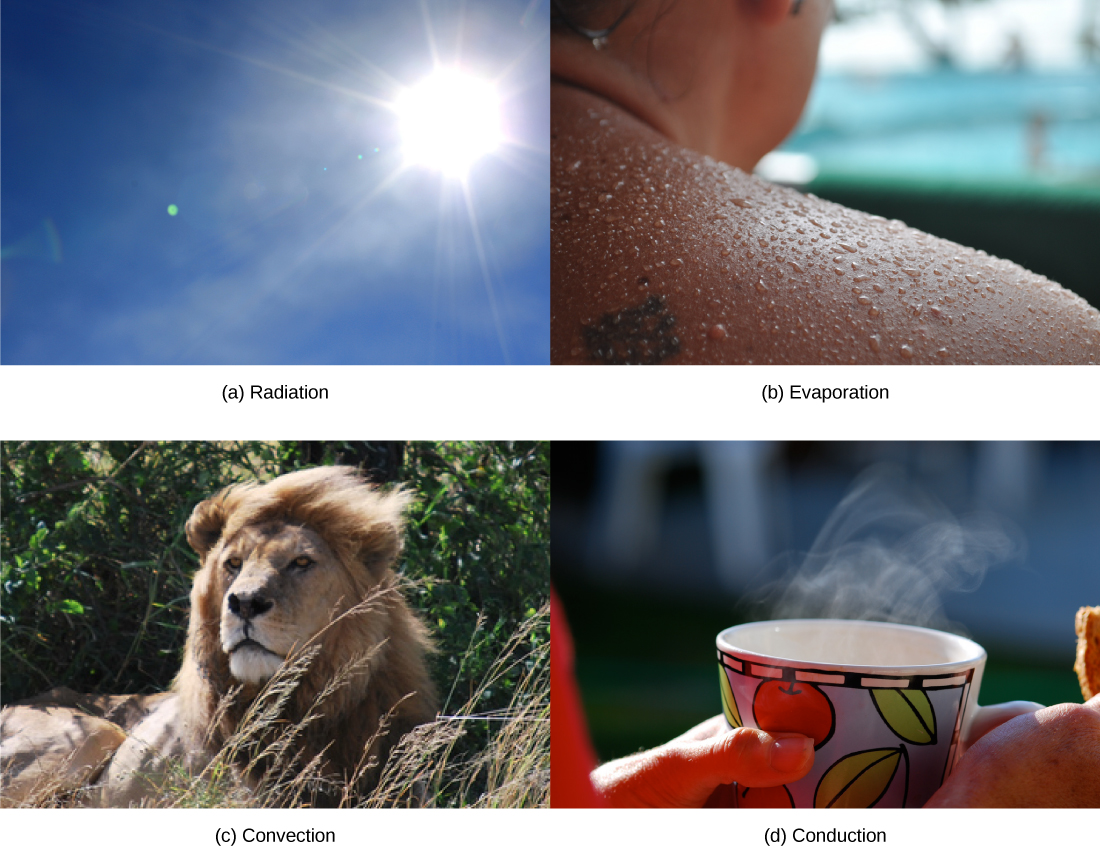
Heat can be exchanged between an animal and its environment through four mechanisms: radiation, evaporation, convection, and conduction (Figure 33.22). Radiation is the emission of electromagnetic “heat” waves. Heat comes from the sun in this manner and radiates from dry skin the same way. Heat can be removed with liquid from a surface during evaporation. This occurs when a mammal sweats. Convection currents of air remove heat from the surface of dry skin as the air passes over it. Heat will be conducted from one surface to another during direct contact with the surfaces, such as an animal resting on a warm rock.
英語のヒント
動物と環境の間の熱交換には、放射、蒸発、対流、伝導という四つの仕組みがある(図33.22)。放射とは、電磁波の「熱」波を放出することである。太陽からの熱はこの方法で届き、乾いた皮膚からも同じように放射される。蒸発の際には、液体とともに表面から熱が奪われる。哺乳類が汗をかくときに起こるのがこれである。対流する空気は、乾いた皮膚の表面を通過する際に熱を奪う。表面どうしが直接触れていると、熱は一方の表面から他方へ伝導する。動物が温かい岩の上で休む場合などがその例である。
OpenStax, Rice University; Biology 2e. (credit b: modification of work by “Kullez”/Flickr; credit c: modification of work by Chad Rosenthal; credit d: modification of work by “stacey.d”/Flickr) · CC BY 4.0 · Source出典

Figure 33.22図 33.22
Heat can be exchanged by four mechanisms: (a) radiation, (b) evaporation, (c) convection, or (d) conduction. (credit b: modification of work by “Kullez”/Flickr; credit c: modification of work by Chad Rosenthal; credit d: modification of work by “stacey.d”/Flickr)
熱は、(a)放射、(b)蒸発、(c)対流、(d)伝導という四つの仕組みで交換される。(クレジットb:「Kullez」/Flickrの作品を改変、c:Chad Rosenthalの作品を改変、d:「stacey.d」/Flickrの作品を改変)