第17章バイオテクノロジーとゲノミクス
17.5 Genomics and Proteomics17.5 ゲノミクスとプロテオミクス
Learning Objectives学習目標
By the end of this section, you will be able to do the following:
この節を終えると、次のことができるようになる。
- Explain systems biologyシステム生物学を説明する。
- Describe a proteomeプロテオームを説明する。
- Define protein signatureタンパク質シグネチャーを定義する。
Proteins are the final products of genes, which help perform the function that the gene encodes. Amino acids comprise proteins and play important roles in the cell. All enzymes (except ribozymes) are proteins that act as catalysts to affect the rate of reactions. Proteins are also regulatory molecules, and some are hormones. Transport proteins, such as hemoglobin, help transport oxygen to various organs. Antibodies that defend against foreign particles are also proteins. In the diseased state, protein function can be impaired because of changes at the genetic level or because of direct impact on a specific protein.
英語のヒント
タンパク質は遺伝子の最終産物であり、その遺伝子がコードする機能の実行を助ける。タンパク質はアミノ酸からなり、細胞内で重要な役割を果たす。リボザイムを除くすべての酵素はタンパク質であり、触媒として作用して反応速度に影響する。タンパク質には調節分子としての役割もあり、一部はホルモンである。ヘモグロビンなどの輸送タンパク質は、酸素をさまざまな器官へ運ぶのを助ける。異物を防ぐ抗体もタンパク質である。病気の状態では、遺伝子レベルの変化や、特定のタンパク質への直接の影響によって、タンパク質の機能が損なわれることがある。
A proteome is the entire set of proteins that a cell type produces. We can study proteoms using the knowledge of genomes because genes code for mRNAs, and the mRNAs encode proteins. Although mRNA analysis is a step in the right direction, not all mRNAs are translated into proteins. Proteomics is the study of proteomes' function. Proteomics complements genomics and is useful when scientists want to test their hypotheses that they based on genes. Even though all multicellular organisms' cells have the same set of genes, the set of proteins produced in different tissues is different and dependent on gene expression. Thus, the genome is constant, but the proteome varies and is dynamic within an organism. In addition, RNAs can be alternately spliced (cut and pasted to create novel combinations and novel proteins) and many proteins modify themselves after translation by processes such as proteolytic cleavage, phosphorylation, glycosylation, and ubiquitination. There are also protein-protein interactions, which complicate studying proteomes. Although the genome provides a blueprint, the final architecture depends on several factors that can change the progression of events that generate the proteome.
英語のヒント
プロテオームは、ある細胞型が作るタンパク質の全体である。遺伝子はmRNAをコードし、mRNAはタンパク質をコードするため、ゲノムの知識を使ってプロテオームを研究できる。mRNAの分析は正しい方向への一歩だが、すべてのmRNAがタンパク質へ翻訳されるわけではない。プロテオミクスは、プロテオームの機能を研究するものである。これはゲノミクスを補い、遺伝子に基づいて立てた仮説を検証したいときに役立つ。多細胞生物のすべての細胞は同じ遺伝子の一式をもつが、組織ごとに作られるタンパク質の一式は異なり、遺伝子発現に依存する。したがって、一つの生物の中でゲノムは一定だが、プロテオームは変化し、動的である。さらに、RNAは選択的にスプライシングされることがあり(切り貼りによって新しい組み合わせやタンパク質を作る)、多くのタンパク質は翻訳後に、タンパク質分解による切断、リン酸化、グリコシル化、ユビキチン化などの過程で修飾される。タンパク質どうしの相互作用もあり、プロテオームの研究を複雑にする。ゲノムは設計図を与えるが、最終的な構造は、プロテオームを生み出す出来事の進み方を変えうる、いくつもの要因に依存する。
Metabolomics is related to genomics and proteomics. Metabolomics involves studying small molecule metabolites in an organism. The metabolome is the complete set of metabolites that are related to an organism's genetic makeup. Metabolomics offers an opportunity to compare genetic makeup and physical characteristics, as well as genetic makeup and environmental factors. The goal of metabolome research is to identify, quantify, and catalogue all the metabolites in living organisms' tissues and fluids.
英語のヒント
メタボロミクスは、ゲノミクスやプロテオミクスと関連している。メタボロミクスでは、生物内の小分子の代謝物を研究する。メタボロームは、生物の遺伝的構成に関係する代謝物の全体である。メタボロミクスは、遺伝的構成と身体的特徴、また遺伝的構成と環境要因を比較する機会を提供する。メタボローム研究の目標は、生物の組織や体液中にあるすべての代謝物を同定し、定量し、目録にすることである。
Basic Techniques in Protein Analysisタンパク質分析の基本技術
The ultimate goal of proteomics is to identify or compare the proteins expressed from a given genome under specific conditions, study the interactions between the proteins, and use the information to predict cell behavior or develop drug targets. Just as scientists analyze the genome using the basic DNA sequencing technique, proteomics requires techniques for protein analysis. The basic technique for protein analysis, analogous to DNA sequencing, is mass spectrometry. Mass spectrometry identifies and determines a molecule's characteristics. Advances in spectrometry have allowed researchers to analyze very small protein samples. X-ray crystallography, for example, enables scientists to determine a protein crystal's three-dimensional structure at atomic resolution. Another protein imaging technique, nuclear magnetic resonance (NMR), uses atoms' magnetic properties to determine the protein's three-dimensional structure in aqueous solution. Scientists have also used protein microarrays to study protein interactions. Large-scale adaptations of the basic two-hybrid screen (Figure 17.17) have provided the basis for protein microarrays. Scientists use computer software to analyze the vast amount of data for proteomic analysis.
英語のヒント
プロテオミクスの最終的な目標は、特定の条件下で、あるゲノムから発現するタンパク質を同定・比較し、タンパク質間の相互作用を調べ、その情報を使って細胞の挙動を予測したり、薬の標的を開発したりすることである。基本的なDNA配列決定技術でゲノムを分析するのと同じように、プロテオミクスにはタンパク質分析の技術が必要である。DNAの配列決定に相当する、タンパク質分析の基本技術は質量分析である。質量分析は、分子を同定し、その特徴を明らかにする。分析技術の進歩によって、非常に少量のタンパク質試料を分析できるようになった。例えばX線結晶構造解析では、タンパク質結晶の三次元構造を、原子の分解能で決定できる。別のタンパク質構造解析技術である核磁気共鳴(NMR)は、原子の磁気的性質を利用し、水溶液中のタンパク質の三次元構造を決める。タンパク質の相互作用の研究には、タンパク質マイクロアレイも使われてきた。基本的なツーハイブリッド・スクリーニング(図17.17)を大規模化したものが、タンパク質マイクロアレイの基礎となっている。プロテオーム解析の膨大なデータの分析には、コンピューターソフトウェアを使う。
Genomic- and proteomic-scale analyses are part of systems biology, which is the study of whole biological systems (genomes and proteomes) based on interactions within the system. The European Bioinformatics Institute and the Human Proteome Organization (HUPO) are developing and establishing effective tools to sort through the enormous pile of systems biology data. Because proteins are the direct products of genes and reflect activity at the genomic level, it is natural to use proteomes to compare the protein profiles of different cells to identify proteins and genes involved in disease processes. Most pharmaceutical drug trials target proteins. Researchers use information that they obtain from proteomics to identify novel drugs and to understand their mechanisms of action.
英語のヒント
ゲノム規模やプロテオーム規模の解析は、システム生物学の一部である。システム生物学は、システム内の相互作用に基づいて、生物学的システム全体(ゲノムやプロテオーム)を研究する。欧州バイオインフォマティクス研究所とヒトプロテオーム機構(HUPO)は、システム生物学の膨大なデータを整理する有効なツールを開発・確立している。タンパク質は遺伝子の直接の産物であり、ゲノムレベルの活動を反映するため、プロテオームを使って異なる細胞のタンパク質パターンを比較し、病気の過程に関与するタンパク質や遺伝子を同定するのは自然なことである。医薬品の試験の多くは、タンパク質を標的とする。研究者はプロテオミクスから得た情報を用いて、新薬を見つけ、その作用機序を理解する。
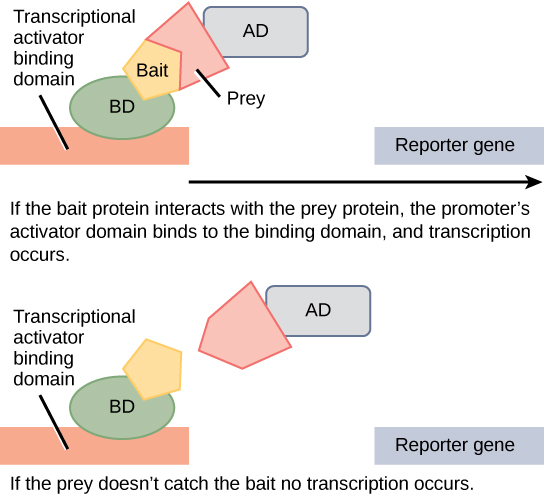

Figure 17.17図 17.17
Scientists use two-hybrid screening to determine whether two proteins interact. In this method, a transcription factor splits into a DNA-binding domain (BD) and an activator domain (AD). The binding domain is able to bind the promoter in the activator domain's absence, but it does not turn on transcription. The bait protein attaches to the BD, and the prey protein attaches to the AD. Transcription occurs only if the prey “catches” the bait.
英語のヒント
ツーハイブリッド・スクリーニングは、二つのタンパク質が相互作用するかどうかを調べるために使う。この方法では、転写因子をDNA結合ドメイン(BD)と活性化ドメイン(AD)に分ける。結合ドメインは、活性化ドメインがなくてもプロモーターに結合できるが、転写はオンにしない。ベイトタンパク質をBDに、プレイタンパク質をADに付ける。転写が起こるのは、プレイがベイトを「捕らえた」場合だけである。
Scientists are challenged when implementing proteomic analysis because it is difficult to detect small protein quantities. Although mass spectrometry is good for detecting small protein amounts, variations in protein expression in diseased states can be difficult to discern. Proteins are naturally unstable molecules, which makes proteomic analysis much more difficult than genomic analysis.
英語のヒント
プロテオーム解析の実施には難しさがある。少量のタンパク質を検出するのが難しいためである。質量分析は少量のタンパク質の検出に優れているが、病気の状態でのタンパク質発現の変化を見分けるのは難しいことがある。タンパク質は本来不安定な分子であり、そのためプロテオーム解析はゲノム解析よりはるかに難しくなる。