第17章バイオテクノロジーとゲノミクス
Genetic Engineering遺伝子工学
Genetic engineering is the alteration of an organism’s genotype using recombinant DNA technology to modify an organism’s DNA to achieve desirable traits. The addition of foreign DNA in the form of recombinant DNA vectors generated by molecular cloning is the most common method of genetic engineering. The organism that receives the recombinant DNA is a genetically modified organism (GMO). If the foreign DNA comes from a different species, the host organism is transgenic. Scientists have genetically modified bacteria, plants, and animals since the early 1970s for academic, medical, agricultural, and industrial purposes. In the US, GMOs such as Roundup-ready soybeans and borer-resistant corn are part of many common processed foods.
英語のヒント
遺伝子工学とは、望ましい形質を得るために、組換えDNA技術で生物のDNAを改変し、遺伝子型を変えることである。最も一般的な方法は、分子クローニングで作った組換えDNAベクターの形で、外来DNAを加えることである。組換えDNAを受け取った生物は、遺伝子組換え生物(GMO)である。外来DNAが別の種に由来する場合、その宿主生物はトランスジェニックであるという。科学者は1970年代初め以来、学術、医療、農業、工業の目的で、細菌、植物、動物を遺伝子改変してきた。米国では、ラウンドアップ耐性ダイズや穿孔性害虫に抵抗性をもつトウモロコシなどのGMOが、多くの一般的な加工食品に含まれている。
Gene Targeting遺伝子ターゲティング
Although classical methods of studying gene function began with a given phenotype and determined the genetic basis of that phenotype, modern techniques allow researchers to start at the DNA sequence level and ask: "What does this gene or DNA element do?" This technique, reverse genetics, has resulted in reversing the classic genetic methodology. This method would be similar to damaging a body part to determine its function. An insect that loses a wing cannot fly, which means that the wing's function is flight. The classical genetic method would compare insects that cannot fly with insects that can fly, and observe that the non-flying insects have lost wings. Similarly, mutating or deleting genes provides researchers with clues about gene function. We collectively call the methods they use to disable gene function gene targeting. Gene targeting is the use of recombinant DNA vectors to alter a particular gene's expression, either by introducing mutations in a gene, or by eliminating a certain gene's expression by deleting a part or all of the gene sequence from the organism's genome.
英語のヒント
遺伝子機能を調べる古典的な方法は、ある表現型から出発し、その表現型の遺伝的基盤を明らかにするものだった。それに対し、現代の技術では、DNA配列の段階から出発して、「この遺伝子やDNAエレメントは何をするのか」と問うことができる。この逆遺伝学という技術は、古典的な遺伝学の方法を逆転させた。これは、体の一部を傷つけて、その機能を明らかにする方法に似ている。翅を失った昆虫が飛べなくなることから、翅の機能は飛翔だと分かる。古典的な遺伝学の方法なら、飛べない昆虫を飛べる昆虫と比較し、飛べない昆虫が翅を失っていることを観察するだろう。同じように、遺伝子に変異を起こしたり、遺伝子を削除したりすると、遺伝子の機能に関する手がかりが得られる。遺伝子機能を失わせるための方法を、まとめて遺伝子ターゲティングと呼ぶ。これは組換えDNAベクターを使って特定の遺伝子の発現を変えるもので、遺伝子に変異を導入するか、ゲノムから遺伝子配列の一部または全部を削除して、その遺伝子の発現をなくす。
Biotechnology in Medicine and Agriculture医療と農業におけるバイオテクノロジー
It is easy to see how biotechnology can be used for medicinal purposes. Knowledge of the genetic makeup of our species, the genetic basis of heritable diseases, and the invention of technology to manipulate and fix mutant genes provides methods to treat disease. Biotechnology in agriculture can enhance resistance to disease, pest, and environmental stress, and improve both crop yield and quality.
英語のヒント
バイオテクノロジーが医療目的に利用できることは、理解しやすい。私たちの種の遺伝的構成や遺伝性疾患の遺伝的基盤に関する知識と、変異した遺伝子を操作・修復する技術の発明は、病気を治療する方法をもたらす。農業のバイオテクノロジーは、病気、害虫、環境ストレスに対する抵抗性を高め、作物の収量と品質の両方を改善できる。
Genetic Diagnosis and Gene Therapy遺伝子診断と遺伝子治療
Scientists call the process of testing for suspected genetic defects before administering treatment genetic diagnosis by genetic testing. Depending on the inheritance patterns of a disease-causing gene, family members are advised to undergo genetic testing. For example, doctors usually advise people diagnosed with breast cancer to have a biopsy so that the medical team can determine the genetic basis of cancer development. Doctors base treatment plans on genetic test findings that determine the type of cancer. If inherited gene mutations cause the cancer, doctors also advise other female relatives to undergo genetic testing and periodic screening for breast cancer. Doctors also offer genetic testing for fetuses (or embryos with in vitro fertilization) to determine the presence or absence of disease-causing genes in families with specific debilitating diseases.
英語のヒント
治療を行う前に、疑われる遺伝的異常を検査する過程を、遺伝子検査による遺伝子診断という。病気を引き起こす遺伝子の遺伝形式によっては、家族にも遺伝子検査が勧められる。例えば、乳がんと診断された人には通常、がんの発生の遺伝的基盤を医療チームが明らかにできるよう、生検が勧められる。医師は、がんの種類を特定する遺伝子検査の結果に基づいて、治療計画を立てる。受け継がれた遺伝子変異ががんの原因である場合、ほかの女性の親族にも、遺伝子検査や定期的な乳がん検診を勧める。また、特定の重い疾患をもつ家系では、原因遺伝子が存在するかどうかを調べるために、胎児(または体外受精で得た胚)の遺伝子検査も提供される。
Gene therapy is a genetic engineering technique used to cure disease. In its simplest form, it involves the introduction of a good gene at a random location in the genome to aid the cure of a disease that is caused by a mutated gene. The good gene is usually introduced into diseased cells as part of a vector transmitted by a virus that can infect the host cell and deliver the foreign DNA (Figure 17.9). More advanced forms of gene therapy try to correct the mutation at the original site in the genome, such as is the case with treatment of severe combined immunodeficiency (SCID).
英語のヒント
遺伝子治療は、病気を治すために使う遺伝子工学の技術である。最も単純な形では、ゲノムの無作為な位置に正常な遺伝子を導入し、変異した遺伝子が原因の病気を治す助けとする。正常な遺伝子は通常、宿主細胞に感染して外来DNAを届けることのできるウイルスで運ばれるベクターの一部として、病気の細胞へ導入される(図17.9)。より進んだ遺伝子治療では、重症複合免疫不全症(SCID)の治療の場合のように、ゲノム上の元の位置で変異を修正しようとする。
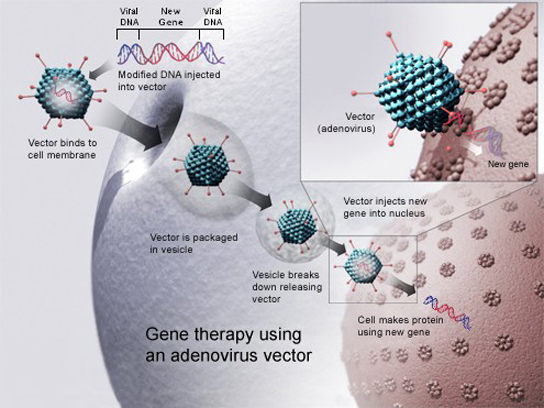

Figure 17.9図 17.9
Gene therapy using an adenovirus vector can be used to cure certain genetic diseases in which a person has a defective gene. (credit: NIH)
英語のヒント
アデノウイルスベクターを用いる遺伝子治療は、異常な遺伝子をもつ人の、特定の遺伝性疾患を治すために利用できる。(クレジット:NIH)
Production of Vaccines, Antibiotics, and Hormonesワクチン、抗生物質、ホルモンの生産
Traditional vaccination strategies use weakened or inactive forms of microorganisms to mount the initial immune response. Modern techniques use the genes of microorganisms cloned into vectors to mass produce the desired antigen. Doctors then introduce the antigen into the body to stimulate the primary immune response and trigger immune memory. The medical field has used genes cloned from the influenza virus to combat the constantly changing strains of this virus.
英語のヒント
従来のワクチン接種では、弱毒化した、または不活性化した微生物を用いて、最初の免疫応答を起こさせる。現代の技術では、微生物の遺伝子をベクターへクローニングし、目的の抗原を大量生産する。医師はその抗原を体内へ導入して一次免疫応答を刺激し、免疫記憶を生じさせる。医学では、絶えず変化するインフルエンザウイルスの株に対処するため、そのウイルスからクローニングした遺伝子を利用してきた。
Antibiotics are a biotechnological product. Microorganisms, such as fungi, naturally produce them to attain an advantage over bacterial populations. Cultivating and manipulating fungal cells produces antibiotics.
英語のヒント
抗生物質は、バイオテクノロジーの産物である。菌類などの微生物は、細菌集団に対して有利になるため、自然に抗生物質を作る。菌類の細胞を培養・操作することで、抗生物質が生産される。
Scientists used recombinant DNA technology to produce large-scale quantities of human insulin in E. coli as early as 1978. Previously, it was only possible to treat diabetes with pig insulin, which caused allergic reactions in humans because of differences in the gene product. In addition, doctors use human growth hormone (HGH) to treat growth disorders in children. Researchers cloned the HGH gene from a cDNA library and inserted it into E. coli cells by cloning it into a bacterial vector.
英語のヒント
科学者は早くも1978年に、組換えDNA技術を用いて、大腸菌でヒトのインスリンを大量に生産した。それ以前は、糖尿病の治療にはブタのインスリンを使うしかなく、遺伝子産物の違いのため、ヒトではアレルギー反応が起きた。また、医師は子どもの成長障害の治療に、ヒト成長ホルモン(HGH)を用いる。研究者はcDNAライブラリーからHGH遺伝子をクローニングし、細菌のベクターへ組み込むことによって大腸菌の細胞へ導入した。