第17章バイオテクノロジーとゲノミクス
Nucleic Acid Fragment Amplification by Polymerase Chain Reactionポリメラーゼ連鎖反応による核酸断片の増幅
Although genomic DNA is visible to the naked eye when it is extracted in bulk, DNA analysis often requires focusing on one or more specific genome regions. Polymerase chain reaction (PCR) is a technique that scientists use to amplify specific DNA regions for further analysis (Figure 17.5). Researchers use PCR for many purposes in laboratories, such as cloning gene fragments to analyze genetic diseases, identifying contaminant foreign DNA in a sample, and amplifying DNA for sequencing. More practical applications include determining paternity and detecting genetic diseases.
英語のヒント
ゲノムDNAは大量に抽出すると肉眼で見えるが、DNA分析では、ゲノムの一つ以上の特定領域に注目する必要があることが多い。ポリメラーゼ連鎖反応(PCR)は、さらに分析するために特定のDNA領域を増幅する技術である(図17.5)。研究者は実験室で、遺伝性疾患を分析するための遺伝子断片のクローニング、試料に混入した外来DNAの同定、塩基配列を決定するためのDNA増幅など、さまざまな目的にPCRを使う。より実用的な応用には、父子関係の判定や遺伝性疾患の検出がある。
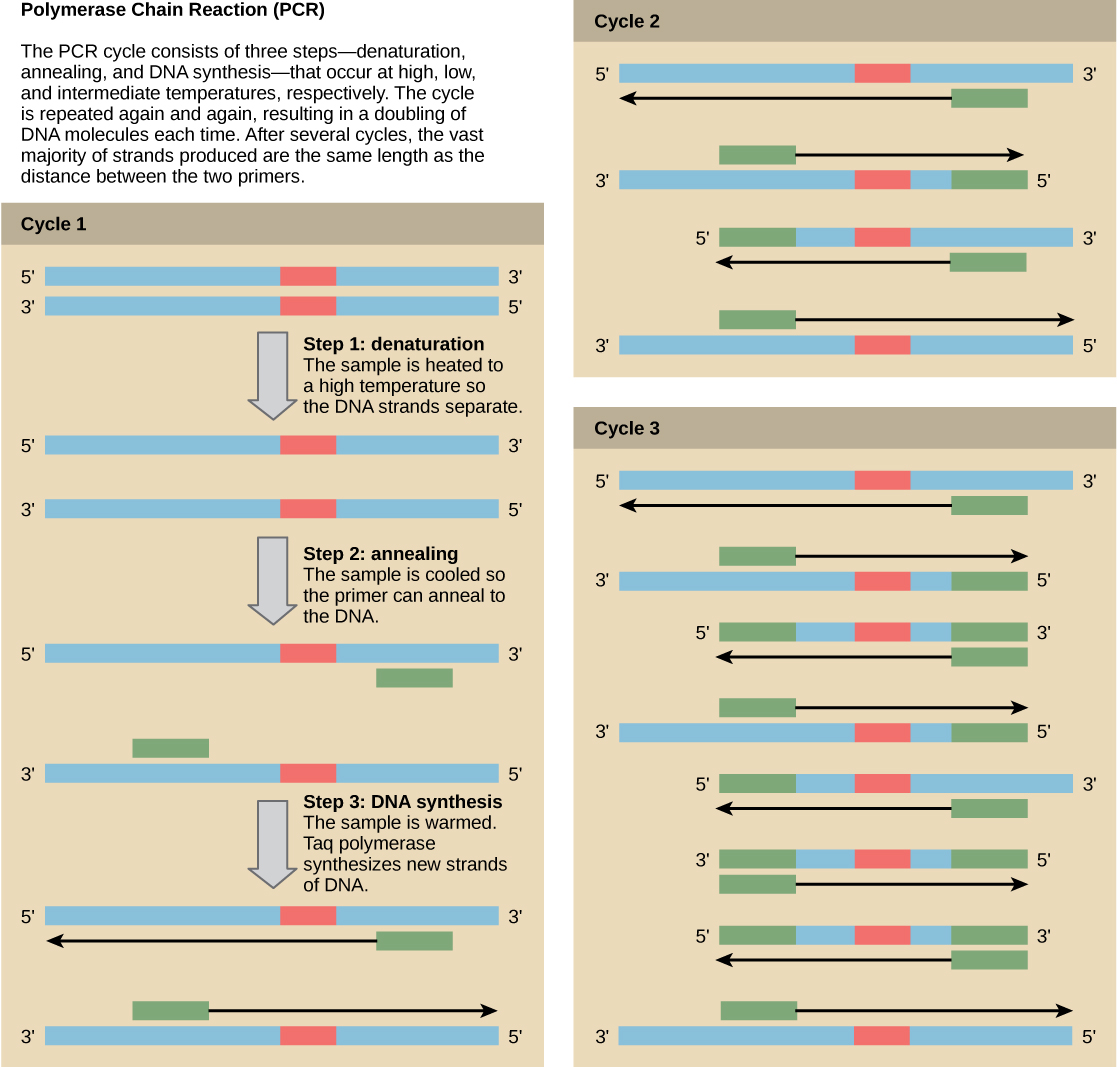
Figure 17.5図 17.5
Scientists use polymerase chain reaction, or PCR, to amplify a specific DNA sequence. Primers—short pieces of DNA complementary to each end of the target sequence combine with genomic DNA, Taq polymerase, and deoxynucleotides. Taq polymerase is a DNA polymerase isolated from the thermostable bacterium Thermus aquaticus that is able to withstand the high temperatures that scientists use in PCR. Thermus aquaticus grows in the Lower Geyser Basin of Yellowstone National Park. Reverse transcriptase PCR (RT-PCR) is similar to PCR, but cDNA is made from an RNA template before PCR begins.
英語のヒント
科学者は、ポリメラーゼ連鎖反応(PCR)を用いて、特定のDNA配列を増幅する。標的配列の両端にそれぞれ相補的な短いDNA断片であるプライマーを、ゲノムDNA、Taqポリメラーゼ、デオキシヌクレオチドと合わせる。Taqポリメラーゼは、耐熱性細菌Thermus aquaticusから単離されたDNAポリメラーゼであり、PCRで用いられる高温に耐えられる。Thermus aquaticusは、イエローストーン国立公園のローワー・ガイザー・ベイスンに生息する。逆転写酵素PCR(RT-PCR)はPCRと似ているが、PCRを始める前にRNAを鋳型としてcDNAを作る。
DNA fragments can also be amplified from an RNA template in a process called reverse transcriptase PCR (RT-PCR). The first step is to recreate the original DNA template strand (called cDNA) by applying DNA nucleotides to the mRNA. This process is called reverse transcription. This requires the presence of an enzyme called reverse transcriptase. After the cDNA is made, regular PCR can be used to amplify it.
英語のヒント
DNA断片は、逆転写酵素PCR(RT-PCR)という過程で、RNAを鋳型として増幅することもできる。最初の段階では、mRNAに沿ってDNAヌクレオチドを並べ、元のDNA鋳型鎖を再現する(これをcDNAという)。この過程は逆転写と呼ばれ、逆転写酵素という酵素を必要とする。cDNAを作った後は、通常のPCRでそれを増幅できる。
Hybridization, Southern Blotting, and Northern Blottingハイブリダイゼーション、サザンブロッティング、ノーザンブロッティング
Scientists can probe nucleic acid samples, such as fragmented genomic DNA and RNA extracts, for the presence of certain sequences. Scientists design and label short DNA fragments, or probes with radioactive or fluorescent dyes to aid detection. Gel electrophoresis separates the nucleic acid fragments according to their size. Scientists then transfer the fragments in the gel onto a nylon membrane in a procedure we call blotting (Figure 17.6). Scientists can then probe the nucleic acid fragments that are bound to the membrane's surface with specific radioactively or fluorescently labeled probe sequences. When scientists transfer DNA to a nylon membrane, they refer to the technique as Southern blotting. When they transfer the RNA to a nylon membrane, they call it Northern blotting. Scientists use Southern blots to detect the presence of certain DNA sequences in a given genome, and Northern blots to detect gene expression.
英語のヒント
科学者は、断片化したゲノムDNAやRNA抽出物などの核酸試料を調べ、特定の配列が存在するかどうかを確かめることができる。検出を助けるために、短いDNA断片、すなわちプローブを設計し、放射性物質や蛍光色素で標識する。ゲル電気泳動によって核酸断片を大きさに応じて分離し、次に、ブロッティングと呼ばれる操作で、ゲル内の断片をナイロン膜へ移す(図17.6)。その後、膜表面に結合した核酸断片を、放射性物質や蛍光物質で標識した特異的な配列のプローブで調べることができる。DNAをナイロン膜へ移す技術をサザンブロッティングと呼ぶ。RNAをナイロン膜へ移す場合は、ノーザンブロッティングと呼ぶ。科学者は、あるゲノム内の特定のDNA配列の存在を検出するためにサザンブロットを用い、遺伝子発現を検出するためにノーザンブロットを用いる。
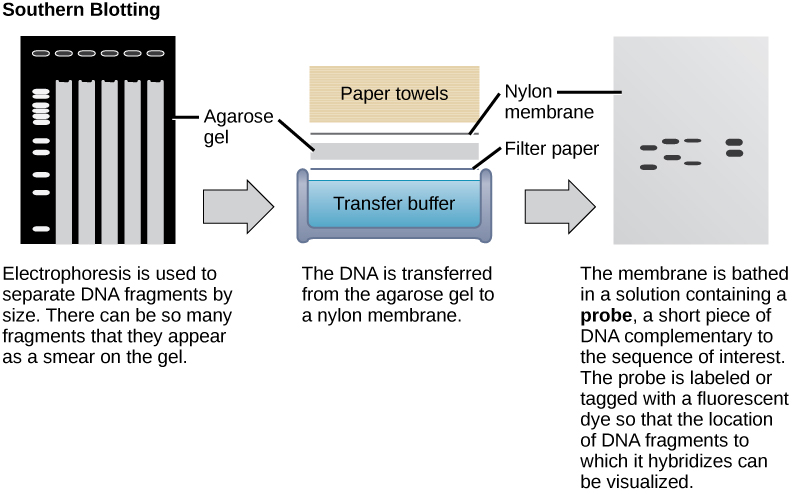


Figure 17.6図 17.6
Scientists use Southern blotting to find a particular sequence in a DNA sample. Scientists separate DNA fragments on a gel, transfer them to a nylon membrane, and incubate them with a DNA probe complementary to the sequence of interest. Northern blotting is similar to Southern blotting, but scientists run RNA on the gel instead of DNA. In Western blotting, scientists run proteins on a gel and detect them using antibodies.
英語のヒント
科学者は、DNA試料内の特定の配列を見つけるためにサザンブロッティングを用いる。DNA断片をゲルで分離し、ナイロン膜へ移し、目的の配列に相補的なDNAプローブとともに反応させる。ノーザンブロッティングはサザンブロッティングと似ているが、DNAの代わりにRNAをゲルで泳動する。ウェスタンブロッティングでは、タンパク質をゲルで泳動し、抗体を使って検出する。
Molecular Cloning分子クローニング
In general, the word “cloning” means the creation of a perfect replica; however, in biology, the re-creation of a whole organism is referred to as “reproductive cloning.” Long before attempts were made to clone an entire organism, researchers learned how to reproduce desired regions or fragments of the genome, a process that is referred to as molecular cloning. The technique offered methods to create new medicines and to overcome difficulties with existing ones. When Lydia Villa-Komaroff, working in the Gilbert Lab at Harvard, published the first paper outlining the technique for producing synthetic insulin, diabetes researchers and patients received new hope in fighting the disease. Insulin at that time was only produced using pig and cow pancreases, and the life-saving substance was often in short supply. Synthetic insulin, once mass produced, would solve that problem for many patients. These early discoveries led to the "BioTech Boom," and spurred continued research and funding for newer and better ways to improve health.
英語のヒント
一般に「クローニング」は完全な複製を作ることを意味するが、生物学では、生物個体全体を再現することを「生殖クローニング」と呼ぶ。生物全体のクローンを作る試みのはるか以前に、研究者はゲノムの目的の領域や断片を複製する方法を学んだ。この過程は分子クローニングと呼ばれる。この技術は、新しい薬を作り、既存の薬の問題を克服する方法をもたらした。ハーバード大学のギルバート研究室で働いていたLydia Villa-Komaroffが、合成インスリンの製造技術を概説する最初の論文を発表したとき、糖尿病の研究者と患者は、この病気と闘うための新たな希望を得た。当時、インスリンはブタやウシの膵臓を使ってのみ生産されており、この命を救う物質はしばしば不足していた。合成インスリンが大量生産されれば、多くの患者にとってこの問題は解決されるはずだった。これらの初期の発見は「バイオテック・ブーム」を生み、健康を改善するための、より新しく優れた方法に向けた継続的な研究と資金提供を促した。
Cloning small genome fragments allows researchers to manipulate and study specific genes (and their protein products), or noncoding regions in isolation. A plasmid, or vector, is a small circular DNA molecule that replicates independently of the chromosomal DNA. In cloning, scientists can use the plasmid molecules to provide a "folder" in which to insert a desired DNA fragment. Plasmids are usually introduced into a bacterial host for proliferation. In the bacterial context, scientists call the DNA fragment from the human genome (or the genome of another studied organism) foreign DNA, or a transgene, to differentiate it from the bacterium's DNA, or the host DNA.
英語のヒント
ゲノムの小さな断片をクローニングすると、特定の遺伝子(とそのタンパク質産物)や非コード領域を、切り離して操作・研究できる。プラスミド、すなわちベクターは、染色体DNAとは独立に複製する、小さな環状DNA分子である。クローニングでは、プラスミド分子を、目的のDNA断片を挿入する「フォルダー」として利用できる。プラスミドは通常、増やすために細菌の宿主へ導入される。細菌を扱う場合、科学者は、ヒトのゲノム(または研究対象となる別の生物のゲノム)に由来するDNA断片を、外来DNAまたは導入遺伝子と呼ぶ。これは、細菌自身のDNA、すなわち宿主DNAと区別するためである。
Plasmids occur naturally in bacterial populations (such as Escherichia coli) and have genes that can contribute favorable traits to the organism, such as antibiotic resistance (the ability to be unaffected by antibiotics). Scientists have repurposed and engineered plasmids as vectors for molecular cloning and the large-scale production of important reagents, such as insulin and human growth hormone. An important feature of plasmid vectors is the ease with which scientists can introduce a foreign DNA fragment via the multiple cloning site (MCS). The MCS is a short DNA sequence containing multiple sites that different commonly available restriction endonucleases can cut. Restriction endonucleases recognize specific DNA sequences and cut them in a predictable manner. They are naturally produced by bacteria as a defense mechanism against foreign DNA. Many restriction endonucleases make staggered cuts in the two DNA strands, such that the cut ends have a 2- or 4-base single-stranded overhang. Because these overhangs are capable of annealing with complementary overhangs, we call them “sticky ends.” Adding the enzyme DNA ligase permanently joins the DNA fragments via phosphodiester bonds. In this way, scientists can splice any DNA fragment generated by restriction endonuclease cleavage between the plasmid DNA's two ends that has been cut with the same restriction endonuclease (Figure 17.7).
英語のヒント
プラスミドは、大腸菌などの細菌集団に自然に存在し、抗生物質耐性(抗生物質の影響を受けない能力)など、生物に有利な形質を与えうる遺伝子をもっている。科学者はプラスミドの用途を変え、改変することで、分子クローニングや、インスリン、ヒト成長ホルモンなどの重要な試薬の大量生産に使うベクターにしてきた。プラスミドベクターの重要な特徴は、マルチクローニングサイト(MCS)を介して、外来DNA断片を容易に導入できることである。MCSは、一般に入手できるさまざまな制限エンドヌクレアーゼで切断できる部位を複数含む、短いDNA配列である。制限エンドヌクレアーゼは、特定のDNA配列を認識し、予測できる仕方で切断する。これらは、外来DNAに対する防御の仕組みとして、細菌が自然に作るものである。多くの制限エンドヌクレアーゼは、DNAの2本の鎖をずれた位置で切るため、切断端には2塩基または4塩基の一本鎖の突出部ができる。この突出部は、相補的な突出部と結合できるため、「粘着末端」と呼ばれる。DNAリガーゼという酵素を加えると、DNA断片どうしがホスホジエステル結合によって恒久的につながる。このようにして、制限エンドヌクレアーゼによる切断で生じたDNA断片を、同じ制限エンドヌクレアーゼで切ったプラスミドDNAの両端の間に、つなぎ込むことができる(図17.7)。