第17章バイオテクノロジーとゲノミクス
17.4 Applying Genomics17.4 ゲノミクスの応用
Learning Objectives学習目標
By the end of this section, you will be able to do the following:
この節を終えると、次のことができるようになる。
- Explain pharmacogenomicsファーマコゲノミクスを説明する。
- Define polygenic多遺伝子的とは何かを定義する。
Introducing DNA sequencing and whole genome sequencing projects, particularly the Human Genome project, has expanded the applicability of DNA sequence information. Many fields, such as metagenomics, pharmacogenomics, and mitochondrial genomics are using genomics. Understanding and finding cures for diseases is the most common application of genomics.
英語のヒント
DNAの塩基配列決定や、特にヒトゲノム計画をはじめとする全ゲノム配列決定プロジェクトの導入により、DNA配列情報の応用範囲は広がった。メタゲノミクス、ファーマコゲノミクス、ミトコンドリアゲノミクスなど、多くの分野がゲノミクスを利用している。最も一般的な応用は、病気を理解し、その治療法を見つけることである。
Predicting Disease Risk at the Individual Level個人の病気のリスクを予測する
Predicting disease risk involves screening currently healthy individuals by genome analysis at the individual level. Health care professionals can recommend intervention with lifestyle changes and drugs before disease onset. However, this approach is most applicable when the problem resides within a single gene defect. Such defects only account for approximately 5 percent of diseases in developed countries. Most of the common diseases, such as heart disease, are multi-factored or polygenic, which is a phenotypic characteristic that involves two or more genes, and also involve environmental factors such as diet. In April 2010, scientists at Stanford University published the genome analysis of a healthy individual (Stephen Quake, a scientist at Stanford University, who had his genome sequenced. The analysis predicted his propensity to acquire various diseases. The medical team performed a risk assessment to analyze Quake’s percentage of risk for 55 different medical conditions. The team found a rare genetic mutation, which showed him to be at risk for sudden heart attack. The results also predicted that Quake had a 23 percent risk of developing prostate cancer and a 1.4 percent risk of developing Alzheimer’s. The scientists used databases and several publications to analyze the genomic data. Even though genomic sequencing is becoming more affordable and analytical tools are becoming more reliable, researchers still must address ethical issues surrounding genomic analysis at a population level.
英語のヒント
病気のリスクを予測するには、現在は健康な人を、個人ごとのゲノム解析で調べる。医療従事者は、発症前に、生活習慣の変更や薬による介入を勧められる。しかし、この方法が最もよく適用できるのは、問題が単一の遺伝子の異常にある場合である。こうした異常が占めるのは、先進国の病気の約5パーセントにすぎない。心臓病などの一般的な病気の多くは、多因子的または多遺伝子的であり、二つ以上の遺伝子が関わる表現型の特徴をもつうえに、食事などの環境要因も関係する。2010年4月、スタンフォード大学の科学者たちは、健康な個人のゲノム解析を発表した。対象は同大学の科学者Stephen Quakeで、自分のゲノムの塩基配列を決定してもらっていた。この解析は、Quakeがさまざまな病気にかかりやすい傾向を予測した。医療チームは、55種類の病態について、Quakeのリスクが何パーセントかを分析するリスク評価を行った。チームはまれな遺伝子変異を見つけ、彼に突然の心臓発作のリスクがあることを示した。また、前立腺がんの発症リスクは23パーセント、アルツハイマー病の発症リスクは1.4パーセントと予測された。科学者たちは、データベースや複数の論文を使ってゲノムデータを分析した。ゲノムの塩基配列決定はより手頃になり、分析ツールの信頼性も高まっているが、研究者はなお、集団レベルのゲノム解析をめぐる倫理的問題に取り組まなければならない。
Pharmacogenomics and Toxicogenomicsファーマコゲノミクスとトキシコゲノミクス
Pharmacogenomics, or toxicogenomics, involves evaluating drug effectiveness and safety on the basis of information from an individual's genomic sequence. We can study genomic responses to drugs using experimental animals (such as laboratory rats or mice) or live cells in the laboratory before embarking on studies with humans. Studying changes in gene expression could provide information about the transcription profile in the drug's presence, which we can use as an early indicator of the potential for toxic effects. For example, genes involved in cellular growth and controlled cell death, when disturbed, could lead to cancerous cell growth. Genome-wide studies can also help to find new genes involved in drug toxicity. Medical professionals can use personal genome sequence information to prescribe medications that will be most effective and least toxic on the basis of the individual patient’s genotype. The gene signatures may not be completely accurate, but medical professionals can test them further before pathologic symptoms arise.
英語のヒント
ファーマコゲノミクス、またはトキシコゲノミクスは、個人のゲノム配列情報に基づいて、薬の有効性と安全性を評価するものである。ヒトを対象とした研究に着手する前に、実験動物(実験用のラットやマウスなど)や、実験室の生きた細胞を用いて、薬に対するゲノムの応答を研究できる。遺伝子発現の変化を調べると、薬が存在するときの転写のパターンに関する情報を得られる可能性がある。これは、毒性が生じる可能性の早期の指標として使える。例えば、細胞の増殖や制御された細胞死に関わる遺伝子が乱れると、がん細胞の増殖につながることがある。ゲノム全体の研究は、薬の毒性に関与する新しい遺伝子を見つける助けにもなる。医療従事者は、個人のゲノム配列情報を使い、その患者の遺伝子型に基づいて、最も効果が高く、最も毒性が低い薬を処方できる。遺伝子の特徴的なパターンは完全に正確とは限らないが、病的な症状が現れる前に、さらに検証することができる。
Microbial Genomics: Metagenomics微生物ゲノミクス:メタゲノミクス
Traditionally, scholars have taught microbiology with the view that it is best to study microorganisms under pure culture conditions. This involves isolating a single cell type and culturing it in the laboratory. Because microorganisms can go through several generations in a matter of hours, their gene expression profiles adapt to the new laboratory environment very quickly. In addition, the vast majority of bacterial species resist culturing in isolation. Most microorganisms do not live as isolated entities, but in microbial communities or biofilms. For all of these reasons, pure culture is not always the best way to study microorganisms. Metagenomics is the study of the collective genomes of multiple species that grow and interact in an environmental niche. Metagenomics can be used to identify new species more rapidly and to analyze the effect of pollutants on the environment (Figure 17.16).
英語のヒント
従来の微生物学では、微生物は純粋培養の条件下で研究するのが最善だという見方で教えられてきた。これは、一種類の細胞を分離して、実験室で培養することである。微生物は数時間のうちに何世代も経ることができるため、その遺伝子発現パターンは新しい実験室環境に非常に速く適応する。さらに、細菌種の大多数は、単独では培養しにくい。多くの微生物は、孤立した存在としてではなく、微生物の群集やバイオフィルムの中で生きている。こうした理由から、純粋培養が常に微生物研究の最善の方法というわけではない。メタゲノミクスは、ある環境内のニッチで生育し、相互作用する複数の種のゲノムを、まとめて研究するものである。新しい種をより速く同定したり、汚染物質が環境に及ぼす影響を分析したりするために使える(図17.16)。
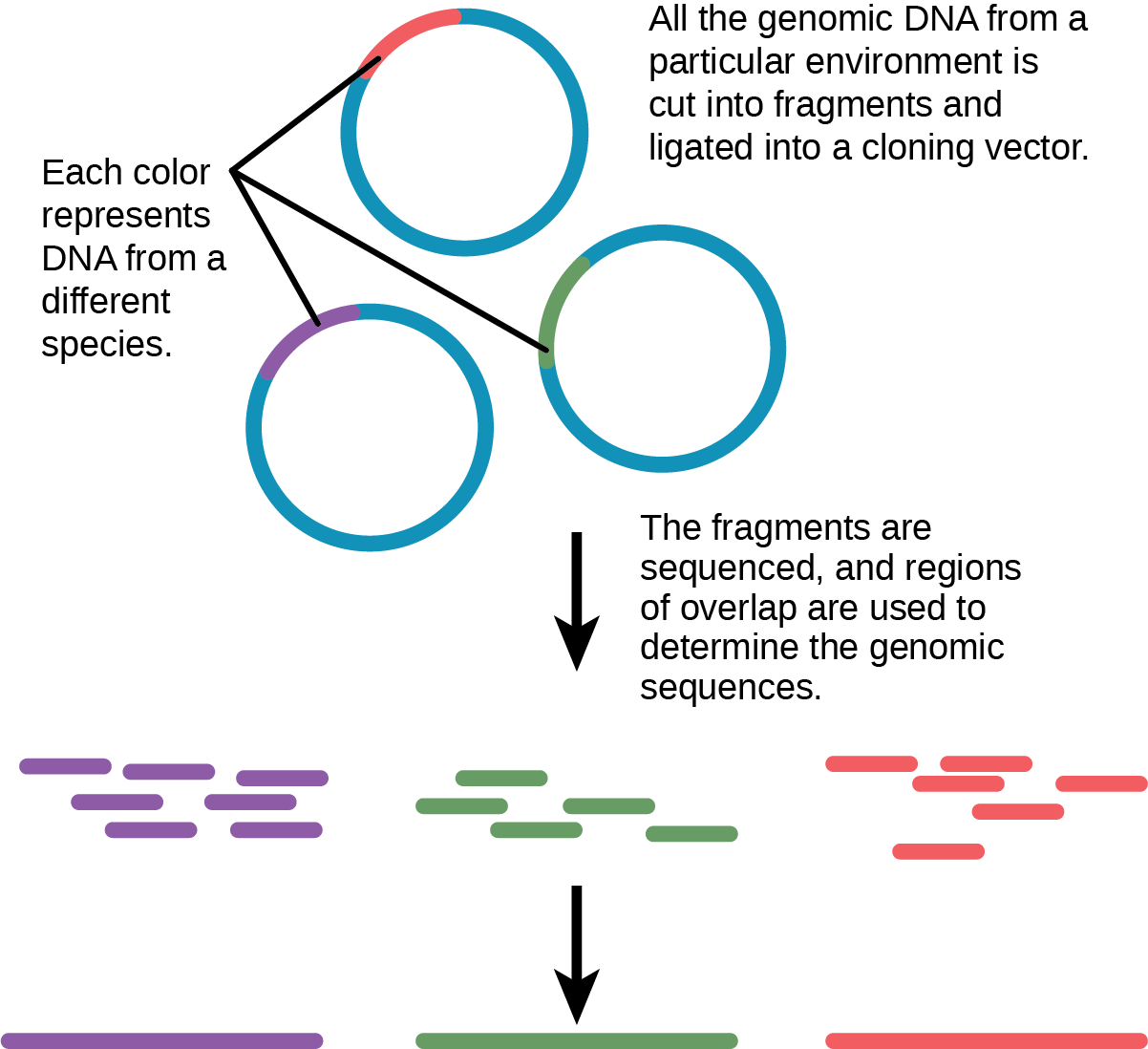

Figure 17.16図 17.16
Metagenomics involves isolating DNA from multiple species within an environmental niche.
メタゲノミクスでは、環境内のあるニッチに存在する複数の種からDNAを分離する。