第17章バイオテクノロジーとゲノミクス
17.3 Whole-Genome Sequencing17.3 全ゲノムの塩基配列決定
Learning Objectives学習目標
By the end of this section, you will be able to do the following:
この節を終えると、次のことができるようになる。
- Describe three types of sequencing三つの種類の塩基配列決定法を説明する。
- Define whole-genome sequencing全ゲノムの塩基配列決定を定義する。
Although there have been significant advances in the medical sciences in recent years, doctors are still confounded by some diseases, and they are using whole-genome sequencing to discover the root of the problem. Whole-genome sequencing is a process that determines an entire genome’s DNA sequence. Whole-genome sequencing is a brute-force approach to problem solving when there is a genetic basis at the core of a disease. Several laboratories now provide services to sequence, analyze, and interpret entire genomes.
英語のヒント
近年、医学は大きく進歩したが、医師たちをなお困惑させる病気もあり、問題の根源を探るために全ゲノムの塩基配列決定が使われている。全ゲノムの塩基配列決定は、ゲノム全体のDNA配列を決める過程である。病気の核心に遺伝的な基盤がある場合に、全体を徹底的に調べて問題を解こうとする方法である。現在、複数の研究施設が、ゲノム全体の配列決定、分析、解釈を行うサービスを提供している。
For example, whole-exome sequencing is a lower-cost alternative to whole genome sequencing. In exome sequencing, the doctor sequences only the DNA’s coding, exon-producing regions. In 2010, doctors used whole-exome sequencing to save a young boy whose intestines had multiple mysterious abscesses. The child had several colon operations with no relief. Finally, they performed whole-exome sequencing, which revealed a defect in a pathway that controls apoptosis (programmed cell death). The doctors used a bone-marrow transplant to overcome this genetic disorder, leading to a cure for the boy. He was the first person to receive successful treatment based on a whole-exome sequencing diagnosis. Today, human genome sequencing is more readily available and results are available within two days for about $1000.
英語のヒント
例えば、全エクソームの塩基配列決定は、全ゲノムの塩基配列決定に代わる、より安価な方法である。エクソームの配列決定では、DNAのうちコード領域、すなわちエクソンを生じる領域だけを調べる。2010年、医師たちは全エクソームの塩基配列決定を用いて、腸に原因不明の膿瘍がいくつもできた幼い男児を救った。この子は結腸の手術を何度も受けたが、改善しなかった。最終的に全エクソームの塩基配列を決定したところ、アポトーシス(プログラムされた細胞死)を制御する経路に異常があることが分かった。医師たちは骨髄移植によってこの遺伝性の異常を克服し、男児は治癒した。この男児は、全エクソームの塩基配列決定による診断に基づいて、治療に成功した最初の人だった。今日では、ヒトゲノムの塩基配列決定はさらに利用しやすくなり、約1,000ドルで2日以内に結果を得られる。
Strategies Used in Sequencing Projects塩基配列決定プロジェクトで用いる方法
The basic sequencing technique used in all modern day sequencing projects is the chain termination method (also known as the dideoxy method), which Fred Sanger developed in the 1970s. The chain termination method involves DNA replication of a single-stranded template by using a primer and a regular deoxynucleotide (dNTP), which is a monomer, or a single DNA unit. The primer and dNTP mix with a small proportion of fluorescently labeled dideoxynucleotides (ddNTPs). The ddNTPs are monomers that are missing a hydroxyl group (–OH) at the site at which another nucleotide usually attaches to form a chain (Figure 17.13). Scientists label each ddNTP with a different color of fluorophore. Every time a ddNTP incorporates in the growing complementary strand, it terminates the DNA replication process, which results in multiple short strands of replicated DNA that each terminate at a different point during replication. When gel electrophoresis processes the reaction mixture after separating into single strands, the multiple newly replicated DNA strands form a ladder because of the differing sizes. Because the ddNTPs are fluorescently labeled, each band on the gel reflects the DNA strand’s size and the ddNTP that terminated the reaction. The different colors of the fluorophore-labeled ddNTPs help identify the ddNTP incorporated at that position. Reading the gel on the basis of each band’s color on the ladder produces the template strand’s sequence (Figure 17.14).
英語のヒント
現在のあらゆる塩基配列決定プロジェクトで使われる基本的な技術は、フレッド・サンガーが1970年代に開発した鎖終結法(ジデオキシ法とも呼ばれる)である。鎖終結法では、プライマーと、DNAの単量体、すなわち一つの構成単位である通常のデオキシヌクレオチド(dNTP)を使って、一本鎖の鋳型からDNAを複製する。プライマーとdNTPには、蛍光標識したジデオキシヌクレオチド(ddNTP)を少量混ぜる。ddNTPは、通常なら次のヌクレオチドがつながって鎖を作る位置に、ヒドロキシ基(−OH)を欠く単量体である(図17.13)。各ddNTPは、それぞれ異なる色の蛍光物質で標識される。伸長中の相補鎖にddNTPが取り込まれるたびに、DNA複製は停止する。その結果、複製の異なる位置でそれぞれ終わる、多数の短いDNA鎖ができる。反応混合物を一本鎖に分離した後、ゲル電気泳動にかけると、新しく複製された多数のDNA鎖は、大きさの違いによってはしご状のパターンを作る。ddNTPが蛍光標識されているため、ゲルの各帯はDNA鎖の大きさと、反応を止めたddNTPを反映する。蛍光標識ddNTPの色の違いによって、その位置に取り込まれたddNTPを同定できる。はしごの各帯の色に基づいてゲルを読み取ると、鋳型鎖の配列が分かる(図17.14)。
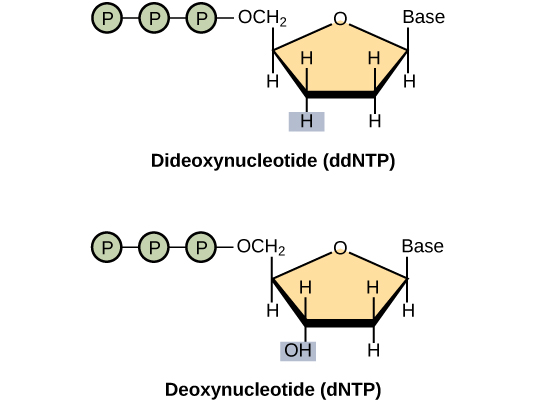
Figure 17.13図 17.13
A dideoxynucleotide is similar in structure to a deoxynucleotide, but is missing the 3' hydroxyl group (indicated by the box). When a dideoxynucleotide is incorporated into a DNA strand, DNA synthesis stops.
ジデオキシヌクレオチドは、デオキシヌクレオチドと構造が似ているが、3′ヒドロキシ基(枠で示す)を欠く。ジデオキシヌクレオチドがDNA鎖に取り込まれると、DNA合成は停止する。
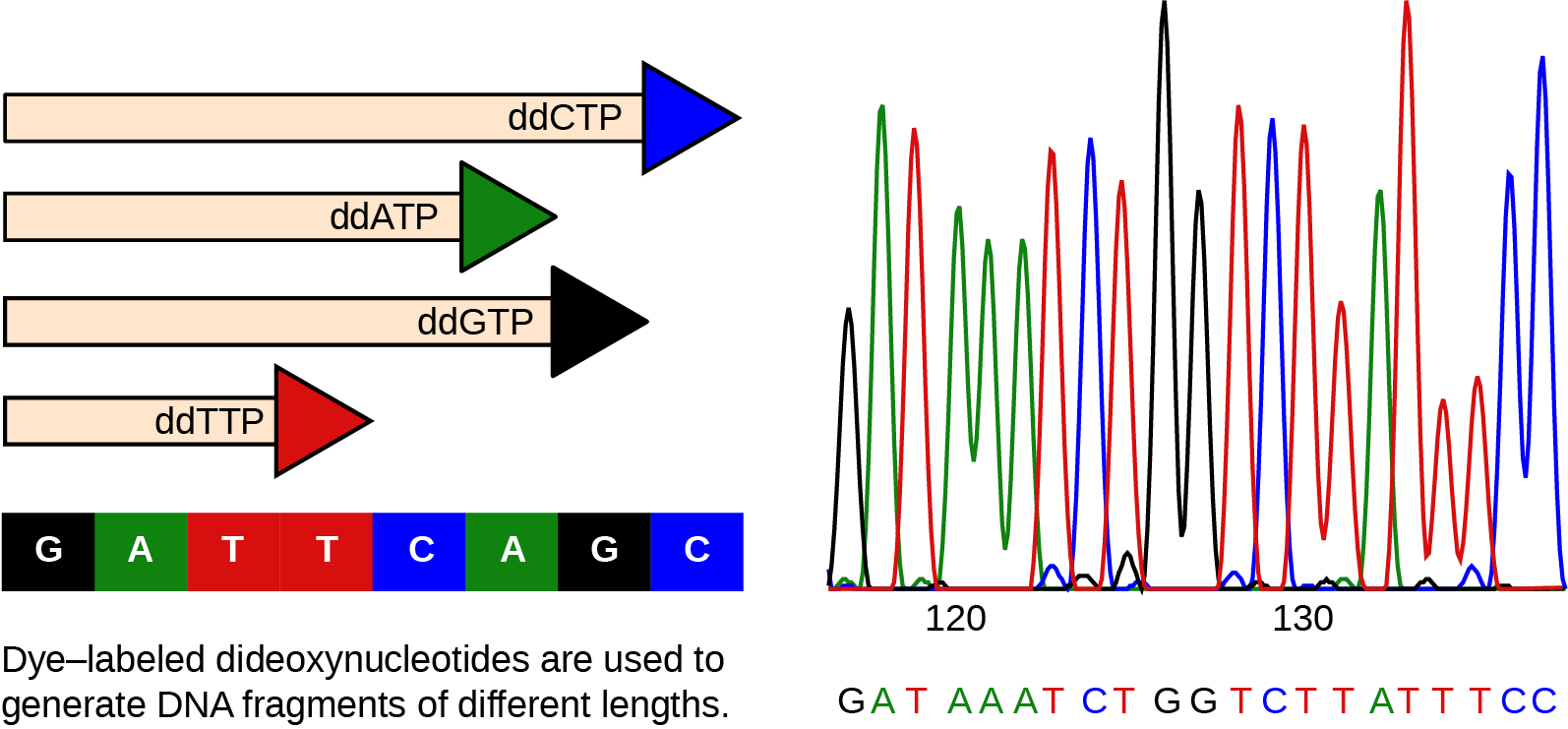


Figure 17.14図 17.14
This figure illustrates Frederick Sanger's dideoxy chain termination method. Using dideoxynucleotides, the DNA fragment can terminate at different points. The DNA separates on the basis of size, and we can read these bands based on the fragments’ size.
フレデリック・サンガーのジデオキシ鎖終結法を示す。ジデオキシヌクレオチドを使うことで、DNA断片は異なる位置で終わる。DNAは大きさに基づいて分離され、断片の大きさに基づいて帯を読み取れる。
Early Strategies: Shotgun Sequencing and Pair-Wise End Sequencing初期の方法:ショットガン法とペアエンド法による配列決定
In shotgun sequencing method, several DNA fragment copies cut randomly into many smaller pieces (somewhat like what happens to a round shot cartridge when fired from a shotgun). All of the segments sequence using the chain-sequencing method. Then, with sequence computer assistance, scientists can analyze the fragments to see where their sequences overlap. By matching overlapping sequences at each fragment’s end, scientists can reform the entire DNA sequence. A larger sequence that is assembled from overlapping shorter sequences is called a contig. As an analogy, consider that someone has four copies of a landscape photograph that you have never seen before and know nothing about how it should appear. The person then rips up each photograph with their hands, so that different size pieces are present from each copy. The person then mixes all of the pieces together and asks you to reconstruct the photograph. In one of the smaller pieces you see a mountain. In a larger piece, you see that the same mountain is behind a lake. A third fragment shows only the lake, but it reveals that there is a cabin on the shore of the lake. Therefore, from looking at the overlapping information in these three fragments, you know that the picture contains a mountain behind a lake that has a cabin on its shore. This is the principle behind reconstructing entire DNA sequences using shotgun sequencing.
英語のヒント
ショットガン法では、DNA断片のコピーを複数用意し、それぞれを無作為に多数の小片へ切る。これは散弾銃から散弾が発射されるときに少し似ている。すべての断片について、鎖の配列を決める方法で塩基配列を決定する。次に、コンピューターの助けを借りて断片を分析し、配列が重なり合う場所を探す。各断片の端の重複配列を合わせることで、DNA全体の配列を再構成できる。重なり合う短い配列を組み立ててできた長い配列を、コンティグと呼ぶ。たとえとして、あなたが見たこともなく、どんな風景かも知らない写真を、誰かが4枚もっているとしよう。その人は各写真を手で破り、それぞれのコピーから大きさの異なる断片を作る。次に、すべての断片を混ぜて、元の写真を復元するよう、あなたに頼む。小さな断片の一つには山が見える。より大きな断片には、同じ山が湖の向こうにあるのが見える。三つ目の断片には湖しか見えないが、湖岸に小屋があることが分かる。この三つの断片の重なる情報から、写真には、岸に小屋がある湖と、その向こうの山が写っていると分かる。これが、ショットガン法でDNA全体の配列を再構成する原理である。
Originally, shotgun sequencing only analyzed one end of each fragment for overlaps. This was sufficient for sequencing small genomes. However, the desire to sequence larger genomes, such as that of a human, led to developing double-barrel shotgun sequencing, or pairwise-end sequencing. In pairwise-end sequencing, scientists analyze each fragment’s end for overlap. Pairwise-end sequencing is, therefore, more cumbersome than shotgun sequencing, but it is easier to reconstruct the sequence because there is more available information.
英語のヒント
もともとのショットガン法では、各断片の片方の端だけを調べて、重なりを探していた。小さなゲノムの配列決定には、それで十分だった。しかし、ヒトのような大きなゲノムの配列を決めたいという要求から、ダブルバレル・ショットガン法、すなわちペアエンド法が開発された。ペアエンド法では、各断片の両端を調べて重なりを探す。このため、通常のショットガン法より手間がかかるが、利用できる情報が多いので、配列の再構成は容易になる。