第12章メンデルの実験と遺伝
12.3 Laws of Inheritance12.3 遺伝の法則
Learning Objectives学習目標
By the end of this section, you will be able to do the following:
この節を学ぶと、次のことができるようになる。
- Explain Mendel’s law of segregation and independent assortment in terms of genetics and the events of meiosis分離の法則と独立の法則を、遺伝学と減数分裂の出来事に基づいて説明する。
- Use the forked-line method and the probability rules to calculate the probability of genotypes and phenotypes from multiple gene crosses分岐図法と確率の法則を使い、多遺伝子交配の遺伝子型と表現型の確率を計算する。
- Explain the effect of linkage and recombination on gamete genotypes連鎖と組換えが配偶子の遺伝子型に与える影響を説明する。
- Explain the phenotypic outcomes of epistatic effects between genes遺伝子間の上位性が表現型にもたらす結果を説明する。
Mendel generalized the results of his pea-plant experiments into four postulates, some of which are sometimes called “laws,” that describe the basis of dominant and recessive inheritance in diploid organisms. As you have learned, more complex extensions of Mendelism exist that do not exhibit the same F2 phenotypic ratios (3:1). Nevertheless, these laws summarize the basics of classical genetics.
英語のヒント
メンデルはエンドウの実験結果を四つの原則に一般化した。その一部は「法則」とも呼ばれ、二倍体生物における優性・劣性遺伝の基礎を説明する。これまで学んだように、同じF2表現型比(3:1)を示さない、もっと複雑なメンデル遺伝の拡張もある。それでもこれらの法則は古典遺伝学の基礎を要約している。
Pairs of Unit Factors, or Genes対になった単位因子、すなわち遺伝子
Mendel proposed first that paired unit factors of heredity were transmitted faithfully from generation to generation by the dissociation and reassociation of paired factors during gametogenesis and fertilization, respectively. After he crossed peas with contrasting traits and found that the recessive trait resurfaced in the F2 generation, Mendel deduced that hereditary factors must be inherited as discrete units. This finding contradicted the belief at that time that parental traits were blended in the offspring.
英語のヒント
メンデルが最初に提唱したのは、対になった遺伝の単位因子が、配偶子形成時に分かれ、受精時に再び対になることで、世代から世代へ忠実に伝わるという考えだった。対照的な形質のエンドウを交配し、劣性形質がF2世代で再び現れると分かると、遺伝因子は別々の単位として受け継がれるはずだと推論した。この発見は、親の形質が子で混ざるという当時の信念と矛盾した。
Alleles Can Be Dominant or Recessive対立遺伝子には優性と劣性がある
Mendel’s law of dominance states that in a heterozygote, one trait will conceal the presence of another trait for the same characteristic. Rather than both alleles contributing to a phenotype, the dominant allele will be expressed exclusively. The recessive allele will remain “latent” but will be transmitted to offspring by the same manner in which the dominant allele is transmitted. The recessive trait will only be expressed by offspring that have two copies of this allele (Figure 12.15), and these offspring will breed true when self-crossed.
英語のヒント
メンデルの優性の法則では、ヘテロ接合体で一つの形質が、同じ特徴のもう一つの形質の存在を隠す。両対立遺伝子が表現型に寄与するのではなく、優性対立遺伝子だけが発現する。劣性対立遺伝子は「潜在」したままだが、優性と同じ方法で子へ伝わる。劣性形質はその対立遺伝子を2コピー持つ子だけで発現し(図12.15)、その子を自家交配すると純系として同じ形質の子を生む。
Since Mendel’s experiments with pea plants, researchers have found that the law of dominance does not always hold true. Instead, several different patterns of inheritance have been found to exist.
メンデルのエンドウの実験以降、優性の法則が常に成り立つわけではないと分かってきた。代わりに、いくつかの異なる遺伝パターンが見つかっている。
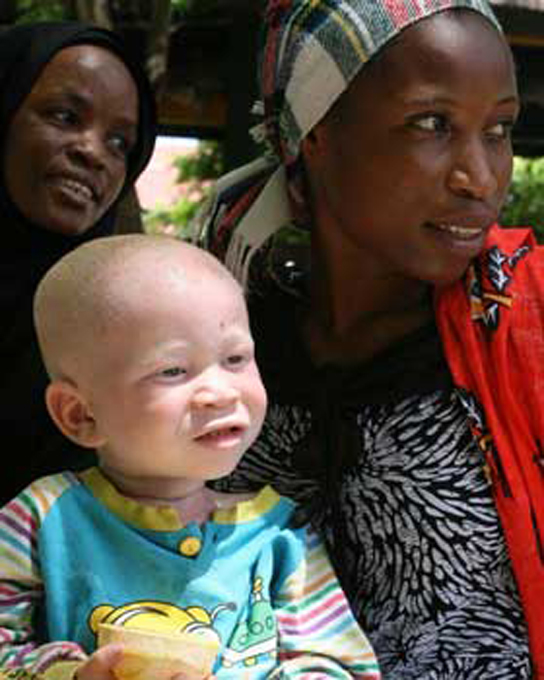

Figure 12.15図 12.15
The child in the photo expresses albinism, a recessive trait.
写真の子どもには、劣性形質である白皮症が現れている。
Equal Segregation of Alleles対立遺伝子の等しい分離
Observing that true-breeding pea plants with contrasting traits gave rise to F1 generations that all expressed the dominant trait and F2 generations that expressed the dominant and recessive traits in a 3:1 ratio, Mendel proposed the law of segregation. This law states that paired unit factors (genes) must segregate equally into gametes such that offspring have an equal likelihood of inheriting either factor. For the F2 generation of a monohybrid cross, the following three possible combinations of genotypes could result: homozygous dominant, heterozygous, or homozygous recessive. Because heterozygotes could arise from two different pathways (receiving one dominant and one recessive allele from either parent), and because heterozygotes and homozygous dominant individuals are phenotypically identical, the law supports Mendel’s observed 3:1 phenotypic ratio. The equal segregation of alleles is the reason we can apply the Punnett square to accurately predict the offspring of parents with known genotypes. The physical basis of Mendel’s law of segregation is the first division of meiosis, in which the homologous chromosomes with their different versions of each gene are segregated into daughter nuclei. The role of the meiotic segregation of chromosomes in sexual reproduction was not understood by the scientific community during Mendel’s lifetime.
英語のヒント
対照的な形質の純系エンドウから、すべて優性形質を示すF1世代と、優性:劣性が3:1のF2世代ができることを観察し、メンデルは分離の法則を提唱した。この法則は、対になった単位因子、つまり遺伝子が配偶子へ等しく分離し、子がどちらの因子を受け継ぐ可能性も等しいというものである。一遺伝子雑種交配のF2世代では、優性ホモ接合、ヘテロ接合、劣性ホモ接合の三つの遺伝子型が生じうる。ヘテロ接合には、どちらの親から優性・劣性対立遺伝子を受け取るかで二つの経路がある。またヘテロ接合体と優性ホモ接合体は同じ表現型なので、この法則はメンデルが観察した3:1を説明する。対立遺伝子が等しく分離するからこそ、親の遺伝子型が既知ならパネット方形で子を正確に予測できる。分離の法則の物理的な基盤は減数第一分裂であり、各遺伝子の異なる型を持つ相同染色体が娘核へ分かれる。染色体の減数分裂時の分離が有性生殖で果たす役割は、メンデルの生前には科学界で理解されていなかった。
Independent Assortment独立の振り分け
Mendel’s law of independent assortment states that genes do not influence each other with regard to the sorting of alleles into gametes, and every possible combination of alleles for every gene is equally likely to occur. The independent assortment of genes can be illustrated by the dihybrid cross, a cross between two true-breeding parents that express different traits for two characteristics. Consider the characteristics of seed color and seed texture for two pea plants, one that has green, wrinkled seeds (yyrr) and another that has yellow, round seeds (YYRR). Because each parent is homozygous, the law of segregation indicates that the gametes for the green/wrinkled plant all are yr, and the gametes for the yellow/round plant are all YR. Therefore, the F1 generation of offspring all are YyRr (Figure 12.16).
英語のヒント
メンデルの独立の法則は、配偶子へ対立遺伝子が振り分けられるとき、遺伝子どうしは影響せず、各遺伝子の対立遺伝子の可能な組み合わせはすべて同じ確率で起こるというものである。二つの特徴で異なる形質を示す純系の親を交配する二遺伝子雑種交配で、この独立性を示せる。種子の色と表面の形を考え、一方が緑色・しわ(yyrr)、他方が黄色・丸(YYRR)だとしよう。各親はホモ接合なので、分離の法則より緑色・しわの親の配偶子はすべてyr、黄色・丸の親ではすべてYRになる。したがってF1の子はすべてYyRrとなる(図12.16)。
For the F2 generation, the law of segregation requires that each gamete receive either an R allele or an r allele along with either a Y allele or a y allele. The law of independent assortment states that a gamete into which an r allele sorted would be equally likely to contain either a Y allele or a y allele. Thus, there are four equally likely gametes that can be formed when the YyRr heterozygote is self-crossed, as follows: YR, Yr, yR, and yr. Arranging these gametes along the top and left of a 4 × 4 Punnett square (Figure 12.16) gives us 16 equally likely genotypic combinations. From these genotypes, we infer a phenotypic ratio of 9 round/yellow:3 round/green:3 wrinkled/yellow:1 wrinkled/green (Figure 12.16). These are the offspring ratios we would expect, assuming we performed the crosses with a large enough sample size.
英語のヒント
Because of independent assortment and dominance, the 9:3:3:1 dihybrid phenotypic ratio can be collapsed into two 3:1 ratios, characteristic of any monohybrid cross that follows a dominant and recessive pattern. Ignoring seed color and considering only seed texture in the above dihybrid cross, we would expect that three quarters of the F2 generation offspring would be round, and one quarter would be wrinkled. Similarly, isolating only seed color, we would assume that three quarters of the F2 offspring would be yellow and one quarter would be green. The sorting of alleles for texture and color are independent events, so we can apply the product rule. Therefore, the proportion of round and yellow F2 offspring is expected to be (3/4) × (3/4) = 9/16, and the proportion of wrinkled and green offspring is expected to be (1/4) × (1/4) = 1/16. These proportions are identical to those obtained using a Punnett square. Round, green and wrinkled, yellow offspring can also be calculated using the product rule, as each of these genotypes includes one dominant and one recessive phenotype. Therefore, the proportion of each is calculated as (3/4) × (1/4) = 3/16.
英語のヒント
独立の振り分けと優性により、二遺伝子雑種の9:3:3:1という表現型比は、優性・劣性に従う一遺伝子雑種交配に特徴的な、二つの3:1の比にまとめられる。上の交配で色を無視して形だけを見ると、F2の4分の3が丸、4分の1がしわと予測される。同じく色だけなら、F2の4分の3が黄色、4分の1が緑色となる。形と色の対立遺伝子の振り分けは独立な事象なので、積の法則を使える。丸かつ黄色のF2の子は(3/4)×(3/4)=9/16、しわかつ緑色は(1/4)×(1/4)=1/16と予測される。これはパネット方形の結果と一致する。丸・緑色と、しわ・黄色も積の法則で求められる。それぞれ優性の表現型を一つ、劣性の表現型を一つ含むので、割合はどちらも(3/4)×(1/4)=3/16となる。
The law of independent assortment also indicates that a cross between yellow, wrinkled (YYrr) and green, round (yyRR) parents would yield the same F1 and F2 offspring as in the YYRR x yyrr cross.
独立の法則は、黄色・しわ(YYrr)と緑色・丸(yyRR)の親を交配しても、YYRR×yyrrの場合と同じF1とF2の子ができることを示す。
The physical basis for the law of independent assortment also lies in meiosis I, in which the different homologous pairs line up in random orientations. Each gamete can contain any combination of paternal and maternal chromosomes (and therefore the genes on them) because the orientation of tetrads on the metaphase plane is random.
英語のヒント
独立の法則の物理的な基盤も減数第一分裂にあり、異なる相同染色体対が無作為な向きで並ぶ。赤道面での四分子の向きが無作為なので、各配偶子は父親由来と母親由来の染色体、したがってその上の遺伝子を、どんな組み合わせでも含みうる。