第12章メンデルの実験と遺伝
The Punnett Square Approach for a Monohybrid Cross一遺伝子雑種交配をパネット方形で考える
When fertilization occurs between two true-breeding parents that differ in only one characteristic, the process is called a monohybrid cross, and the resulting offspring are monohybrids. Mendel performed seven monohybrid crosses involving contrasting traits for each characteristic. On the basis of his results in F1 and F2 generations, Mendel postulated that each parent in the monohybrid cross contributed one of two paired unit factors to each offspring, and every possible combination of unit factors was equally likely.
英語のヒント
一つの特徴だけが異なる純系の親どうしが受精する過程を一遺伝子雑種交配といい、できた子を一遺伝子雑種という。メンデルは各特徴の対照的な形質を使い、七つの一遺伝子雑種交配を行った。F1とF2世代の結果に基づき、各親は対になった二つの単位因子の片方を各子に与え、単位因子の可能な組み合わせはすべて等しく起こりやすいと仮定した。
To demonstrate a monohybrid cross, consider the case of true-breeding pea plants with yellow versus green pea seeds. The dominant seed color is yellow; therefore, the parental genotypes were YY for the plants with yellow seeds and yy for the plants with green seeds, respectively. A Punnett square, devised by the British geneticist Reginald Punnett, can be drawn that applies the rules of probability to predict the possible outcomes of a genetic cross or mating and their expected frequencies. To prepare a Punnett square, all possible combinations of the parental alleles are listed along the top (for one parent) and side (for the other parent) of a grid, representing their meiotic segregation into haploid gametes. Then the combinations of egg and sperm are made in the boxes in the table to show which alleles are combining. Each box then represents the diploid genotype of a zygote, or fertilized egg, that could result from this mating. Because each possibility is equally likely, genotypic ratios can be determined from a Punnett square. If the pattern of inheritance (dominant or recessive) is known, the phenotypic ratios can be inferred as well. For a monohybrid cross of two true-breeding parents, each parent contributes one type of allele. In this case, only one genotype is possible. All offspring are Yy and have yellow seeds (Figure 12.4).
英語のヒント
一遺伝子雑種交配の例として、黄色い種子と緑色の種子を持つ純系のエンドウを考えよう。優性は黄色なので、親の遺伝子型は黄色がYY、緑色がyyである。英国の遺伝学者レジナルド・パネットが考案したパネット方形は、確率の法則を使い、交配の可能な結果と予想頻度を示す図である。作るには、格子の上辺に一方の親、側辺にもう一方の親が作る対立遺伝子の可能な組み合わせをすべて並べる。これが減数分裂で半数体配偶子へ分かれることを表す。次に各升目で卵と精子を組み合わせ、どの対立遺伝子が一緒になるかを示す。各升目は交配で生じうる接合子、すなわち受精卵の二倍体遺伝子型を表す。各可能性は等しく起こるので、パネット方形から遺伝子型の比が分かる。遺伝のパターン(優性か劣性か)が分かれば、表現型の比も推定できる。純系の親どうしの一遺伝子雑種交配では、各親は一種類の対立遺伝子を与えるので、できる遺伝子型は一つだけである。すべての子がYyとなり、黄色い種子を持つ(図12.4)。
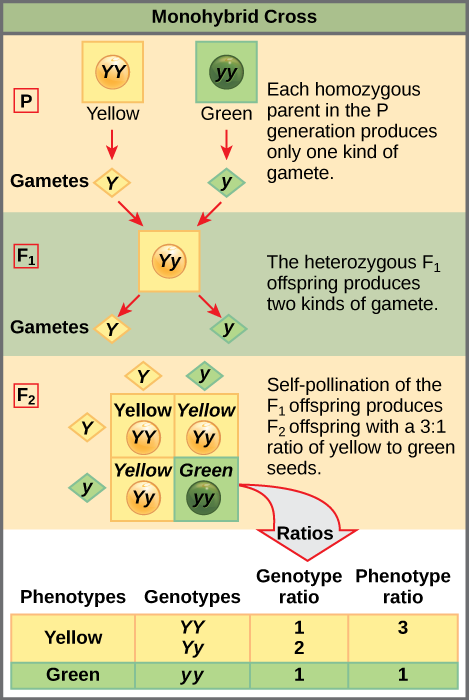

Figure 12.4図 12.4
In the P generation, pea plants that are true-breeding for the dominant yellow phenotype are crossed with plants with the recessive green phenotype. This cross produces F1 heterozygotes with a yellow phenotype. Punnett square analysis can be used to predict the genotypes of the F2 generation.
P世代で、優性の黄色という表現型の純系と、劣性の緑色という表現型の植物を交配する。F1には黄色い表現型のヘテロ接合体ができる。パネット方形によって、F2世代の遺伝子型を予測できる。
A self-cross of one of the Yy heterozygous offspring can be represented in a 2 × 2 Punnett square because each parent can donate one of two different alleles. Therefore, the offspring can potentially have one of four allele combinations: YY, Yy, yY, or yy (Figure 12.4). Notice that there are two ways to obtain the Yy genotype: a Y from the egg and a y from the sperm, or a y from the egg and a Y from the sperm. Both of these possibilities must be counted. Recall that Mendel’s pea-plant characteristics behaved in the same way in reciprocal crosses. Therefore, the two possible heterozygous combinations produce offspring that are genotypically and phenotypically identical despite their dominant and recessive alleles deriving from different parents. They are grouped together. Because fertilization is a random event, we expect each combination to be equally likely and for the offspring to exhibit a ratio of YY:Yy:yy genotypes of 1:2:1 (Figure 12.4). Furthermore, because the YY and Yy offspring have yellow seeds and are phenotypically identical, applying the sum rule of probability, we expect the offspring to exhibit a phenotypic ratio of 3 yellow:1 green. Indeed, working with large sample sizes, Mendel observed approximately this ratio in every F2 generation resulting from crosses for individual traits.
英語のヒント
Yyのヘテロ接合の子を自家交配すると、各親が二つの異なる対立遺伝子の片方を与えられるため、2×2のパネット方形で表せる。子の組み合わせはYY、Yy、yY、yyの四つである(図12.4)。Yyを得る経路には、卵からYと精子からy、または卵からyと精子からYという二通りがあり、両方を数えなければならない。メンデルのエンドウは正逆交配でも同じ振る舞いをしたことを思い出そう。したがって、優性・劣性対立遺伝子の由来する親が異なっても、二つのヘテロ接合の組み合わせは、遺伝子型と表現型が同一の子を生むので、一つにまとめる。受精は無作為なので、各組み合わせは等しい確率で起こり、YY:Yy:yyの遺伝子型の比は1:2:1になると期待される(図12.4)。さらにYYとYyはともに黄色い種子で表現型が同一なので、確率の和の法則を使うと、表現型の比は黄色3:緑色1と予測される。実際、メンデルは多数の試料を調べ、個々の形質についての交配から得た各F2世代で、ほぼこの比を観察した。
Mendel validated these results by performing an F3 cross in which he self-crossed the dominant- and recessive-expressing F2 plants. When he self-crossed the plants expressing green seeds, all of the offspring had green seeds, confirming that all green seeds had homozygous genotypes of yy. When he self-crossed the F2 plants expressing yellow seeds, he found that one-third of the plants bred true, and two-thirds of the plants segregated at a 3:1 ratio of yellow:green seeds. In this case, the true-breeding plants had homozygous (YY) genotypes, whereas the segregating plants corresponded to the heterozygous (Yy) genotype. When these plants self-fertilized, the outcome was just like the F1 self-fertilizing cross.
英語のヒント
メンデルは優性または劣性を示すF2植物を自家交配し、F3の交配でこれらの結果を検証した。緑色の種子を示す植物を自家交配すると、すべての子が緑色となり、緑色の種子はすべてホモ接合のyyであると確認できた。黄色い種子のF2植物を自家交配すると、3分の1は純系として子を生み、3分の2は黄色:緑色が3:1に分離した。純系として子を生んだ植物はホモ接合のYY、分離した植物はヘテロ接合のYyに相当する。これらを自家受精させた結果は、F1の自家受精交配と同じだった。