第12章メンデルの実験と遺伝
Human Sex-linked Disordersヒトの伴性遺伝性疾患
Sex-linkage studies in Morgan’s laboratory provided the fundamentals for understanding X-linked recessive disorders in humans, which include red-green color blindness, and Types A and B hemophilia. Because human males need to inherit only one recessive mutant X allele to be affected, X-linked disorders are disproportionately observed in males. Females must inherit recessive X-linked alleles from both of their parents in order to express the trait. When they inherit one recessive X-linked mutant allele and one dominant X-linked wild-type allele, they are carriers of the trait and are typically unaffected. Carrier females can manifest mild forms of the trait due to the inactivation of the dominant allele located on one of the X chromosomes. However, female carriers can contribute the trait to their male children, resulting in the male exhibiting the trait, or they can contribute the recessive allele to their female children, resulting in the children being carriers of the trait (Figure 12.13). Although some Y-linked recessive disorders exist, typically they are associated with infertility in males and are therefore not transmitted to subsequent generations.
英語のヒント
モーガンの研究室の伴性遺伝研究は、赤緑色覚異常やA型・B型血友病など、ヒトのX連鎖劣性疾患を理解する基礎を作った。男性は劣性変異X対立遺伝子を一つ受け継ぐだけで発症するため、X連鎖疾患は男性に偏って見られる。女性は形質を示すために、両親から劣性X連鎖対立遺伝子を受け継ぐ必要がある。劣性変異型と優性野生型を一つずつ受け継ぐと保因者となり、通常は発症しない。保因者の女性でも、一方のX染色体の優性対立遺伝子が不活性化されることで、軽い形質が現れることがある。また息子へ伝えれば息子に形質が現れ、娘へ劣性対立遺伝子を伝えれば娘は保因者となりうる(図12.13)。Y連鎖劣性疾患もいくつかあるが、通常は男性の不妊に関わるため、次世代へは伝わらない。
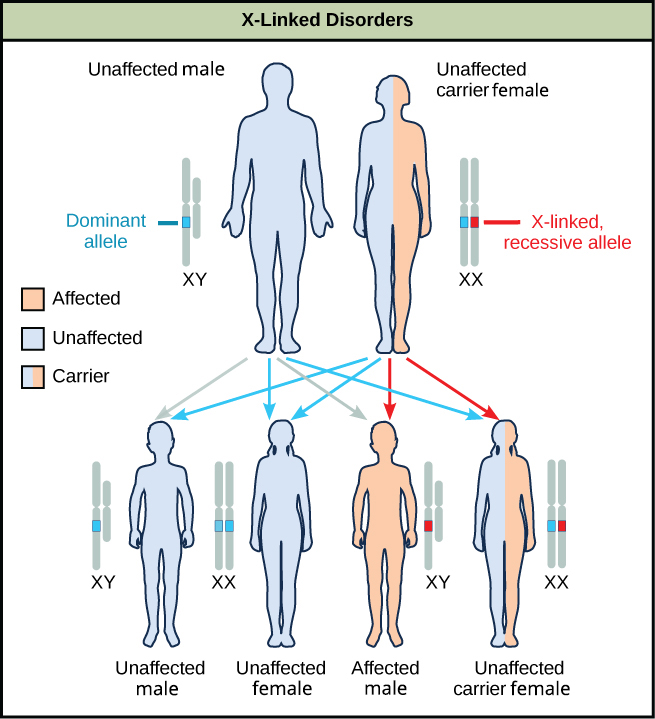

Figure 12.13図 12.13
The male offspring of a person who is a carrier of a recessive X-linked disorder will have a 50 percent chance of being affected. A female will not be affected, but she will have a 50 percent chance of being a carrier like the female parent.
X連鎖劣性疾患の保因者の男の子は、50%の確率で発症する。女の子は発症しないが、50%の確率で母親と同じく保因者となる。
Lethality致死性
A large proportion of genes in an individual’s genome are essential for survival. Occasionally, a nonfunctional allele for an essential gene can arise by mutation and be transmitted in a population as long as individuals with this allele also have a wild-type, functional copy. The wild-type allele functions at a capacity sufficient to sustain life and is therefore considered to be dominant over the nonfunctional allele. However, consider two heterozygous parents that have a genotype of wild-type/nonfunctional mutant for a hypothetical essential gene. In one quarter of their offspring, we would expect to observe individuals that are homozygous recessive for the nonfunctional allele. Because the gene is essential, these individuals might fail to develop past fertilization, die in utero, or die later in life, depending on what life stage requires this gene. An inheritance pattern in which an allele is only lethal in the homozygous form and in which the heterozygote may be normal or have some altered nonlethal phenotype is referred to as recessive lethal.
英語のヒント
ゲノム内の多くの遺伝子は生存に不可欠である。ときに、必須遺伝子の働かない対立遺伝子が突然変異で生じるが、その個体が機能する野生型コピーも持つ限り、個体群内で伝わっていく。野生型は生命維持に十分な能力を発揮するため、機能しない対立遺伝子に対して優性と考えられる。ある仮想の必須遺伝子について、両親がともに野生型/機能しない変異型のヘテロ接合だとしよう。子の4分の1は、機能しない対立遺伝子の劣性ホモ接合体になると予測される。この遺伝子は必須なので、必要となる生活段階に応じて、受精後の発生が進まない、子宮内で死ぬ、あるいは後の段階で死ぬ可能性がある。対立遺伝子がホモ接合でだけ致死となり、ヘテロ接合体は正常か、死には至らない変化した表現型を持つ遺伝パターンを、劣性致死という。
For crosses between heterozygous individuals with a recessive lethal allele that causes death before birth when homozygous, only wild-type homozygotes and heterozygotes would be observed. The genotypic ratio would therefore be 2:1. In other instances, the recessive lethal allele might also exhibit a dominant (but not lethal) phenotype in the heterozygote. For instance, the recessive lethal Curly allele in Drosophila affects wing shape in the heterozygote form but is lethal in the homozygote.
ホモ接合になると出生前に死亡する劣性致死対立遺伝子について、ヘテロ接合体どうしを交配すると、観察されるのは野生型ホモ接合体とヘテロ接合体だけになる。そのため遺伝子型の比は2:1になる。別の場合には、劣性致死対立遺伝子がヘテロ接合体で優性の、ただし致死ではない表現型も示すことがある。例えばショウジョウバエの劣性致死のCurly対立遺伝子は、ヘテロ接合では翅の形に影響し、ホモ接合では致死となる。
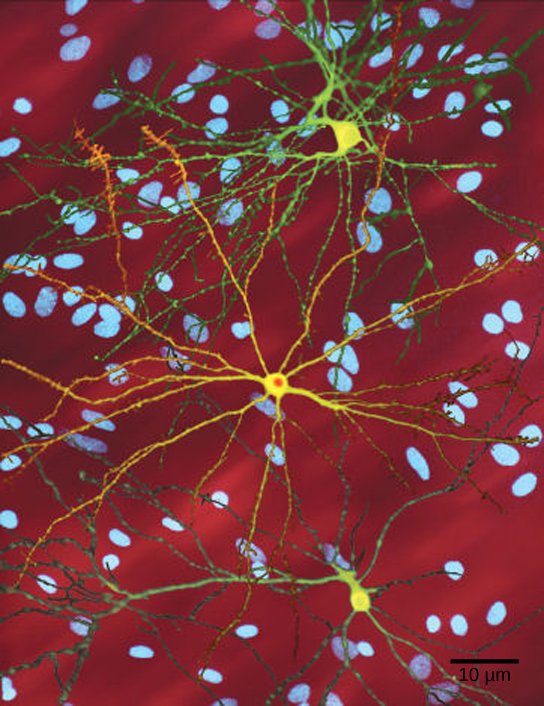
A single copy of the wild-type allele is not always sufficient for normal functioning or even survival. The dominant lethal inheritance pattern is one in which an allele is lethal both in the homozygote and the heterozygote; this allele can only be transmitted if the lethality phenotype occurs after reproductive age. Individuals with mutations that result in dominant lethal alleles fail to survive even in the heterozygote form. Dominant lethal alleles are very rare because, as you might expect, the allele only lasts one generation and is not transmitted. However, just as the recessive lethal allele might not immediately manifest the phenotype of death, dominant lethal alleles also might not be expressed until adulthood. Once the individual reaches reproductive age, the allele may be unknowingly passed on, resulting in a delayed death in both generations. An example of this in humans is Huntington’s disease, in which the nervous system gradually wastes away (Figure 12.14). People who are heterozygous for the dominant Huntington allele (Hh) will inevitably develop the fatal disease. However, the onset of Huntington’s disease may not occur until age 40, at which point the afflicted persons may have already passed the allele to 50 percent of their offspring.
英語のヒント
野生型対立遺伝子が1コピーあっても、正常な働きや生存に十分とは限らない。優性致死という遺伝パターンでは、ホモ接合とヘテロ接合の両方で対立遺伝子が致死となる。この対立遺伝子は、繁殖年齢の後に致死表現型が現れる場合にしか伝わらない。優性致死対立遺伝子を生む変異を持つ個体は、ヘテロ接合でも生存できない。通常は一世代しか存続せず伝わらないため、優性致死対立遺伝子は非常にまれである。しかし劣性致死がすぐに死亡という表現型を示すとは限らないように、優性致死も成人するまで発現しない場合がある。繁殖年齢に達すると、気付かずに対立遺伝子を伝え、両世代に後から死亡が起こりうる。ヒトの例は、神経系が徐々に衰えるハンチントン病である(図12.14)。優性のハンチントン対立遺伝子のヘテロ接合体Hhは、この致死的な病気を必ず発症する。ただし発症が40歳まで起こらない場合があり、その時点ではすでに子の50%に対立遺伝子を伝えているかもしれない。
OpenStax, Rice University; Biology 2e. (credit: Dr. Steven Finkbeiner, Gladstone Institute of Neurological Disease, The Taube-Koret Center for Huntington's Disease Research, and the University of California San Francisco/Wikimedia) · CC BY 4.0 · Source出典

Figure 12.14図 12.14
The neuron in the center of this micrograph (yellow) has nuclear inclusions characteristic of Huntington’s disease (orange area in the center of the neuron). Huntington’s disease occurs when an abnormal dominant allele for the Huntington gene is present. (credit: Dr. Steven Finkbeiner, Gladstone Institute of Neurological Disease, The Taube-Koret Center for Huntington's Disease Research, and the University of California San Francisco/Wikimedia)
顕微鏡写真中央のニューロン(黄色)には、ハンチントン病に特徴的な核内封入体がある(ニューロン中央のオレンジ色部分)。この病気は、ハンチントン遺伝子に異常な優性対立遺伝子があると起こる。(出典:Steven Finkbeiner博士、Gladstone神経疾患研究所、Taube-Koretハンチントン病研究センター、カリフォルニア大学サンフランシスコ校/Wikimedia)