第12章メンデルの実験と遺伝
12.1 Mendel’s Experiments and the Laws of Probability12.1 メンデルの実験と確率の法則
Learning Objectives学習目標
By the end of this section, you will be able to do the following:
この節を学ぶと、次のことができるようになる。
- Describe the scientific reasons for the success of Mendel’s experimental workメンデルの実験研究が成功した科学的な理由を説明する。
- Describe the expected outcomes of monohybrid crosses involving dominant and recessive alleles優性・劣性対立遺伝子を扱う一遺伝子雑種交配の予想結果を説明する。
- Apply the sum and product rules to calculate probabilities和の法則と積の法則を使って確率を計算する。
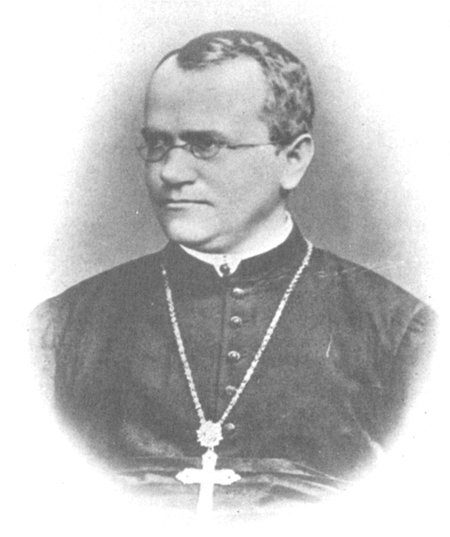
Figure 12.2図 12.2
Johann Gregor Mendel is considered the father of genetics.
ヨハン・グレゴール・メンデルは遺伝学の父とされる。
Johann Gregor Mendel (1822–1884) (Figure 12.2) was a lifelong learner, teacher, scientist, and man of faith. As a young adult, he joined the Augustinian Abbey of St. Thomas in Brno in what is now the Czech Republic. Supported by the monastery, he taught physics, botany, and natural science courses at the secondary and university levels. In 1856, he began a decade-long research pursuit involving inheritance patterns in honeybees and plants, ultimately settling on pea plants as his primary model system (a system with convenient characteristics used to study a specific biological phenomenon to be applied to other systems). In 1865, Mendel presented the results of his experiments with nearly 30,000 pea plants to the local Natural History Society. He demonstrated that traits are transmitted from parents to offspring independently of other traits and in dominant and recessive patterns. In 1866, he published his work, Experiments in Plant Hybridization, Johann Gregor Mendel, Versuche über Pflanzenhybriden Verhandlungen des naturforschenden Vereines in Brünn, Bd. IV für das Jahr, 1865 Abhandlungen, 3–47. [for English translation see http://www.mendelweb.org/Mendel.plain.html] in the proceedings of the Natural History Society of Brünn.
英語のヒント
ヨハン・グレゴール・メンデル(1822〜1884年、図12.2)は、生涯学び続けた人であり、教師、科学者、信仰の人でもあった。若いころ、現在のチェコ共和国にあるブルノの聖トマス修道院(アウグスチノ会)に入った。修道院の支援を受け、中等教育と大学の段階で、物理学、植物学、自然科学を教えた。1856年、ミツバチと植物の遺伝パターンについて10年にわたる研究を始め、最終的にはエンドウを主要なモデル系に選んだ。モデル系とは、特定の生物学的現象を調べ、その成果をほかの系に適用するために用いる、研究に都合のよい特徴を持つ系である。1865年、約3万個体のエンドウを使った実験結果を、地元の自然史協会に発表した。形質がほかの形質とは独立に、優性・劣性のパターンで親から子へ伝わることを示した。1866年、ブルノ自然史協会の紀要に「植物の雑種形成に関する実験」を発表した。出典:Johann Gregor Mendel「植物雑種に関する実験」ブルノ自然研究協会紀要、第4巻、1865年分、論文3〜47頁。英訳はメンデルの論文英訳を参照。
Mendel’s work went virtually unnoticed by the scientific community, which believed, incorrectly, that the process of inheritance involved a blending of parental traits that produced an intermediate physical appearance in offspring. The blending theory of inheritance asserted that the original parental traits were lost or absorbed by the blending in the offspring, but we now know that this is not the case. This hypothetical process appeared to be correct because of what we know now as continuous variation. Continuous variation results from the action of many genes to determine a characteristic like human height. Offspring appear to be a “blend” of their parents’ traits.
英語のヒント
メンデルの研究は科学界でほとんど注目されなかった。当時は、遺伝では親の形質が混ざり、子には中間的な外見が現れると誤って考えられていた。混合遺伝説は、親のもとの形質が子の中で混ざることにより失われるか吸収されると主張したが、現在ではそうではないと分かっている。この仮説上の過程が正しく見えたのは、今日でいう連続変異のためだった。連続変異は、ヒトの身長のような特徴を、多くの遺伝子の作用が決めることで生じる。子は親の形質を「混ぜた」ものに見える。
Instead of continuous characteristics, Mendel worked with traits that were inherited in distinct classes (specifically, violet versus white flowers); this is referred to as discontinuous variation. Mendel’s choice of these kinds of traits allowed him to see experimentally that the traits were not blended in the offspring, nor were they absorbed, but rather that they kept their distinctness and could be passed on. In 1868, Mendel became abbot of the monastery and exchanged his scientific pursuits for his pastoral duties. He was not recognized for his extraordinary scientific contributions during his lifetime. In fact, it was not until 1900 that his work was rediscovered, reproduced, and revitalized by scientists on the brink of discovering the chromosomal basis of heredity.
英語のヒント
メンデルが扱ったのは連続的な特徴ではなく、明瞭な種類に分かれて遺伝する形質、具体的には紫色と白色の花だった。これを不連続変異という。そのような形質を選んだことで、子の中で形質が混ざったり吸収されたりせず、区別を保ったまま伝わることを実験で確かめられた。1868年、メンデルは修道院長となり、科学研究を司牧の務めに替えた。生前には卓越した科学的貢献を評価されなかった。実際、その研究が再発見され、再現され、再び注目されたのは1900年になってからで、科学者たちは染色体が遺伝の基盤であると発見する直前にいた。
Mendel’s Model Systemメンデルのモデル系
Mendel’s seminal work was accomplished using the garden pea, Pisum sativum, to study inheritance. This species naturally self-fertilizes, such that pollen encounters ova within individual flowers. The flower petals remain sealed tightly until after pollination, preventing pollination from other plants. The result is highly inbred, or “true-breeding,” pea plants. These are plants that always produce offspring that look like the parent. By experimenting with true-breeding pea plants, Mendel avoided the appearance of unexpected traits in offspring that might occur if the plants were not true breeding. The garden pea also grows to maturity within one season, meaning that several generations could be evaluated over a relatively short time. Finally, large quantities of garden peas could be cultivated simultaneously, allowing Mendel to conclude that his results did not come about simply by chance.
英語のヒント
メンデルはエンドウ(Pisum sativum)を使って遺伝を研究し、その後の基礎となる業績を成し遂げた。この種は自然に自家受精し、個々の花の中で花粉が卵細胞に出会う。花弁は受粉が終わるまで固く閉じているため、ほかの植物からの受粉を防ぐ。その結果、高度に近親交配した、つまり「純系」のエンドウができる。これは親に似た子を常に作る植物である。純系のエンドウで実験することで、純系でない植物なら生じうる、子の予想外の形質を避けられた。エンドウは1季節で成熟するため、比較的短い期間で数世代を調べられる。さらに、多数の個体を同時に育てられたので、結果が単なる偶然ではないと結論できた。
Mendelian Crossesメンデルの交配
Mendel performed hybridizations, which involve mating two true-breeding individuals that have different traits. In the pea, which is naturally self-pollinating, this is done by manually transferring pollen from the anther of a mature pea plant of one variety to the stigma of a separate mature pea plant of the second variety. In plants, pollen carries the male gametes (sperm) to the stigma, a sticky organ that traps pollen and allows the sperm to move down the pistil to the female gametes (ova) below. To prevent the pea plant that was receiving pollen from self-fertilizing and confounding his results, Mendel painstakingly removed all of the anthers from the plant’s flowers before they had a chance to mature.
英語のヒント
メンデルは異なる形質を持つ二つの純系個体を交配する、雑種形成の実験を行った。自然に自家受粉するエンドウでは、一方の品種の成熟個体の葯から、別の品種の成熟個体の柱頭へ、手で花粉を移す。植物では、花粉は雄性配偶子(精子)を柱頭に運ぶ。柱頭は花粉を捕らえる粘りのある器官で、精子が雌しべを下って下方の雌性配偶子(卵細胞)へ移動できるようにする。花粉を受けるエンドウが自家受精して結果を混乱させることを防ぐため、メンデルは葯が成熟する前に、花からすべての葯を丹念に取り除いた。
Plants used in first-generation crosses were called P0, or parental generation one (Figure 12.3). After each cross, Mendel collected the seeds belonging to the P0 plants and grew them the following season. These offspring were called the F1, or the first filial (filial = offspring, daughter or son) generation. Once Mendel examined the characteristics in the F1 generation of plants, he allowed them to self-fertilize naturally. He then collected and grew the seeds from the F1 plants to produce the F2, or second filial, generation. Mendel’s experiments extended beyond the F2 generation to the F3 and F4 generations, and so on, but it was the ratio of characteristics in the P0−F1−F2 generations that were the most intriguing and became the basis for Mendel’s postulates.
英語のヒント
最初の交配に使った植物は、P0、すなわち親世代1と呼ばれた(図12.3)。メンデルは交配ごとにP0植物から種子を集め、翌季に育てた。この子をF1、つまり雑種第一代と呼んだ。filialは子、娘または息子という意味である。F1世代の特徴を調べると、それらを自然に自家受精させた。次にF1植物から種子を集めて育て、F2、つまり雑種第二代を作った。実験はF2世代を越えて、F3、F4 世代などへ進んだが、最も興味深く、メンデルの原則の基礎となったのはP0−F1−F2世代での特徴の比だった。
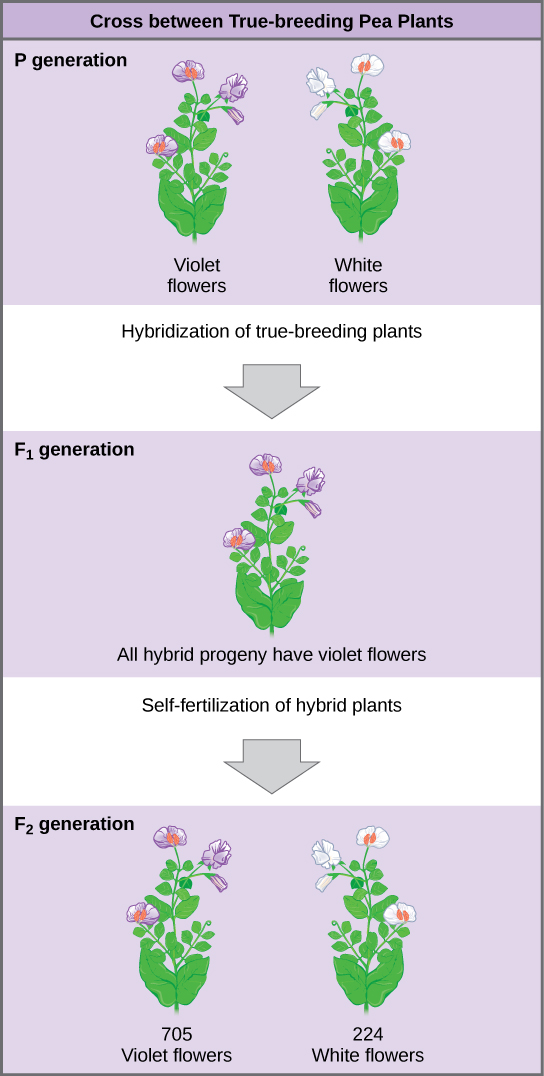


Figure 12.3図 12.3
In one of his experiments on inheritance patterns, Mendel crossed plants that were true-breeding for violet flower color with plants true-breeding for white flower color (the P generation). The resulting hybrids in the F1 generation all had violet flowers. In the F2 generation, approximately three quarters of the plants had violet flowers, and one quarter had white flowers.
遺伝パターンを調べる実験の一つで、メンデルは紫色の花の純系と白色の花の純系を交配した(P世代)。その結果できたF1世代の雑種はすべて紫色の花を持った。F2世代では約4分の3が紫色、4分の1が白色の花を持った。