第12章メンデルの実験と遺伝
The Test Cross Distinguishes the Dominant Phenotype検定交雑で優性表現型の遺伝子型を見分ける
Beyond predicting the offspring of a cross between known homozygous or heterozygous parents, Mendel also developed a way to determine whether an organism that expressed a dominant trait was a heterozygote or a homozygote. Called the test cross, this technique is still used by plant and animal breeders. In a test cross, the dominant-expressing organism is crossed with an organism that is homozygous recessive for the same characteristic. If the dominant-expressing organism is a homozygote, then all F1 offspring will be heterozygotes expressing the dominant trait (Figure 12.5). Alternatively, if the dominant expressing organism is a heterozygote, the F1 offspring will exhibit a 1:1 ratio of heterozygotes and recessive homozygotes (Figure 12.5). The test cross further validates Mendel’s postulate that pairs of unit factors segregate equally.
英語のヒント
Many human diseases are genetically inherited. A healthy person in a family in which some members suffer from a recessive genetic disorder may want to know if they have the disease-causing gene and what risk exists of passing the disorder on to their offspring. Of course, doing a test cross in humans is unethical and impractical. Instead, geneticists use pedigree analysis to study the inheritance pattern of human genetic diseases (Figure 12.6).
英語のヒント
ヒトの多くの病気は遺伝する。家族の一部に劣性遺伝性疾患のある健康な人は、自分が原因遺伝子を持つのか、子へ伝える危険がどれほどあるのか知りたいかもしれない。もちろんヒトの検定交雑は倫理に反し、実用的でもない。代わりに遺伝学者は家系分析を用いて、ヒトの遺伝性疾患の遺伝パターンを調べる(図12.6)。
Alternatives to Dominance and Recessiveness単純な優性・劣性以外の遺伝
Mendel’s experiments with pea plants suggested that: (1) two “units” or alleles exist for every gene; (2) alleles maintain their integrity in each generation (no blending); and (3) in the presence of the dominant allele, the recessive allele is hidden and makes no contribution to the phenotype. Therefore, recessive alleles can be “carried” and not expressed by individuals. Such heterozygous individuals are sometimes referred to as “carriers.” Further genetic studies in other plants and animals have shown that much more complexity exists, but that the fundamental principles of Mendelian genetics still hold true. In the sections to follow, we consider some of the extensions of Mendelism. If Mendel had chosen an experimental system that exhibited these genetic complexities, it’s possible that he would not have understood what his results meant.
英語のヒント
エンドウの実験は、(1)各遺伝子に二つの「単位」、すなわち対立遺伝子がある、(2)対立遺伝子は世代ごとに完全性を保ち、混ざらない、(3)優性対立遺伝子があると劣性対立遺伝子は隠れ、表現型に寄与しない、ということを示唆した。したがって劣性対立遺伝子は、個体に「保有」されても発現しないことがある。このようなヘテロ接合個体を「保因者」と呼ぶことがある。ほかの動植物の研究は、もっと複雑な遺伝があるものの、メンデル遺伝学の基本原理はなお成り立つと示してきた。以下ではメンデル遺伝の拡張をいくつか考える。もしメンデルがこのような複雑さを示す実験系を選んでいたら、結果の意味を理解できなかったかもしれない。
Incomplete Dominance不完全優性
Mendel’s results, that traits are inherited as dominant and recessive pairs, contradicted the view at that time that offspring exhibited a blend of their parents’ traits. However, the heterozygote phenotype occasionally does appear to be intermediate between the two parents. For example, in the snapdragon, Antirrhinum majus (Figure 12.7), a cross between a homozygous parent with white flowers (CWCW) and a homozygous parent with red flowers (CRCR) will produce offspring with pink flowers (CRCW). (Note that different genotypic abbreviations are used for Mendelian extensions to distinguish these patterns from simple dominance and recessiveness.) This pattern of inheritance is described as incomplete dominance, denoting the expression of two contrasting alleles such that the individual displays an intermediate phenotype. The allele for red flowers is incompletely dominant over the allele for white flowers. However, the results of a heterozygote self-cross can still be predicted, just as with Mendelian dominant and recessive crosses. In this case, the genotypic ratio would be 1 CRCR:2 CRCW:1 CWCW, and the phenotypic ratio would be 1:2:1 for red:pink:white.
英語のヒント
形質が優性と劣性の対として遺伝するというメンデルの結果は、子が親の形質を混ぜた姿を示すという当時の見解と矛盾した。しかしヘテロ接合体の表現型は、ときに本当に両親の中間に見える。例えばキンギョソウ(Antirrhinum majus、図12.7)では、白い花のホモ接合の親(CWCW)と赤い花のホモ接合の親(CRCR)を交配すると、ピンクの花の子(CRCW)ができる。メンデル遺伝を拡張したパターンは、単純な優性・劣性と区別するため、遺伝子型の略記を変える。この遺伝パターンを不完全優性という。二つの対照的な対立遺伝子の発現によって、中間の表現型が現れることを指す。赤い花の対立遺伝子は、白い花の対立遺伝子に対して不完全に優性である。それでもヘテロ接合体の自家交配の結果は、メンデル型の優性・劣性の交配と同様に予測できる。遺伝子型の比は1 CRCR:2 CRCW:1 CWCW、表現型の比は赤:ピンク:白=1:2:1となる。
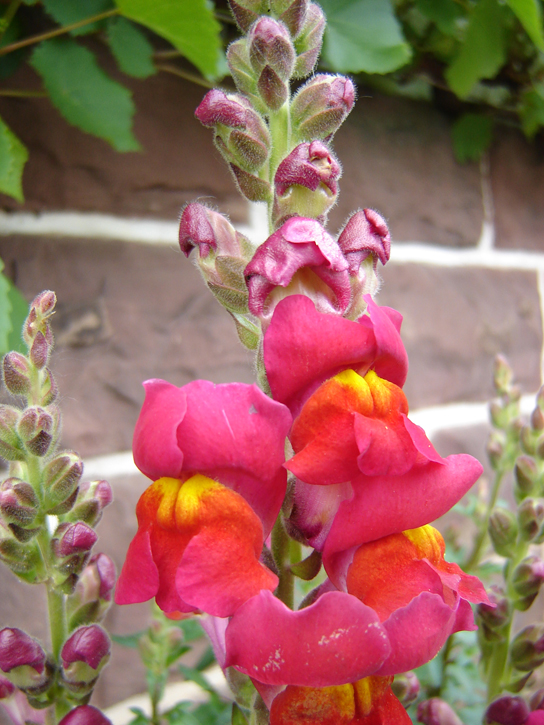

Figure 12.7図 12.7
These pink flowers of a heterozygote snapdragon result from incomplete dominance. (credit: “storebukkebruse”/Flickr)
ヘテロ接合のキンギョソウのピンクの花は、不完全優性による。(出典:storebukkebruse/Flickr)