第12章メンデルの実験と遺伝
Rules for Multihybrid Fertilization多遺伝子雑種の受精についての規則
Predicting the genotypes and phenotypes of offspring from given crosses is the best way to test your knowledge of Mendelian genetics. Given a multihybrid cross that obeys independent assortment and follows a dominant and recessive pattern, several generalized rules exist; you can use these rules to check your results as you work through genetics calculations (Table 12.5). To apply these rules, first you must determine n, the number of heterozygous gene pairs (the number of genes segregating two alleles each). For example, a cross between AaBb and AaBb heterozygotes has an n of 2. In contrast, a cross between AABb and AABb has an n of 1 because A is not heterozygous.
交配から子の遺伝子型と表現型を予測するのは、メンデル遺伝学の理解を試す最良の方法である。独立の振り分けと優性・劣性に従う多遺伝子雑種交配には、計算結果の確認に使える一般的な規則がある(表12.5)。まずn、すなわちヘテロ接合の遺伝子対の数(各々二つの対立遺伝子が分離する遺伝子の数)を決める。例えばAaBb×AaBbではn=2である。AABb×AABbではAがヘテロ接合でないのでn=1となる。
General Rules for Multihybrid Crosses 多遺伝子雑種交配の一般的な規則 |
|
|---|---|
General Rule 一般則 |
Number of Heterozygous Gene Pairs ヘテロ接合の遺伝子対の数 |
Number of different F1 gametes 異なるF1配偶子の数 |
2n |
Number of different F2 genotypes 異なるF2遺伝子型の数 |
3n |
Given dominant and recessive inheritance, the number of different F2 phenotypes 優性・劣性遺伝の場合の、異なるF2表現型の数 |
2n |
Linked Genes Violate the Law of Independent Assortment連鎖遺伝子は独立の法則に従わない
Although all of Mendel’s pea characteristics behaved according to the law of independent assortment, we now know that some allele combinations are not inherited independently of each other. Genes that are located on separate non-homologous chromosomes will always sort independently. However, each chromosome contains hundreds or thousands of genes, organized linearly on chromosomes like beads on a string. The segregation of alleles into gametes can be influenced by linkage, in which genes that are located physically close to each other on the same chromosome are more likely to be inherited as a pair. However, because of the process of recombination, or “crossover,” it is possible for two genes on the same chromosome to behave independently, or as if they are not linked. To understand this, let’s consider the biological basis of gene linkage and recombination.
英語のヒント
メンデルのエンドウの特徴はすべて独立の法則に従ったが、現在では独立に遺伝しない対立遺伝子の組み合わせも知られている。別々の非相同染色体上の遺伝子は、常に独立に振り分けられる。しかし各染色体には数百から数千の遺伝子が、ひもに通したビーズのように直線的に並ぶ。配偶子への対立遺伝子の分離は連鎖の影響を受ける。同じ染色体上で物理的に近い遺伝子は、対として遺伝しやすいのである。ただし組換え、すなわち「乗換え」により、同じ染色体上の二遺伝子でも、連鎖していないかのように独立に振る舞いうる。このことを理解するため、連鎖と組換えの生物学的な基盤を考えよう。
Homologous chromosomes possess the same genes in the same linear order. The alleles may differ on homologous chromosome pairs, but the genes to which they correspond do not. In preparation for the first division of meiosis, homologous chromosomes replicate and synapse. Like genes on the homologs align with each other. At this stage, segments of homologous chromosomes exchange linear segments of genetic material (Figure 12.18). This process is called recombination, or crossover, and it is a common genetic process. Because the genes are aligned during recombination, the gene order is not altered. Instead, the result of recombination is that maternal and paternal alleles are combined onto the same chromosome. Across a given chromosome, several recombination events may occur, causing extensive shuffling of alleles.
英語のヒント
相同染色体は同じ遺伝子を同じ順序で持つ。対立遺伝子が異なることはあっても、対応する遺伝子自体は同じである。減数第一分裂に向けて相同染色体が複製され対合すると、同じ遺伝子どうしが向き合って並ぶ。この段階で相同染色体の部分が、遺伝物質の直線的な区間を交換する(図12.18)。これが組換え、すなわち乗換えという、よく起こる遺伝的過程である。遺伝子が対応して並ぶため、順序は変わらず、母親由来と父親由来の対立遺伝子が同じ染色体上で組み合わされる。一つの染色体上で複数の組換えが起こり、対立遺伝子の大幅な組み替えが生じうる。
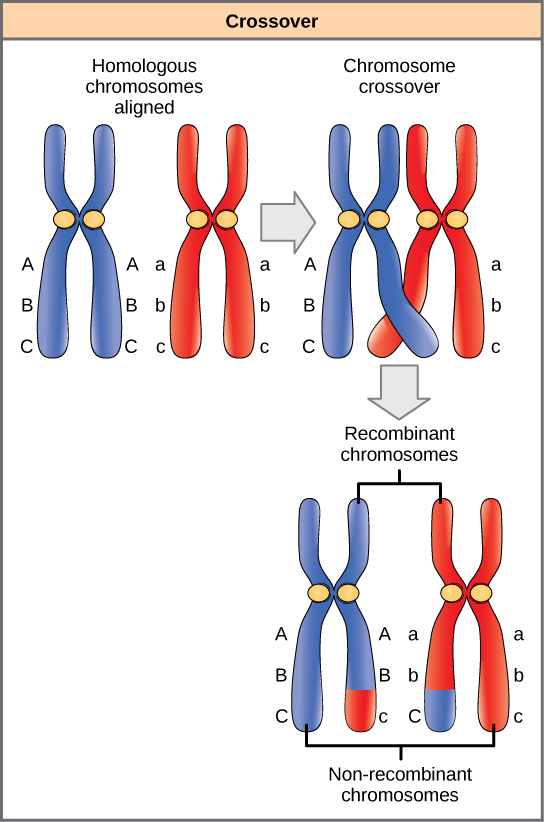

Figure 12.18図 12.18
The process of crossover, or recombination, occurs when two homologous chromosomes align during meiosis and exchange a segment of genetic material. Here, the alleles for gene C were exchanged. The result is two recombinant and two non-recombinant chromosomes (for clarity, only one recombination event between two of the four chromatids is represented).
乗換え、すなわち組換えは、減数分裂で二つの相同染色体が並び、遺伝物質の一部を交換するときに起こる。ここでは遺伝子Cの対立遺伝子が交換された。結果は組換え染色体2本と非組換え染色体2本である。見やすさのため、4本の染色分体のうち2本の間で起こる、1回の組換えだけを示す。
When two genes are located in close proximity on the same chromosome, they are considered linked, and their alleles tend to be transmitted through meiosis together. To exemplify this, imagine a dihybrid cross involving flower color and plant height in which the genes are next to each other on the chromosome. If one homologous chromosome has alleles for tall plants and red flowers, and the other chromosome has genes for short plants and yellow flowers, then when the gametes are formed, the tall and red alleles will go together into a gamete and the short and yellow alleles will go into other gametes. These are called the parental genotypes because they have been inherited intact from the parents of the individual producing gametes. But unlike if the genes were on different chromosomes, there will be no gametes with tall and yellow alleles and no gametes with short and red alleles. If you create the Punnett square with these gametes, you will see that the classical Mendelian prediction of a 9:3:3:1 outcome of a dihybrid cross would not apply. As the distance between two genes increases, the probability of one or more crossovers between them increases, and the genes behave more like they are on separate chromosomes. Geneticists have used the proportion of recombinant gametes (the ones not like the parents) as a measure of how far apart genes are on a chromosome. Using this information, they have constructed elaborate maps of genes on chromosomes for well-studied organisms, including humans.
英語のヒント
同じ染色体上で近接する二遺伝子は連鎖していると考えられ、その対立遺伝子は減数分裂を通じて一緒に伝わりやすい。花色と草丈の遺伝子が隣り合う二遺伝子雑種交配を考えよう。一方の相同染色体に高性と赤色、他方に低性と黄色の遺伝子があると、配偶子形成では高性と赤色が一緒に、低性と黄色が別の配偶子へ入る。これは配偶子を作る個体の両親からそのまま受け継いだ組み合わせなので、親型遺伝子型という。異なる染色体上にある場合と違って、高性・黄色や低性・赤色の配偶子はできない。この配偶子でパネット方形を作れば、古典的なメンデルの二遺伝子雑種交配の予測9:3:3:1が当てはまらないと分かる。二遺伝子間の距離が増すと、その間に1回以上の乗換えが起こる確率が増え、別々の染色体上にある場合に近づく。遺伝学者は、親とは異なる組換え型配偶子の割合を、染色体上の遺伝子間距離の尺度としてきた。この情報から、ヒトを含むよく研究された生物で、精密な染色体上の遺伝子地図を作った。
Mendel’s seminal publication makes no mention of linkage, and many researchers have questioned whether he encountered linkage but chose not to publish those crosses out of concern that they would invalidate his independent assortment postulate. The garden pea has seven pairs of chromosomes, and some have suggested that his choice of seven characteristics was not a coincidence. However, even if the genes he examined were not located on separate chromosomes, it is possible that he simply did not observe linkage because of the extensive shuffling effects of recombination.
英語のヒント
メンデルの基礎的な論文は連鎖に言及していない。多くの研究者は、連鎖を見つけたものの、独立の原則を無効にしかねないと心配して、その交配結果を発表しなかったのではないかと疑問を呈してきた。エンドウには7対の染色体があり、七つの特徴を選んだのは偶然ではないという指摘もある。しかし調べた遺伝子が別々の染色体上になかったとしても、組換えによる大幅な組み替えのため、単に連鎖を観察しなかった可能性もある。