第12章メンデルの実験と遺伝
X-Linked TraitsX連鎖形質
In humans, as well as in many other animals and some plants, the sex of the individual is determined by sex chromosomes. The sex chromosomes are one pair of non-homologous chromosomes. Until now, we have only considered inheritance patterns among non-sex chromosomes, or autosomes. In addition to 22 homologous pairs of autosomes, human females have a homologous pair of X chromosomes, whereas human males have an XY chromosome pair. Although the Y chromosome contains a small region of similarity to the X chromosome so that they can pair during meiosis, the Y chromosome is much shorter and contains many fewer genes. In fact, when Nettie Stevens discovered that the X and Y chromosomes were the determinants of sex, she differentiated them only by size. (Note that in this case and in the description below, the terms X and Y chromosome were not used at the time.) When a gene being examined is present on the X chromosome, but not on the Y chromosome, it is said to be X-linked.
英語のヒント
ヒトや多くの動物、一部の植物では、個体の性は性染色体によって決まる。性染色体は1対の非相同染色体である。ここまでは、性染色体以外の染色体、つまり常染色体の遺伝パターンだけを考えてきた。ヒトの女性は22対の相同な常染色体に加え、相同な1対のX染色体を持ち、男性はXYの染色体対を持つ。Y染色体にはX染色体に似た小領域があり、減数分裂時に対合できるが、Yははるかに短く、遺伝子数もずっと少ない。実際、ネティー・スティーヴンズがXとYの染色体が性を決めると発見した際には、大きさだけで両者を区別した。このときも以下で述べる時代も、X染色体・Y染色体という用語はまだ使われていなかった。調べている遺伝子がX染色体にあり、Y染色体にはない場合、X連鎖しているという。
Eye color in Drosophila was one of the first X-linked traits to be identified. Thomas Hunt Morgan mapped this trait to what became known as the X chromosome in 1910. Like humans, Drosophila males have an XY chromosome pair, and females are XX. In flies, the wild-type eye color is red (XW) and it is dominant to white eye color (Xw) (Figure 12.11). Because of the location of the eye-color gene, reciprocal crosses do not produce the same offspring ratios. Males are said to be hemizygous, because they have only one allele for any X-linked characteristic. Hemizygosity makes the descriptions of dominance and recessiveness irrelevant for XY males. Drosophila males lack a second allele copy on the Y chromosome; that is, their genotype can only be XWY or XwY. In contrast, females have two allele copies of this gene and can be XWXW, XWXw, or XwXw.
英語のヒント
ショウジョウバエの眼色は、初めて特定されたX連鎖形質の一つだった。1910年、トーマス・ハント・モーガンはこの形質を、後にX染色体と呼ばれる染色体上に位置付けた。ヒトと同じく雄はXY、雌はXXである。野生型の眼色は赤(XW)で、白(Xw)に対して優性である(図12.11)。眼色遺伝子の位置により、正逆交配では子の比が同じにならない。雄はX連鎖する各特徴の対立遺伝子を一つしか持たないため、ヘミ接合という。ヘミ接合のXY雄には優性・劣性という区別は当てはまらない。Y染色体に二つ目のコピーがなく、遺伝子型はXWYかXwYしかない。対して雌はこの遺伝子を2コピー持ち、XWXW、XWXw、XwXwのいずれかになる。
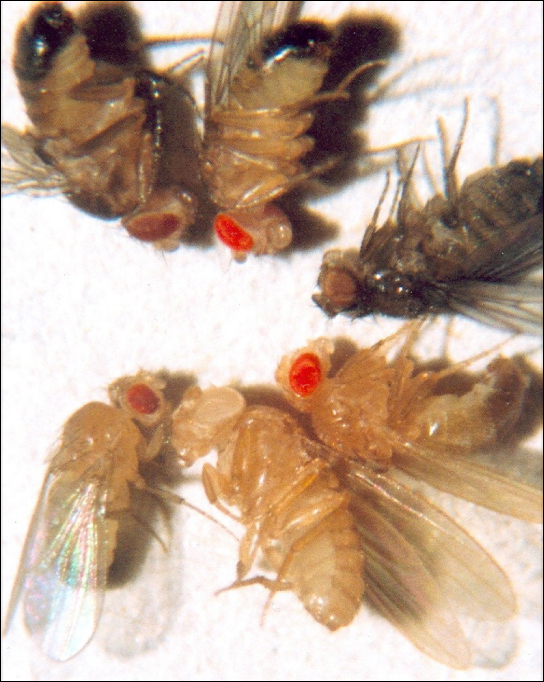

Figure 12.11図 12.11
In Drosophila, several genes determine eye color. The genes for white and vermilion eye colors are located on the X chromosome. Others are located on the autosomes. Clockwise from top left are brown, cinnabar, sepia, vermilion, white, and red. Red eye color is wild-type and is dominant to white eye color.
ショウジョウバエの眼色はいくつかの遺伝子で決まる。白眼と朱色眼の遺伝子はX染色体上、ほかは常染色体上にある。左上から時計回りに、褐色、辰砂色、セピア色、朱色、白色、赤色。赤色は野生型で、白色に優性である。
In an X-linked cross, the genotypes of F1 and F2 offspring depend on whether the recessive trait was expressed by the male or the female in the P1 generation. With regard to Drosophila eye color, when the P1 male expresses the white-eye phenotype and the female is homozygous red-eyed, all members of the F1 generation exhibit red eyes (Figure 12.12). The F1 females are heterozygous (XWXw), and the males are all XWY, having received their X chromosome from the homozygous dominant P1 female and their Y chromosome from the P1 male. A subsequent cross between the XWXw female and the XWY male would produce only red-eyed females (with XWXW or XWXw genotypes) and both red- and white-eyed males (with XWY or XwY genotypes). Now, consider a cross between a homozygous white-eyed female and a male with red eyes. The F1 generation would exhibit only heterozygous red-eyed females (XWXw) and only white-eyed males (XwY). Half of the F2 females would be red-eyed (XWXw) and half would be white-eyed (XwXw). Similarly, half of the F2 males would be red-eyed (XWY) and half would be white-eyed (XwY).
英語のヒント
X連鎖の交配では、F1とF2の子の遺伝子型は、P1世代で劣性形質を示したのが雄か雌かによって異なる。眼色について、P1の雄が白眼、雌が赤眼ホモ接合の場合、F1世代はすべて赤眼となる(図12.12)。F1の雌はヘテロ接合(XWXw)、雄はすべてXWYである。雄は優性ホモ接合のP1雌からXを、P1雄からYを受け取る。続いてXWXwの雌とXWYの雄を交配すると、雌はすべて赤眼(XWXWまたはXWXw)となり、雄には赤眼と白眼(XWYまたはXwY)が生じる。今度は白眼ホモ接合の雌と赤眼の雄を交配しよう。F1では、雌はすべて赤眼ヘテロ接合(XWXw)、雄はすべて白眼(XwY)となる。F2の雌の半分は赤眼(XWXw)、半分は白眼(XwXw)となる。同じくF2の雄も、半分は赤眼(XWY)、半分は白眼(XwY)となる。
Discoveries in fruit fly genetics can be applied to human genetics. When a female parent is homozygous for a recessive X-linked trait, she will pass the trait on to 100 percent of her offspring. Her male offspring are, therefore, destined to express the trait, as they will inherit their father's Y chromosome. In humans, the alleles for certain conditions (some forms of color blindness, hemophilia, and muscular dystrophy) are X-linked. Females who are heterozygous for these diseases are said to be carriers and may not exhibit any phenotypic effects. These females will pass the disease to half of their sons and will pass carrier status to half of their daughters; therefore, recessive X-linked traits appear more frequently in males than females.
英語のヒント
ショウジョウバエの遺伝学の発見は、ヒトにも応用できる。女性の親がX連鎖劣性形質のホモ接合なら、100%の子へその形質を伝える。男の子は父のY染色体を受け継ぐので、その形質が必ず現れる。ヒトでは、色覚異常の一部、血友病、筋ジストロフィーなどの対立遺伝子がX連鎖する。これらについてヘテロ接合の女性は保因者と呼ばれ、表現型への影響を示さない場合がある。息子の半分に病気を伝え、娘の半分を保因者にする。そのためX連鎖劣性形質は女性より男性に多く現れる。
In some groups of organisms with sex chromosomes, the sex with the non-homologous sex chromosomes is the female rather than the male. This is the case for all birds. In this case, sex-linked traits will be more likely to appear in the female, in which they are hemizygous.
性染色体を持つ生物群の中には、非相同の性染色体を持つ性が雄ではなく雌の場合がある。鳥類はすべてこれに当たる。この場合、伴性形質は、その遺伝子がヘミ接合となる雌に現れやすい。