第12章メンデルの実験と遺伝
Epistasis上位性
Mendel’s studies in pea plants implied that the sum of an individual’s phenotype was controlled by genes (or as he called them, unit factors), such that every characteristic was distinctly and completely controlled by a single gene. In fact, single observable characteristics are almost always under the influence of multiple genes (each with two or more alleles) acting in unison. For example, at least eight genes contribute to eye color in humans.
英語のヒント
メンデルの研究は、個体の表現型全体が遺伝子、彼の言う単位因子によって決まり、各特徴を一つの遺伝子が明確かつ完全に支配することを示唆した。しかし実際には、一つの観察可能な特徴はほぼ常に、協調して働く複数の遺伝子の影響を受ける。各遺伝子には二つ以上の対立遺伝子がある。例えばヒトの眼色には、少なくとも八つの遺伝子が寄与する。
In some cases, several genes can contribute to aspects of a common phenotype without their gene products ever directly interacting. In the case of organ development, for instance, genes may be expressed sequentially, with each gene adding to the complexity and specificity of the organ. Genes may function in complementary or synergistic fashions, such that two or more genes need to be expressed simultaneously to affect a phenotype. Genes may also oppose each other, with one gene modifying the expression of another.
英語のヒント
複数の遺伝子が、産物どうしは直接相互作用しなくても、一つの表現型の側面に寄与する場合がある。例えば器官の発生では、遺伝子が順番に発現し、各遺伝子が器官の複雑さと特異性を増していくことがある。遺伝子が相補的・相乗的に働き、二つ以上が同時に発現して初めて表現型に影響することもある。反対に、一方が他方の発現を変えるなど、拮抗する場合もある。
In epistasis, the interaction between genes is antagonistic, such that one gene masks or interferes with the expression of another. “Epistasis” is a word composed of Greek roots that mean “standing upon.” The alleles that are being masked or silenced are said to be hypostatic to the epistatic alleles that are doing the masking. Often the biochemical basis of epistasis is a gene pathway in which the expression of one gene is dependent on the function of a gene that precedes or follows it in the pathway.
英語のヒント
上位性では遺伝子間の相互作用が拮抗的で、一方の遺伝子が他方の発現を隠したり妨げたりする。epistasisは「上に立つ」を意味するギリシャ語の語根からできた語である。隠したり抑えたりされる対立遺伝子は、隠す側の上位の対立遺伝子に対して下位という。上位性の生化学的基盤はしばしば遺伝子の経路にあり、ある遺伝子の発現が、その経路で前後に位置する別の遺伝子の機能に依存する。
An example of epistasis is pigmentation in mice. The wild-type coat color, agouti (AA), is dominant to solid-colored fur (aa). However, a separate gene (C) is necessary for pigment production. A mouse with a recessive c allele at this locus is unable to produce pigment and is albino regardless of the allele present at locus A (Figure 12.20). Therefore, the genotypes AAcc, Aacc, and aacc all produce the same albino phenotype. A cross between heterozygotes for both genes (AaCc x AaCc) would generate offspring with a phenotypic ratio of 9 agouti:3 solid color:4 albino (Figure 12.20). In this case, the C gene is epistatic to the A gene.
英語のヒント
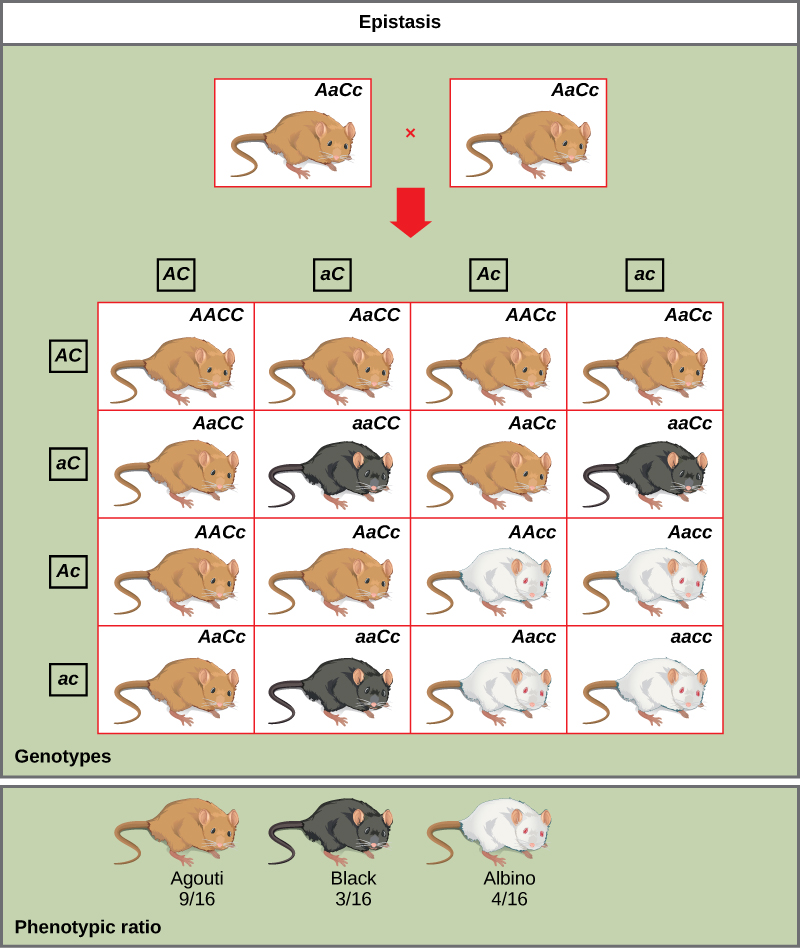

Figure 12.20図 12.20
In mice, the mottled agouti coat color (A) is dominant to a solid coloration, such as black or gray. A gene at a separate locus (C) is responsible for pigment production. The recessive c allele does not produce pigment, and a mouse with the homozygous recessive cc genotype is albino regardless of the allele present at the A locus. Thus, the C gene is epistatic to the A gene.
マウスでは、まだらに見えるアグーチの毛色(A)が、黒や灰色の単色に優性である。別の遺伝子座Cが色素形成を担う。劣性cは色素を作らず、劣性ホモ接合ccのマウスは、A座の対立遺伝子にかかわらずアルビノになる。したがってC遺伝子はA遺伝子に対して上位である。
Epistasis can also occur when a dominant allele masks expression at a separate gene. Fruit color in summer squash is expressed in this way. Homozygous recessive expression of the W gene (ww) coupled with homozygous dominant or heterozygous expression of the Y gene (YY or Yy) generates yellow fruit, and the wwyy genotype produces green fruit. However, if a dominant copy of the W gene is present in the homozygous or heterozygous form, the summer squash will produce white fruit regardless of the Y alleles. A cross between white heterozygotes for both genes (WwYy × WwYy) would produce offspring with a phenotypic ratio of 12 white:3 yellow:1 green.
英語のヒント
優性対立遺伝子が別の遺伝子の発現を隠す上位性もある。サマースクワッシュの果実色はこの方法で発現する。W遺伝子が劣性ホモ接合wwで、Y遺伝子が優性ホモ接合YYまたはヘテロ接合Yyなら黄色、wwyyなら緑色になる。しかしW遺伝子の優性コピーがホモ接合またはヘテロ接合で存在すると、Yの対立遺伝子にかかわらず白い果実を作る。両遺伝子のヘテロ接合の白い個体どうし(WwYy×WwYy)の交配では、白12:黄3:緑1の表現型比となる。
Finally, epistasis can be reciprocal such that either gene, when present in the dominant (or recessive) form, expresses the same phenotype. In the shepherd’s purse plant (Capsella bursa-pastoris), the characteristic of seed shape is controlled by two genes in a dominant epistatic relationship. When the genes A and B are both homozygous recessive (aabb), the seeds are ovoid. If the dominant allele for either of these genes is present, the result is triangular seeds. That is, every possible genotype other than aabb results in triangular seeds, and a cross between heterozygotes for both genes (AaBb x AaBb) would yield offspring with a phenotypic ratio of 15 triangular:1 ovoid.
英語のヒント
最後に、上位性は相互的なこともあり、どちらの遺伝子でも優性(または劣性)の型があれば、同じ表現型を示す。ナズナ(Capsella bursa-pastoris)の種子形は、優性の上位関係にある二つの遺伝子で決まる。AとBの両方が劣性ホモ接合aabbなら卵形となり、どちらかの優性対立遺伝子があれば三角形になる。つまりaabb以外のすべての遺伝子型が三角形となり、両遺伝子のヘテロ接合体どうし(AaBb×AaBb)の子は、三角形15:卵形1となる。
As you work through genetics problems, keep in mind that any single characteristic that results in a phenotypic ratio that totals 16 is typical of a two-gene interaction. Recall the phenotypic inheritance pattern for Mendel’s dihybrid cross, which considered two noninteracting genes—9:3:3:1. Similarly, we would expect interacting gene pairs to also exhibit ratios expressed as 16 parts. Note that we are assuming the interacting genes are not linked; they are still assorting independently into gametes.
英語のヒント
遺伝の問題を解くとき、表現型比の合計が16になる一つの特徴は、二遺伝子の相互作用に典型的だと覚えておこう。相互作用しない二遺伝子を考えたメンデルの二遺伝子雑種交配の比は9:3:3:1だった。同様に、相互作用する遺伝子対も全体を16に分けた比で表されると期待できる。ただし、相互作用する遺伝子が連鎖しておらず、配偶子へは依然として独立に分かれることを仮定している。